⚡Free Shipping: Ultra-Quiet Portable Oil-Free Air Compressor AWR800-18LM2
Need Help Choosing the Right Compressor?
Need Help Choosing the Right Compressor?
⚡Free Shipping: Ultra-Quiet Portable Oil-Free Air Compressor AWR800-18LM2
Need Help Choosing the Right Compressor?
⚡Free Shipping: Ultra-Quiet Portable Oil-Free Air Compressor AWR800-18LM2

Oil-Free Air Compressor Buyer Guide 2026: Types, Sizing & Cost | HPDMC
summary
About this guide. Written by the HPDMC compressor engineering team — the group that has manufactured and shipped over 12,000 oil-free and oil-lubricated compressor systems to customers in 40+ countries since 2004. Every specification, certification claim, and performance figure in this article comes from our own lab testing, manufacturer datasheets, or published international standards (ISO 8573-1, NFPA 99, FDA cGMP). When we recommend an oil-free air compressor, it is because we have built, tested, and serviced that exact technology — not because a sponsor paid us to.
An oil-free air compressor is a compressor whose compression chamber does not use lubricating oil. Instead of oil-sealed pistons or rotors, oil-free designs use PTFE-coated piston rings, carbon vane tips, or precision-machined scroll scrolls with dry contact surfaces. The result: the compressed air that exits the unit contains zero oil carryover — meeting ISO 8573-1 Class Zero purity directly from the compressor, with no downstream filtration required.
In this guide we cover how oilless air compressors work, the three main technology types (piston, scroll, and rotary), where they outperform oil-lubricated units, how to size one for your shop or lab, and the total cost of ownership over 10 years. To compare models side by side, browse the full HPDMC Oil-Free Air Compressor collection or visit the product overview catalog.
🛒 Looking for an oil-free air compressor? Browse the Oil-Free Lineup · View Product Catalog
1. What Is an Oil-Free Air Compressor and How Does It Work?
A conventional oil-lubricated compressor uses oil in the compression chamber to seal clearances, lubricate moving parts, and carry away heat. An oil-free air compressor eliminates that oil entirely from the air path. Instead, it relies on dry-running materials — typically PTFE (Teflon) composite piston rings, carbon-tipped vanes, or precision-lapped scroll scrolls — to maintain compression efficiency without liquid lubricant.
The key engineering trade-off is friction management. Without oil to reduce friction and dissipate heat, oil-free designs must run at lower RPM, use higher-grade dry-lubricant materials, or employ advanced cooling. HPDMC's Ultra Quiet Portable Oil-Free Air Compressor (AWR600-9L) solves this with a low-RPM dual-piston pump running at under 60 dB, while the 100% Oil-Free Scroll Air Compressor (WXJOSC3B000) uses an orbiting scroll mechanism with essentially no metal-to-metal contact, achieving ISO 8573-1 Class Zero air at 2–30 HP.
💡 Key distinction: "Oil-free" means no oil in the compression chamber. The crankcase bearings on some "oil-free" piston designs may still use a small amount of oil for bearing lubrication — but that oil never touches the compressed air. True "100% oil-free" designs like scroll compressors have zero oil anywhere in the air path.
👉 New to oil-free compressor technology? Read our guide on How Oil-Free Air Compressors Work
2. Oil-Free vs Oil-Lubricated: Which Technology Is Right for You?
The choice between oil-free and oil-lubricated is not about "better" — it is about matching the technology to your air purity requirement, duty cycle, and noise tolerance. Here is how the two compare on the metrics that actually matter:
2.1 Air Purity
Oil-free compressors deliver air that meets ISO 8573-1 Class Zero for oil content (0.00 mg/m³) directly from the discharge port. Oil-lubricated compressors typically deliver Class 2 or Class 3 oil content (0.1–1.0 mg/m³) and require downstream coalescing filters plus activated carbon towers to reach Class 1. If your application involves food processing, pharmaceuticals, electronics manufacturing, dentistry, or painting, oil-free is not optional — it is a regulatory requirement.
2.2 Noise Level
🔇 Oil-free piston compressors typically run at 55–70 dB at 1 meter. Oil-lubricated piston units of the same capacity run at 75–90 dB. The difference is not just comfort — OSHA requires hearing protection above 85 dB, so a quieter oil-free unit can be operated in an indoor workshop without earplugs. Our Ultra Quiet DIY Compressor (AWR2400-65L, 3 HP, 13 CFM) runs at approximately 60 dB, making it suitable for indoor home workshops and shared studio spaces.
2.3 Duty Cycle and Lifespan
Oil-lubricated compressors win on duty cycle. A typical oil-bath piston unit is rated for 60–70% duty cycle, while oil-free piston units are typically rated for 30–50%. Scroll compressors bridge this gap — the oil-free scroll compressor is rated for 100% continuous duty because its scroll mechanism generates almost no friction heat. Over a 10-year horizon, an oil-lubricated piston unit will typically outlast an oil-free piston unit by 2–3x in a high-duty-cycle shop. But for intermittent use (home garage, dental office, small lab), an oil-free unit's lifespan is entirely adequate.
👉 Wondering how oil-free changes your maintenance schedule? See our Air Compressor Maintenance Guide
3. Key Benefits of Oil-Free Compressor Technology
Beyond clean air, oil-free air compressors deliver several practical advantages that make them the preferred choice in specific sectors:
● Zero oil contamination — no risk of oil entering downstream piping, tools, products, or processes. Eliminates the cost of oil coalescing filters, activated carbon towers, and condensate oil-water separators.
● Lower noise — 10–25 dB quieter than equivalent oil-lubricated piston units. No hearing protection required for most indoor applications.
● No oil changes — eliminates the recurring cost of compressor oil (typically $40–$80 per change, every 3–6 months) and the disposal cost of used oil and oil-soaked filters.
● Cleaner condensate — oil-free compressors produce condensate that can be discharged directly in many jurisdictions. Oil-lubricated condensate must be processed through an oil-water separator before disposal.
● Food-grade and medical compliance — ISO 8573-1 Class Zero air is accepted by FDA cGMP, NFPA 99 (medical air), and most food safety audit schemes (SQF, BRC) without additional oil-removal equipment.
● Lighter and more portable — without an oil sump, oil-free units are typically 20–30% lighter. The Ultra Quiet Portable Oil-Free Compressor (AWR1500-40LM1) weighs only 48 lbs with a built-in handle, making it the lightest unit in its CFM class.
4. How to Size an Oil-Free Air Compressor
Sizing an oil-free air compressor follows the same logic as any compressor: calculate your total tool air demand, add a 25% margin, and match that to the compressor's CFM at 90 PSI. But oil-free units have one additional constraint — duty cycle. Here is how to get it right:
4.1 Calculate Your Tool Demand
List every air tool you plan to run simultaneously. A nail gun needs 2–4 CFM, a framing nailer 3–5 CFM, a paint sprayer 4–8 CFM, an impact wrench 4–6 CFM. Add them up, then multiply by 1.25 for your minimum compressor CFM rating. A workshop running a nail gun plus an impact wrench (6 + 5 = 11 CFM) needs a compressor rated for at least 13.75 CFM at 90 PSI.
4.2 Match CFM, Not Tank Size
⚠️ The most common sizing mistake: buying the biggest tank instead of the right CFM. A 30-gallon tank at 5 CFM will run a nail gun for 30 seconds, then spend 4 minutes refilling. A 9-gallon tank at 13 CFM will keep the same nail gun running continuously. Always prioritize CFM over tank volume. Our guide on 30-Gallon Air Compressor sizing walks through the math in detail.
4.3 Check the Duty Cycle
A 50% duty cycle means the compressor can run for 30 minutes out of every hour. If your tool demand exceeds the compressor's free-air delivery, the unit will run continuously — and if that exceeds the duty cycle rating, the thermal overload will trip. For intermittent use (nailing, stapling, inflating), a 30–50% duty cycle oil-free piston unit is fine. For semi-continuous use (sanding, grinding, spraying), choose a scroll compressor with 100% duty cycle.
👉 Choosing between gas and electric drive? Read our Gas vs Electric Air Compressor Guide
5. Where Oil-Free Compressors Shine: Top Applications
Oil-free technology is not universal — but in the following applications, it is the clear winner:
5.1 Food and Beverage Processing
🥖 Air that contacts food surfaces, packaging, or ingredients must meet ISO 8573-1 Class Zero for oil. Oil-lubricated compressors with filtration can achieve Class 1, but auditors increasingly require Class Zero from the source. A dedicated oil-free air compressor eliminates the audit risk and the maintenance cost of carbon filters that can fail silently.
5.2 Dental and Medical
🦷 Dental chairs use compressed air for handpieces, syringes, and suction. Medical air systems (NFPA 99) require oil-free delivery. A small oil-free piston or scroll compressor is the standard for single-chair and multi-chair dental practices, delivering clean, dry, quiet air without the maintenance burden of an oil-separator system.
5.3 Electronics Manufacturing
🔧 PCB blow-off, pick-and-place vacuum, and SMT nozzle cleaning all require oil-free air. Even trace oil contamination can cause solder defects, coating adhesion failures, and field reliability issues. Scroll oilless air compressors are the preferred choice for cleanroom-adjacent electronics manufacturing.
5.4 Home Workshop and DIY
🏠 A home garage running finish nailers, staple guns, tire inflators, and airbrushes is a perfect fit for a portable oil-free unit. The low noise lets you work in an attached garage without disturbing the household, and the absence of oil means no stain on the garage floor and no oil mist on painted surfaces.
5.5 Painting and Finishing
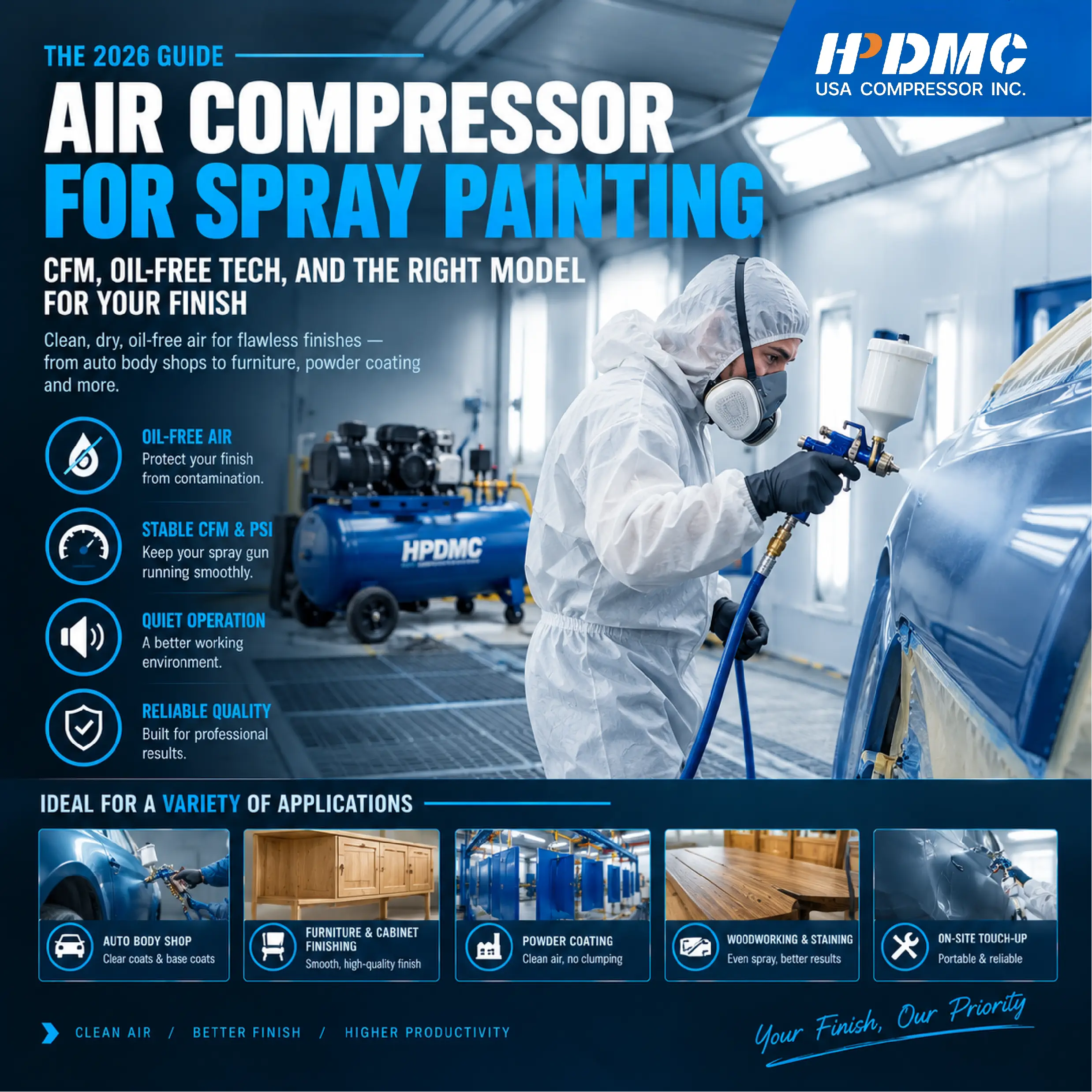
🎨 HVLP and LVLP spray guns require steady, oil-free air. Even a trace of oil in the air line will cause fisheyes and adhesion failure in automotive clearcoat and woodworking lacquer. An oil-free air compressor is the only reliable choice for professional painting.
👉 Already own an oil-lubricated unit? Our guide to Air Compressor Oil Types
6. Maintenance and Lifespan of Oil-Free Compressors
One of the biggest advantages of an oil-free air compressor is the minimal maintenance schedule. There is no oil to change, no oil filter to replace, and no oil-water separator to maintain. But oil-free does not mean maintenance-free.
6.1 Routine Maintenance Schedule
🛠️ Monthly: inspect the intake filter and clean or replace if dirty. Check for unusual noise or vibration. Drain the tank of condensate (water accumulates regardless of oil-free or oil-lubricated design).
🌬️ Every 200 hours: replace the intake filter element. A clogged filter starves the pump, increases compression temperature, and shortens the life of PTFE piston rings or scroll tip coatings.
🔍 Every 12 months: inspect the pressure switch, safety relief valve, and check valve. Bench-test the relief valve to confirm it opens at the rated pressure.
📊 Every 3–5 years: on piston-type oil-free units, inspect the piston ring wear. PTFE rings typically last 1,500–3,000 hours depending on duty cycle and ambient temperature. Scroll compressors typically go 10,000–20,000 hours before requiring tip seal service.
6.2 Typical Lifespan
An oil-free piston compressor used in a home workshop (2–4 hours/week) will typically last 8–12 years before needing a pump rebuild. The same unit in a commercial shop running 20+ hours/week may need a rebuild in 3–5 years. Oil-free scroll compressors, by contrast, typically run 10,000–20,000 hours (equivalent to 5–10 years of continuous duty) before requiring any internal service — making them the longest-lived oil-free technology.
👉 Need a compact pump for mobile jobs? See our Portable Air Pumps Buyer Guide
7. Common Mistakes When Buying an Oil-Free Air Compressor
⚠️ Mistake 1 — confusing "oil-free" with "noise-free." Oil-free piston compressors are quieter than oil-lubricated units, but they are not silent. A 60 dB oil-free piston unit is still audible in a living room. If you need true silence (under 50 dB), choose a scroll compressor, not a piston unit.
⚠️ Mistake 2 — ignoring duty cycle for continuous-demand tools. Sanders, grinders, and spray guns run continuously. An oil-free piston unit rated for 40% duty cycle will overheat and trip its thermal protector within 15 minutes. For continuous-demand tools, either buy a scroll compressor (100% duty cycle) or accept that you need an oil-lubricated unit.
⚠️ Mistake 3 — underestimating CFM requirements. Oil-free units tend to have lower CFM ratings than oil-lubricated units at the same HP because they run at lower RPM. A 2 HP oil-free unit may deliver 6 CFM, while a 2 HP oil-lubricated unit delivers 9 CFM. Always check CFM at 90 PSI, not just HP.
⚠️ Mistake 4 — skipping the intake filter. Without oil in the chamber, any dust that enters the compression port directly abrades the PTFE rings or scroll tip coating. A clean intake filter is the single most important maintenance item on an oil-free compressor. Replace it more often, not less.
💡 Pro tip: if you are transitioning from an oil-lubricated unit to oil-free for the first time, read our companion article on how oil-free compressors work for a deeper dive into the three oil-free technologies (piston, scroll, and rotary vane) and their trade-offs. And for a real-world example of a portable oil-free unit in a home workshop, see our review of the Ultra Quiet Portable Oil-Free model.
Frequently Asked Questions About Oil-Free Air Compressors
Is an oil-free air compressor really 100% oil-free?
It depends on the technology. Oil-free piston compressors have no oil in the compression chamber, but the crankcase bearings may use a small amount of grease or oil — that lubricant never contacts the air. 100% oil-free scroll compressors (like the WXJOSC3B000) have zero oil anywhere in the unit and deliver ISO 8573-1 Class Zero air directly from the discharge port.
How loud is an oil-free air compressor?
Typically 55–70 dB at 1 meter for piston units, and 50–60 dB for scroll units. For comparison, a normal conversation is about 60 dB. Most oil-free units can be operated indoors without hearing protection. Oil-lubricated piston compressors of the same capacity run at 75–90 dB, which requires hearing protection per OSHA standards.
Do oil-free compressors last as long as oil-lubricated ones?
In intermittent-duty applications (home workshop, dental office, lab), an oil-free unit will last 8–12 years — comparable to an oil-lubricated unit. In continuous-duty commercial applications, oil-lubricated units typically outlast oil-free piston units by 2–3x. Oil-free scroll compressors, however, can match or exceed oil-lubricated lifespan thanks to their near-zero-friction scroll mechanism.
Can I use an oil-free compressor for painting?
Yes — in fact, oil-free is the recommended choice for automotive clearcoat, woodworking lacquer, and any finish where oil contamination causes fisheyes or adhesion failure. An oil-free air compressor eliminates the need for in-line oil-removal filters, simplifying the spray system and reducing the risk of filter failure mid-paint job.
What size oil-free compressor do I need for a home garage?
For typical home garage use (nail guns, tire inflation, light airbrushing), a 1–2 HP oil-free unit delivering 4–8 CFM at 90 PSI is sufficient. The AWR600-9L (0.6 HP, 9L tank) handles nail guns and inflation, while the AWR2400-65L (3 HP, 65L tank, 13 CFM) handles framing nailers, staplers, and light spray guns. Match the CFM to your most demanding tool, not the tank size.
Ready to Choose an Oil-Free Air Compressor?
Talk to an HPDMC application engineer. Tell us about your tools, your daily air demand, and your air purity requirements. We will match the right oil-free air compressor to your actual application — whether that is a 0.6 HP portable unit for a home garage or a 30 HP scroll system for a food processing line.
🛒 Browse Oil-Free Lineup · Compare All Compressors
🌐 Or visit the HPDMC main site for the full catalog, technical datasheets, and 20+ years of factory-direct compressor expertise.
✔️ Free consultation · ✔️ Application-matched sizing · ✔️ 24-hr shipping from LA / Chicago · ✔️ ISO 8573-1 Class Zero certified
🔗 Related Solutions & Featured Guides
| Featured Guide |
|---|
| Oil-Free vs Oil-Lubricated Comparison Guide Side-by-side comparison of purity, noise, duty cycle, and cost — the decision matrix referenced throughout this article. |
| Air Compressor Maintenance Guide & Checklist Printable maintenance schedule for oil-free and oil-lubricated units — filter intervals, relief-valve testing, and tank inspection. |
| 30 Gallon Air Compressor Buyers Guide CFM vs tank-size math — why CFM matters more than gallons, and how to calculate your shop demand. |
| Gas vs Electric Air Compressor Guide Drive-system trade-offs: fuel cost, portability, noise, and code requirements for gas vs electric compressors. |
| Air Compressor Oil Types — Synthetic vs Mineral Guide For users transitioning from oil-lubricated to oil-free — understanding oil grades, change intervals, and disposal. |
| Portable Air Pumps — Buyer Guide & Top Picks Compact, on-the-go pump options for home, shop, and mobile service — companion to a stationary oil-free unit. |
| Home CNG Compressor Collection When natural gas compression is needed alongside clean air — HPDMC's residential CNG refueling lineup. |
| Scroll Air Compressors — Complete Guide The 100% oil-free scroll technology referenced in this article — quiet, continuous-duty, ISO Class Zero air at 2–30 HP. |
| 185 CFM Air Compressor — Portable Diesel & Electric Guide High-capacity portable compressor sizing for construction and industrial sites — when shop-class oil-free units are not enough. |

1-Year Warranty
Easy Returns

US-Based Support
Lifetime Technical Support

Help & Advice
service@sales.hpdmc-compressor.com

Live Help
(888)598-0133



Find the Right Compressor for Your Needs
Find the Right Compressor for Your Needs