

1-Year Warranty
Easy Returns

US-Based Support
Lifetime Technical Support

Help & Advice
service@sales.hpdmc-compressor.com

Live Help
(888)598-0133
Why Compressor Oil Matters
If you own an oil-lubricated air compressor, the oil you use is as important as the compressor itself. Compressor oil serves three critical functions: it lubricates the moving parts of the pump to reduce friction and wear, it dissipates heat generated during the compression cycle, and it forms a seal between the piston and cylinder wall to improve compression efficiency.
Using the wrong type of oil — or failing to change it on schedule — leads directly to pump failure.
Synthetic vs. Mineral Oil: The Core Comparison
| Feature | Mineral (Standard) Oil | Synthetic Oil |
| Base Material | Refined crude oil | Chemically engineered base stocks |
| Performance | Good for light to medium-duty use | Superior under high heat and heavy loads |
| Temperature Range | Moderate (breaks down in extreme heat) | Wide range (performs well in cold and heat) |
| Change Interval | Every 500 hours or 3 months | Every 2,000–8,000 hours (varies by brand) |
| Carbon Buildup | More prone to carbon deposits on valves | Resists carbon buildup |
| Environmental Impact | Higher | Lower (longer lifespan = less waste oil) |
| Cost | Lower upfront | Higher upfront, lower long-term cost |
| Best For | Occasional home use, moderate temperatures | Professional, industrial, continuous use |
👉Synthetic Air Compressor Oil: Premium Lubricant Solutions
The Verdict
For compressors used in professional settings or in extreme temperatures, synthetic oil is the clear winner. The extended change intervals alone make it cost-competitive with mineral oil over the life of the machine, and the superior protection it provides can meaningfully extend the pump's operational lifespan.
Compressor Oil Change Guide
Following the correct oil change schedule is non-negotiable for maintaining your compressor's warranty and performance.
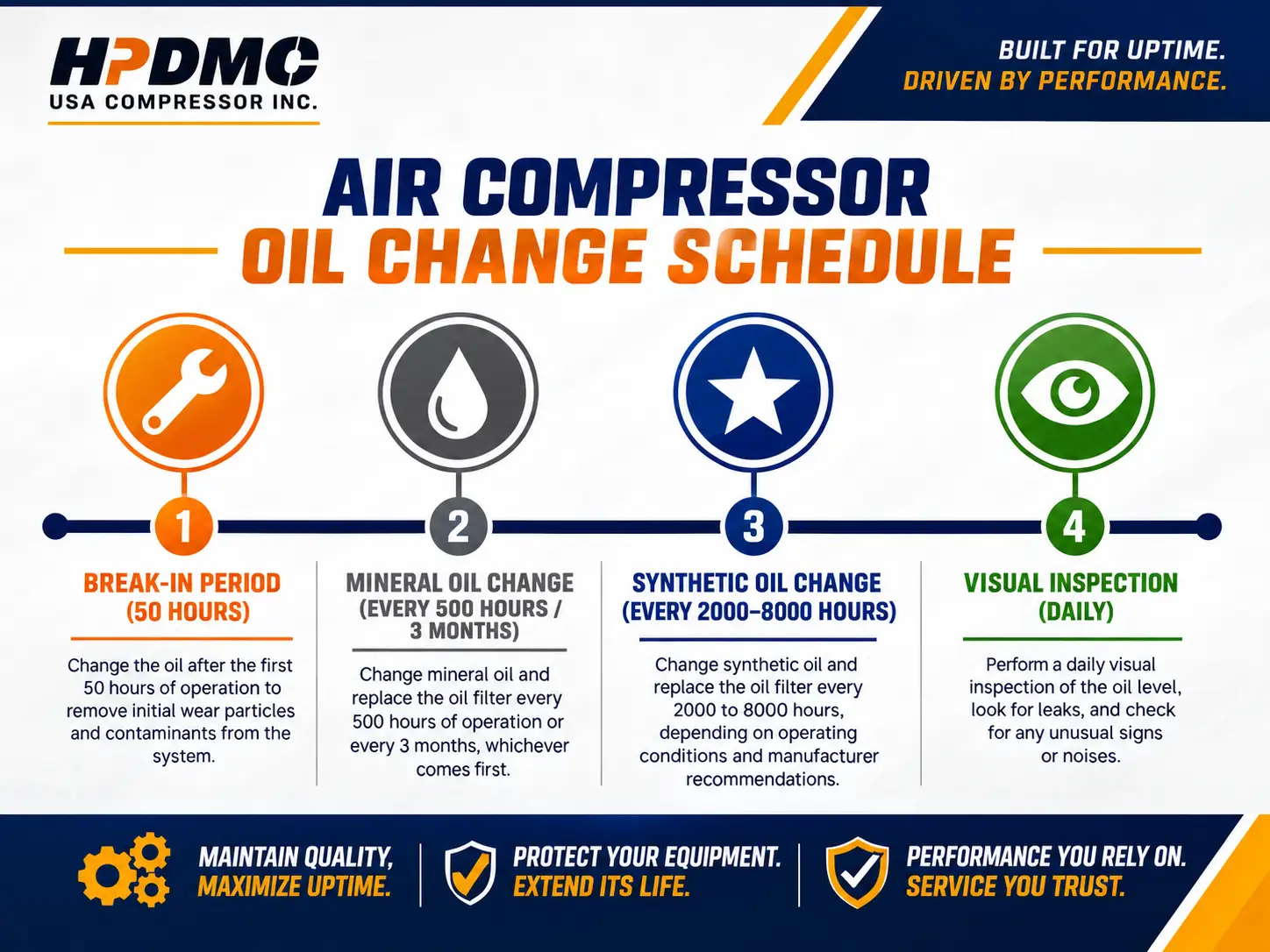
New Compressor Break-In (First 50 Hours): Change the oil after the first 50 hours of use. During this break-in period, tiny metal particles from the manufacturing process circulate in the oil. Changing it early removes these particles before they can cause abrasive wear on the pump's internal surfaces.
Routine Changes with Mineral Oil: Change every 500 hours of use or every 3 months, whichever comes first. In hot climates or dusty environments, consider changing more frequently.
Routine Changes with Synthetic Oil: Follow the manufacturer's recommendation, typically every 2,000 to 8,000 hours depending on the specific oil formulation. Always check your HPDMC owner's manual for the exact interval recommended for your model.
Visual Inspection: Regardless of hours logged, check the oil's condition regularly through the sight glass. If the oil appears dark brown or black, milky (indicating water contamination), or contains visible debris, change it immediately.
Frequently Asked Questions (FAQ)
Q: Can I use motor oil in my air compressor?
A: No. Standard automotive motor oil contains detergent additives designed to keep engine combustion byproducts suspended in the oil. In an air compressor, these detergents cause carbon and varnish deposits to build up on the reed valves, reducing compression efficiency and eventually causing valve failure. Always use a non-detergent compressor oil specifically formulated for air compressors.
Q: What happens if I don't change my compressor oil?
A: Neglecting oil changes allows the oil to break down thermally, losing its viscosity and lubricating properties. As the oil degrades, friction increases between the pump's moving parts, generating more heat and accelerating wear. This cycle leads to overheating, increased energy consumption, and ultimately, catastrophic pump failure requiring expensive repairs or full replacement.
Q: What weight of oil should I use in my air compressor?
A: Most reciprocating (piston) air compressors use a 20-weight or 30-weight non-detergent oil (equivalent to ISO 68 or ISO 100 viscosity grade). The correct viscosity depends on your operating temperature and your specific compressor model. Always consult your HPDMC owner's manual for the exact specification.
👉HPDMC Synthetic & SAE 100 Lubricants – 2026 Guide
Q: How do I check the oil level in my air compressor?
A: Most HPDMC oil-lubricated compressors feature a transparent sight glass on the side of the pump housing. With the compressor turned off and sitting on a level surface, the oil level should be at the center of the sight glass — at or near the marked fill line. Do not overfill, as excess oil can be drawn into the air stream.
Q: Is synthetic oil worth the extra cost?
A: Yes, for most users. While synthetic compressor oil costs more per quart than mineral oil, its extended change intervals (up to 8,000 hours vs. 500 hours for mineral oil) mean you purchase and dispose of far less oil over the life of the machine. The superior protection it provides also reduces the risk of costly pump repairs, making it a sound investment for any compressor used regularly.
1-Year Warranty
Easy Returns
US-Based Support
Lifetime Technical Support
Help & Advice
service@sales.hpdmc-compressor.com
Live Help
(888)598-0133



Find the Right Compressor for Your Needs
Find the Right Compressor for Your Needs