1. Five Real-World Scenarios: Where a Pallet Wrapping Machine Pays for Itself
1.1 Pallet Wrapping Machine for Warehouse and Distribution Centers
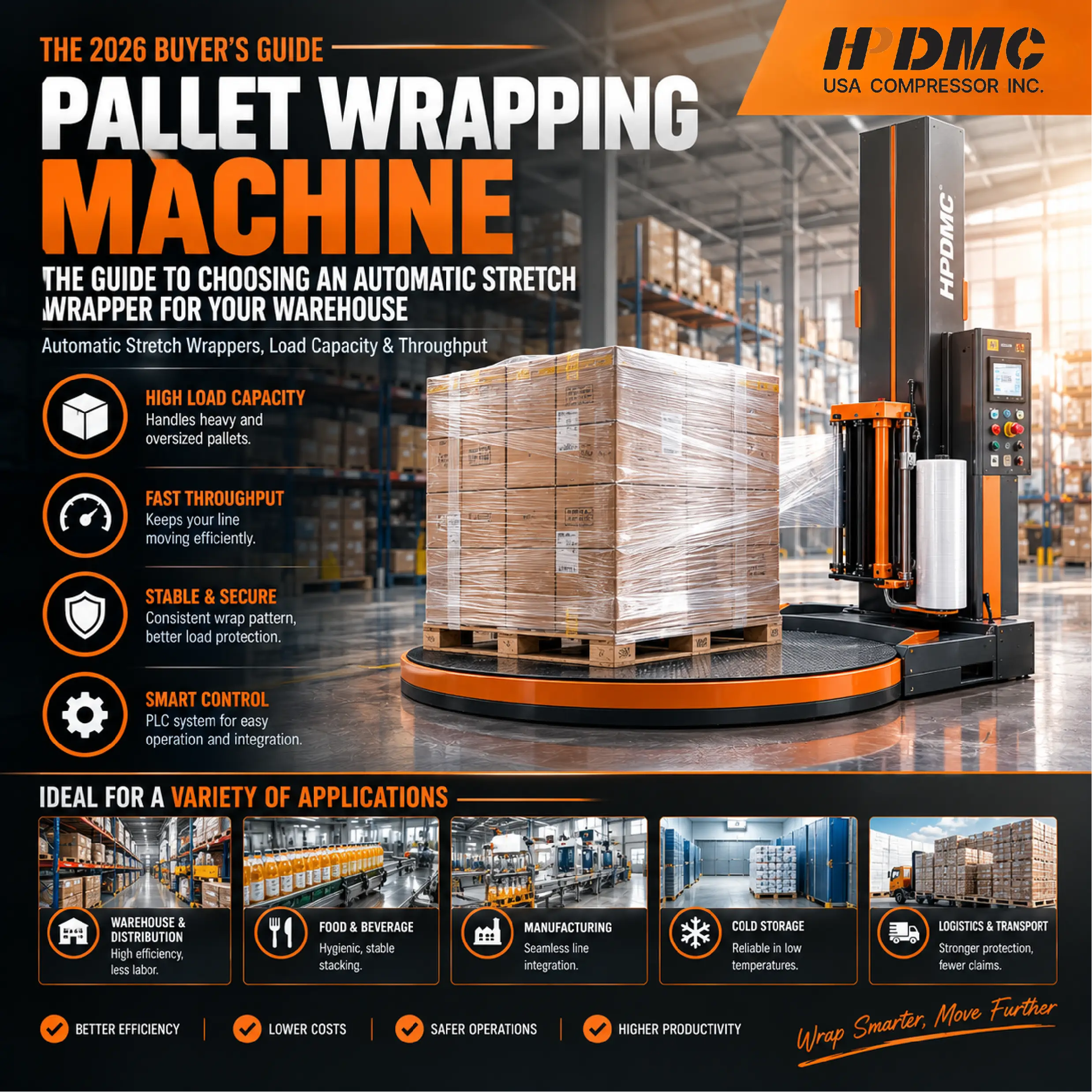
📦 A distribution center shipping 200+ pallets a day cannot afford a manual wrap station. At 4 minutes per hand-wrapped pallet, one operator spends more than 13 hours per shift just wrapping — that is two full-time positions doing nothing but walking around pallets with a film roll. An automatic pallet wrapping machine running at 40 pallets per hour absorbs that entire workload into a single 90-second cycle, and the operator can load the next pallet while the machine finishes the current one. For a DC running two shifts, the payback on an automatic stretch wrapper is typically under 12 months when you account for film savings, labor, and reduced damage claims.
1.2 Pallet Wrapping Machine for Food and Beverage Plants
🥫 Food and beverage plants have a wrapping problem that other industries do not: load stability on stacked cases. A pallet of canned goods or bottled product has a high center of gravity and will shift in transit if the wrap pattern is inconsistent — which is exactly what happens with hand wrapping. An automatic machine applies a controlled, repeatable film force from bottom to top, holding the stack together through turns, braking, and dock transitions. Plants running washdown environments should also confirm the machine base and electrical enclosure ratings before purchase, and specify stainless or coated components where the wrapper sits close to a filler or a case packer.
1.3 Pallet Wrapping Machine for Manufacturing End-of-Line
🏭 In a manufacturing plant, the wrapper is the last machine on the line and it has to talk to everything upstream. A PLC-controlled pallet wrapping machine accepts an input signal from the case packer or palletizer, wraps automatically, and signals downstream equipment when the load is released — no operator intervention in the cycle. This integration is why PLC control matters more than raw speed for most production lines: the wrapper has to match the line's takt time, not beat it. Many end-of-line areas also run pneumatic actuators, air knives, and vacuum grippers — if your packaging line uses compressed air, our air compressor products guide covers how to size the air supply for that equipment.
1.4 Pallet Wrapping Machine for Cold Storage and Freezer Rooms
Cold storage and freezer operations expose a wrapping machine to conditions that degrade standard components: condensation on the turntable, brittle film behavior at low temperature, and lubricant thickening in the drive. A machine specified for cold rooms needs cold-rated drive components, sealed bearings, and a control enclosure rated for condensation. Load capacity also matters more here — a pallet of frozen product is heavier than the same volume of dry goods, and a 4,400 lbs rated turntable gives you margin for the heaviest freezer loads without straining the drive.
1.5 Pallet Wrapping Machine for 3PL and Logistics Operations
Third-party logistics providers wrap a different pallet every hour — mixed heights, mixed weights, mixed customers. Two features matter most in this environment: fast changeover between pallet sizes, and captured weight data. A 3PL billing by weight or auditing freight charges needs a verified weight for every outbound load; a pallet wrapping machine with a built-in scale records that weight during the wrap cycle instead of sending the pallet to a separate floor scale. This eliminates a full extra handling step per pallet — which, at 200 pallets a day, is a significant labor saving.
2. How to Specify a Pallet Wrapping Machine: The Six Numbers That Matter
2.1 Load Capacity: Start Here
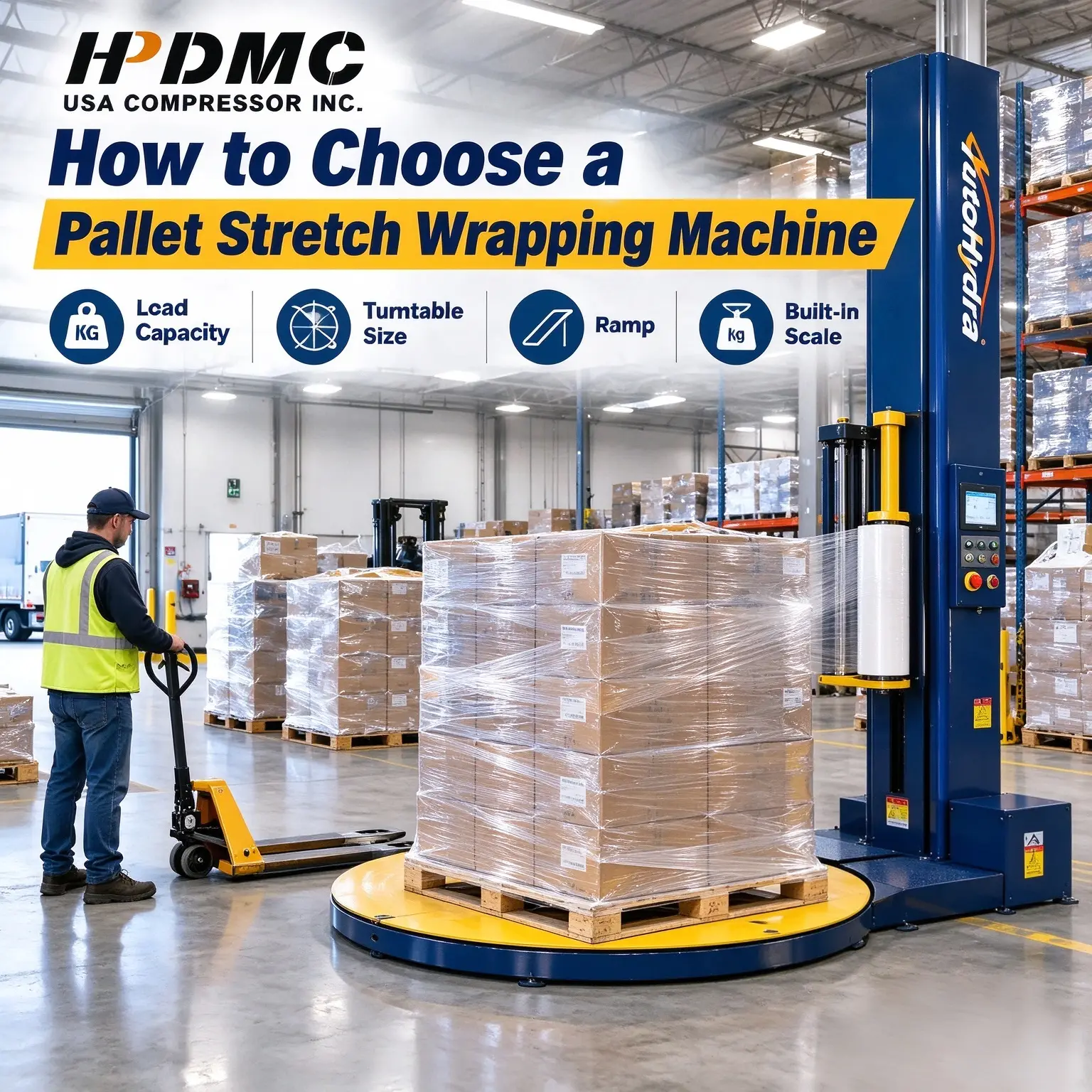
The rated load capacity is the single most important specification, because it sets the drive, the turntable bearings, and the structural frame. A typical loaded US pallet weighs 1,000–2,500 lbs, but heavy loads — canned goods, bagged material, brick, or liquid totes — regularly exceed 3,000 lbs. Our recommendation is to specify at least 30% headroom above your heaviest expected load. A 4,400 lbs rated machine comfortably handles everything up to a fully loaded heavy pallet, and the headroom protects the drive from the shock loads that occur when a forklift sets a pallet down unevenly.
2.2 Turntable Diameter: Match Your Pallet Footprint
⭕ The turntable must accommodate your pallet plus any overhang from the load. Standard GMA pallets are 48" × 40"; a loaded pallet with case overhang can reach 52"–56" in the longest dimension. A 65-inch (1.65 m) turntable handles standard pallets with generous overhang clearance and still fits most dock layouts. If you run oversized pallets (48" × 48", or custom footprints for appliances or furniture), measure your largest load before specifying — the turntable diameter is not something you can change later.
2.3 Automation Level: Semi-Automatic vs Automatic
⚙️ This decision drives both the price and the labor savings:
• Semi-automatic: the operator attaches the film to the pallet, starts the cycle, and cuts the film at the end. Lower cost, but still requires an operator present for every pallet.
• Automatic (PLC-controlled): the machine attaches the film, wraps, cuts, and seals the tail without operator input. The operator only loads and unloads pallets — which means one person can run the wrapper alongside another task.
For any operation above roughly 50 pallets per shift, automatic is almost always the correct choice. The labor difference is not marginal — it is the difference between a dedicated wrapping position and no wrapping position at all.
2.4 Throughput: Do the Shift Math
Throughput is usually quoted as pallets per hour. A machine rated for 40 pallets per hour runs a 90-second cycle, which means it can wrap roughly 320 pallets in an 8-hour shift at continuous operation. Real-world output is lower — allow for pallet transfer time, film roll changes, and operator breaks. A realistic planning figure is 70–75% of rated throughput, so a 40-pallet/hour machine should be planned for about 28–30 pallets per hour in production. Size for your peak shift, not your average day — the wrapper is a bottleneck the moment it falls behind the palletizer.
2.5 Film Carriage and Pre-Stretch: Where the Savings Hide
A powered pre-stretch film carriage stretches the film 150–300% before it reaches the pallet. This matters because stretch film is a consumable — a facility wrapping 200 pallets a day can spend $15,000–$25,000 per year on film. A pre-stretch carriage reduces film consumption by 30–50% compared to hand wrapping while producing a tighter, more stable wrap. If you are comparing two machines on price alone, calculate five-year film cost before deciding — the cheaper machine often costs more to run. Standard 20-inch stretch film rolls are the industry norm; confirm the carriage accepts the roll width and core size you already buy.
2.6 Optional Features: Built-In Scale and Loading Ramp
➕ Two options come up in almost every specification review:
• Built-in scale: captures the pallet weight during the wrap cycle. Essential for 3PLs billing by weight and for freight auditing. Note that if the weight is used for trade or billing, the scale must meet NTEP requirements under NIST Handbook 44 — confirm this with the supplier before purchase, because not every integrated scale is legal-for-trade.
• Loading ramp: lets a forklift, pallet truck, or stacker drive palletized goods directly onto the turntable instead of lifting them over the deck edge. A 2-ton rated ramp matched to the turntable height removes a lift-and-place step from every cycle and reduces the risk of dropping a load on the machine.
Facilities that run wrapping machines alongside other powered production equipment should also review our guide on low-pressure vs. high-pressure compressors for US manufacturing if compressed air is part of the same line.
3. Model Comparison: Three Automatic Pallet Wrapping Machines
📊 Here is how the three current HPDMC pallet wrapping machines compare. All three share the same 65-inch turntable and 4,400 lbs load rating — the difference is in automation features and accessories.
| Model | Turntable | Capacity | Key Feature | Best For |
|---|
| CRJ1650LFDC | 65" | 4,400 lbs | Built-in scale + PLC | Weight capture, freight audit, 3PL billing |
| CRJ1650LFQD | 65" | 4,400 lbs | PLC + auto film cut | High-volume DCs, 40 pallets/hour |
| CRJ1650LFQD + LFPD | 65" | 4,400 lbs | 2-ton loading ramp | Forklift-loaded docks, drive-on loading |
4. Which Pallet Wrapping Machine Fits Your Operation?
4.1 For 3PLs and Operations That Bill by Weight
110V Automatic Pallet Wrapping Machine with Built-in Scale — CRJ1650LFDC — 4,400 lbs capacity, 65" turntable, PLC control, integrated scale, 110V power. This is the model for a 3PL, freight broker, or distribution operation that needs a verified weight on every outbound pallet. The built-in scale captures weight during the wrap cycle, so the pallet never has to be staged on a separate floor scale — one less handling step and one less chance of a mis-recorded weight. The 110V power requirement is a practical advantage: it plugs into a standard outlet, so you can position it wherever the dock layout needs it without running a dedicated 230V circuit.
4.2 For High-Volume Distribution Centers
Automatic Pallet Stretch Wrapping Machine, 65" Turntable — CRJ1650LFQD — 4,400 lbs capacity, 65" turntable, 40 pallets per hour, automatic film cutting, PLC control. This is the workhorse for a high-volume distribution center or manufacturing end-of-line where the wrapper has to keep pace with the palletizer. Automatic film cutting and tail sealing mean no operator intervention mid-cycle — load the pallet, walk away, and the machine finishes the job. The PLC interface accepts upstream signals so the wrapper can be integrated into a conveyor or palletizer line rather than run as a standalone station.
4.3 For Docks That Load with Forklifts or Pallet Trucks
🛠️Stretch Wrapper Machine with 2-Ton Loading Ramp — CRJ1650LFQD + CRJ1650LFPD — the same automatic wrapper platform paired with a 2-ton rated loading ramp built from Q235 hot-rolled steel plate with a checker-plate surface. If your team loads pallets onto the turntable with a forklift, pallet truck, or stacker, the ramp eliminates the lift-and-place step — equipment drives the load straight onto the wrapping platform. That is faster per cycle and materially safer, since it removes the risk of a dropped load landing on the machine or the operator. The checker-plate surface provides traction under wet or dusty dock conditions.
5. Frequently Asked Questions
How many pallets per hour can an automatic pallet wrapping machine handle?
A machine rated for 40 pallets per hour runs a 90-second wrap cycle, which works out to roughly 320 pallets in an 8-hour shift at continuous operation. In production, plan for 70–75% of rated throughput — about 28–30 pallets per hour — to account for pallet transfer, film roll changes, and operator breaks. Always size against your peak shift rather than your average day, because the wrapper becomes a bottleneck the moment it falls behind the palletizer upstream.
What load capacity do I need for a pallet wrapping machine?
Most loaded US pallets weigh 1,000–2,500 lbs, but heavy product — canned goods, bagged material, brick, liquid totes — regularly exceeds 3,000 lbs. Specify at least 30% headroom above your heaviest expected load. A 4,400 lbs rated machine covers essentially all standard US pallet loads with margin for the shock loads that occur when a forklift sets a pallet down unevenly. Undersizing the capacity is one of the most expensive specification mistakes, because it is not a field-upgradeable part — it requires replacing the machine.
Semi-automatic or automatic: which pallet wrapper should I buy?
Go automatic if you wrap more than about 50 pallets per shift. A semi-automatic machine still requires an operator to attach the film and cut the tail for every pallet — so it does not remove the wrapping position, it just makes that position faster. An automatic PLC-controlled machine attaches, wraps, cuts, and seals without operator input, which means the operator can load the next pallet or handle another task entirely. Below 50 pallets per shift, semi-automatic can be the more economical choice; above it, automatic pays back quickly.
Do I need a built-in scale on my pallet wrapping machine?
You need one if weight data drives your business — a 3PL billing by weight, a shipper auditing freight charges, or an operation that must record outbound load weights for compliance. The scale captures weight during the wrap cycle, eliminating a separate weighing step and the handling that goes with it. One important caveat: if the weight is used for trade or billing, the scale must meet NTEP requirements under NIST Handbook 44. Confirm legal-for-trade status with the supplier before purchase — not every integrated scale is certified for commercial use, and retrofitting certification later is not always possible.
How much does stretch film cost, and how do I reduce it?
A facility wrapping 200 pallets a day typically spends $15,000–$25,000 per year on stretch film. The single biggest lever is a powered pre-stretch film carriage, which stretches film 150–300% before it reaches the pallet and cuts consumption by 30–50% compared to hand wrapping. Two secondary levers: match film gauge to load weight (heavier loads need thicker film, but light loads are often over-wrapped), and set the wrap pattern to the minimum that passes carrier requirements rather than a fixed default. If you are comparing machines on purchase price alone, calculate five-year film cost first — the cheaper machine frequently costs more to own.
Ready to Specify Your Pallet Wrapping Machine?
Tell us about your operation — how many pallets per shift, your heaviest load, your largest pallet footprint, and whether you need weight capture or forklift loading. An HPDMC packaging engineer will match the right pallet wrapping machine to your dock layout and throughput target, and confirm the film and power requirements before you commit.
🛒 Get a Free Sizing Review · Browse Product Catalog
✔️ Free layout consultation · ✔️ PLC integration support · ✔️ Film & power verified before order