Title: Oil-Free vs Oil-Lubricated Compressors
Understand the key differences in lubrication, air purity, maintenance, and operating cost. Find the right technology for your workshop, job site, or production line.
⚖️ Compare Compressor Types
1-Year Warranty
Easy Returns

US-Based Support
Lifetime Technical Support

Help & Advice
service@sales.hpdmc-compressor.com

Live Help
(888)598-0133
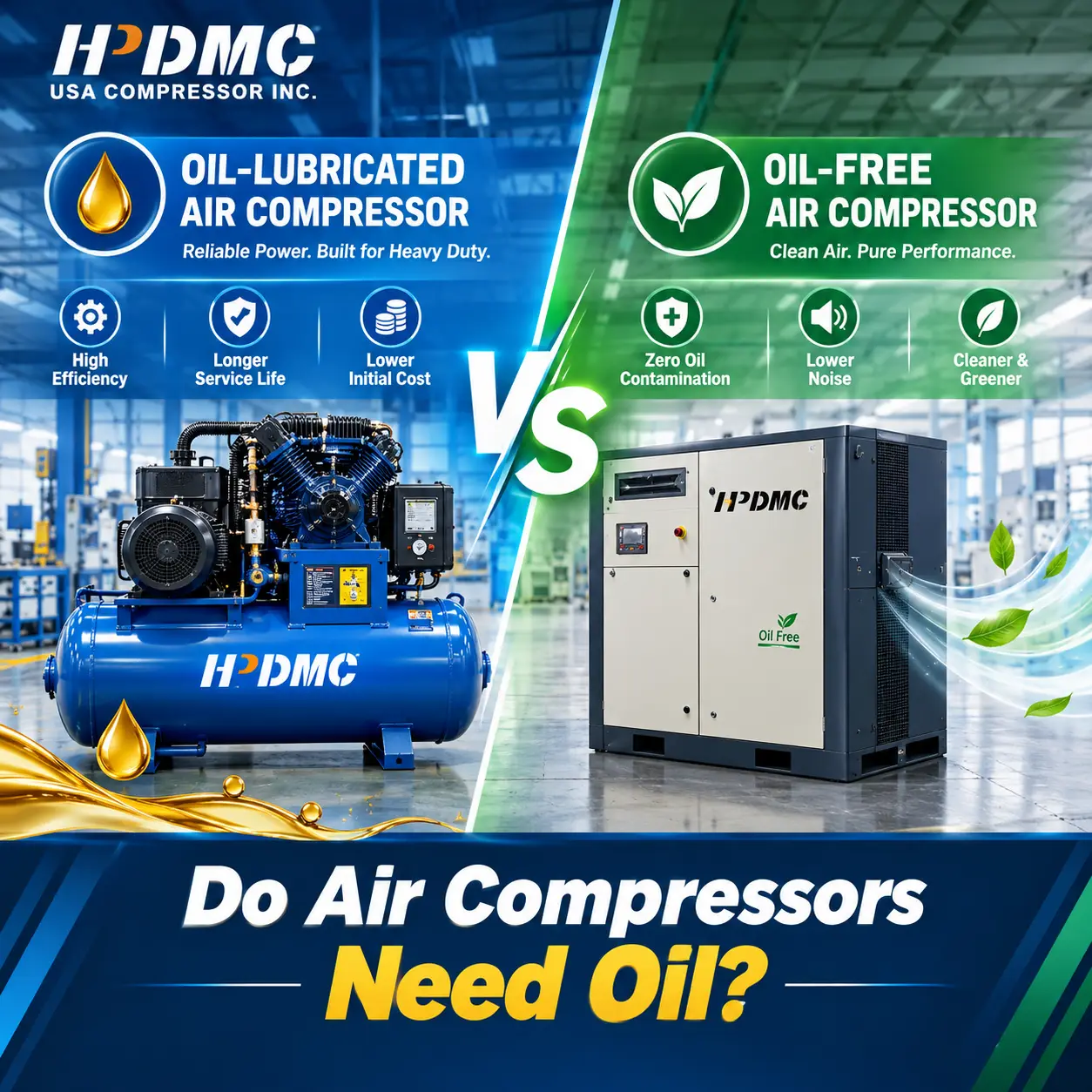
If you are shopping for an air compressor, one of the first questions you may ask is: do air compressors need oil?
📌 Short Answer: Not all air compressors need oil. Some use oil to lubricate, cool, and seal internal components during compression. Others are designed to compress air without oil in the compression chamber and are commonly called oil-free or oil-less air compressors.
The right choice depends on the compressor design, required air quality, operating conditions, maintenance expectations, and application.
In this guide, we explain which air compressors need oil, which do not, what compressor oil does, and when an oil-free compressor may be appropriate.
No. Air compressors do not all require oil.
Air compressors can use different lubrication and compression designs. In an oil-lubricated compressor, oil may be used to reduce friction, remove heat, and help seal internal components.
An oil-free compressor is designed so that oil is not introduced into the compression chamber or compressed-air path. Depending on the compressor technology, manufacturers may use special coatings, materials, clearances, or other engineering methods to reduce friction without introducing oil into the compression process.
⚠️ The term oil-free should generally be understood in the context of the compression system rather than as a statement that every mechanical component in the entire machine contains absolutely no lubricant. Always check the manufacturer's specifications for the specific model.
Many conventional oil-lubricated piston and rotary screw compressors use oil as part of their operating system.
In an oil-lubricated reciprocating compressor, oil helps protect components such as the crankshaft, bearings, piston assembly, and cylinder surfaces. The lubricant helps reduce friction and wear while also helping manage heat generated during compression.
Because the compressor uses oil as part of its lubrication system, regular oil inspection and replacement are part of normal maintenance.
⛔ For oil-lubricated compressors, always use the lubricant specified by the manufacturer rather than assuming automotive engine oil is suitable.
For more details, see HPDMC's compressor oil guidance.
Oil-injected rotary screw compressors use oil differently from many piston compressors. During compression, oil can be introduced into the compression process to help:
The compressed air and oil mixture is then processed through the compressor's separation system before the air is delivered downstream. This design is widely used for applications requiring continuous compressed-air production.
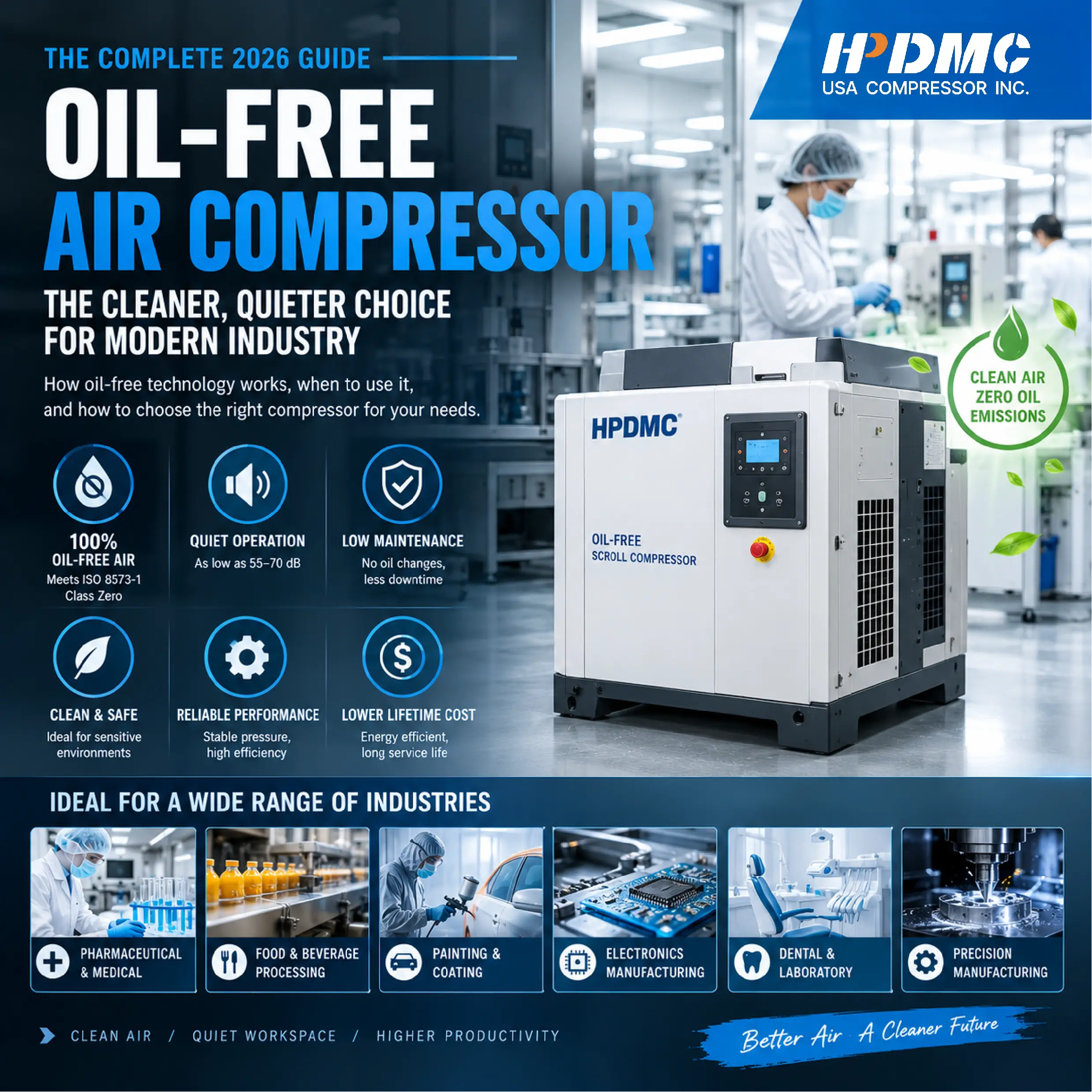
Oil-free compressors are designed to compress air without introducing lubricating oil into the compression chamber.
Common examples include:
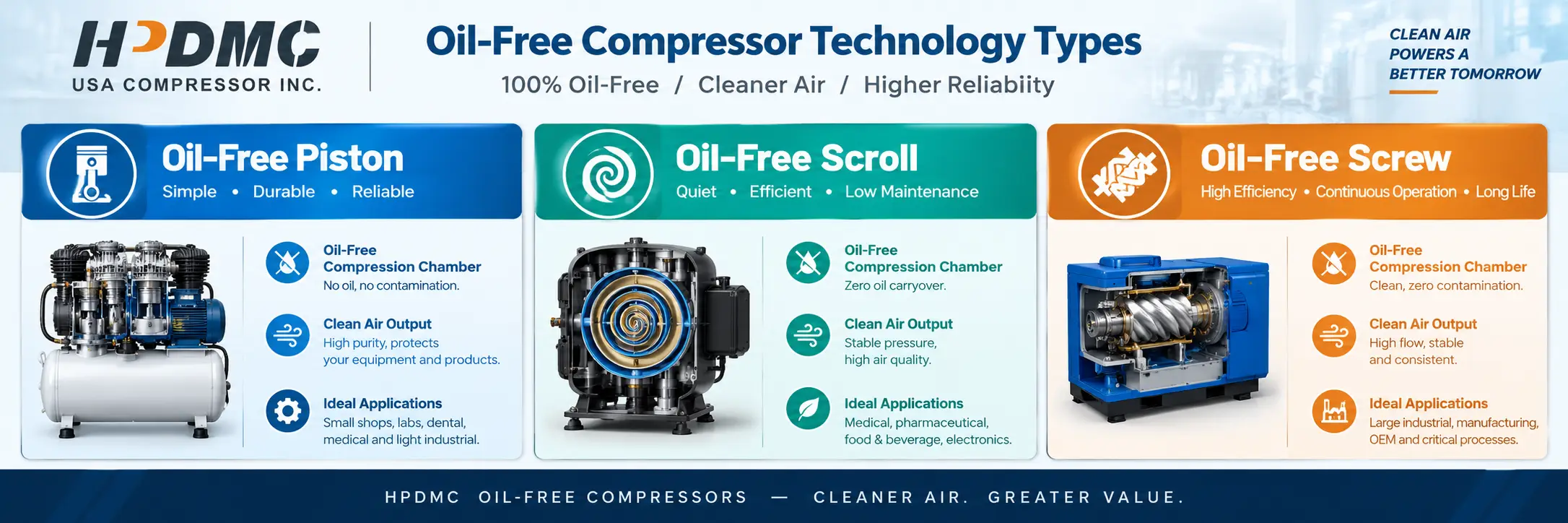
HPDMC's oil-free compressor guide explains that oil-free designs can use specialized materials or coatings to reduce friction and operate without lubricating oil in the compression chamber.
Oil-free piston compressors use specialized materials and component designs to operate without oil in the compression chamber. They are commonly used for applications where clean compressed air is important, including smaller workshops, painting, and other applications where oil contamination can be undesirable.
A scroll compressor uses a fixed scroll and an orbiting scroll to compress air in progressively smaller pockets. Oil-free scroll designs do not introduce oil into the compression chamber and are often used where low noise, low vibration, and clean compressed air are important.
Compare oil-free and oil-lubricated compressors side by side — air purity, maintenance, lifespan, and best uses.
⚖️ Compare Compressor TypesThe main reason is mechanical lubrication. Compression involves moving components operating under load. Depending on the compressor design, lubrication can help perform several functions.
✅ 1. Reduce Friction — Oil creates a lubricating film between moving components, helping reduce direct metal-to-metal contact.
✅ 2. Reduce Wear — Proper lubrication helps protect components during repeated compression cycles.
✅ 3. Help Control Heat — Compression generates heat. In some compressor designs, circulating oil also helps transfer heat away from the compression components.
✅ 4. Improve Sealing — In certain compressor designs, oil helps seal clearances between moving components, improving compression efficiency.
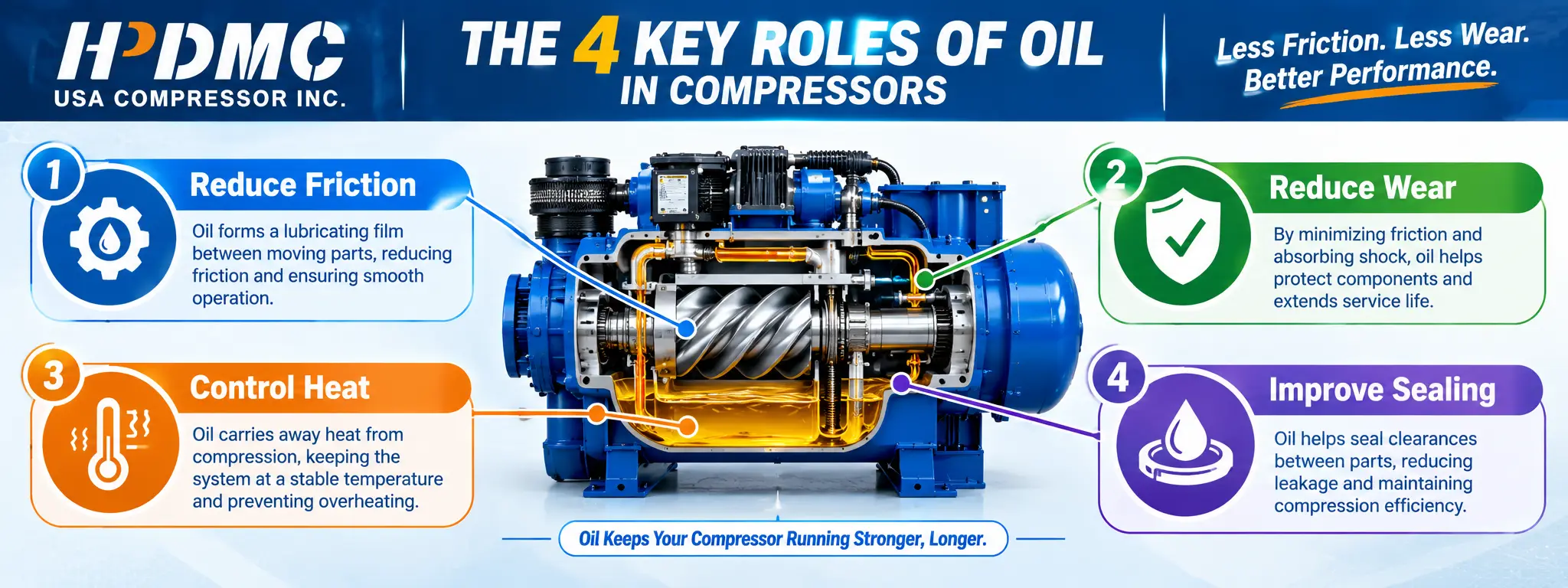
💡 The exact role of oil depends on the compressor technology. The lubrication system should always be evaluated according to the manufacturer's design rather than assuming every compressor uses oil in the same way.
This is one of the most common points of confusion.
Oil-free generally refers to the compression process and compressed-air path, not necessarily every component inside every compressor.
Some oil-free compressor designs can have separate lubrication systems for components such as bearings or gears, while keeping lubricant isolated from the compression chamber and compressed-air path. Other designs are built without those oil-lubricated systems.
⚠️ If your application requires a specific air-purity classification or certification, don't rely only on the words "oil-free" in a product title. Check the manufacturer's technical documentation and the applicable air-quality requirements.
Industry guidance also distinguishes between oil-free compression and the overall cleanliness of the compressed-air system. Ambient contamination, piping, storage tanks, and downstream equipment can all affect final air quality.
The key difference is how the compressor handles lubrication during compression.
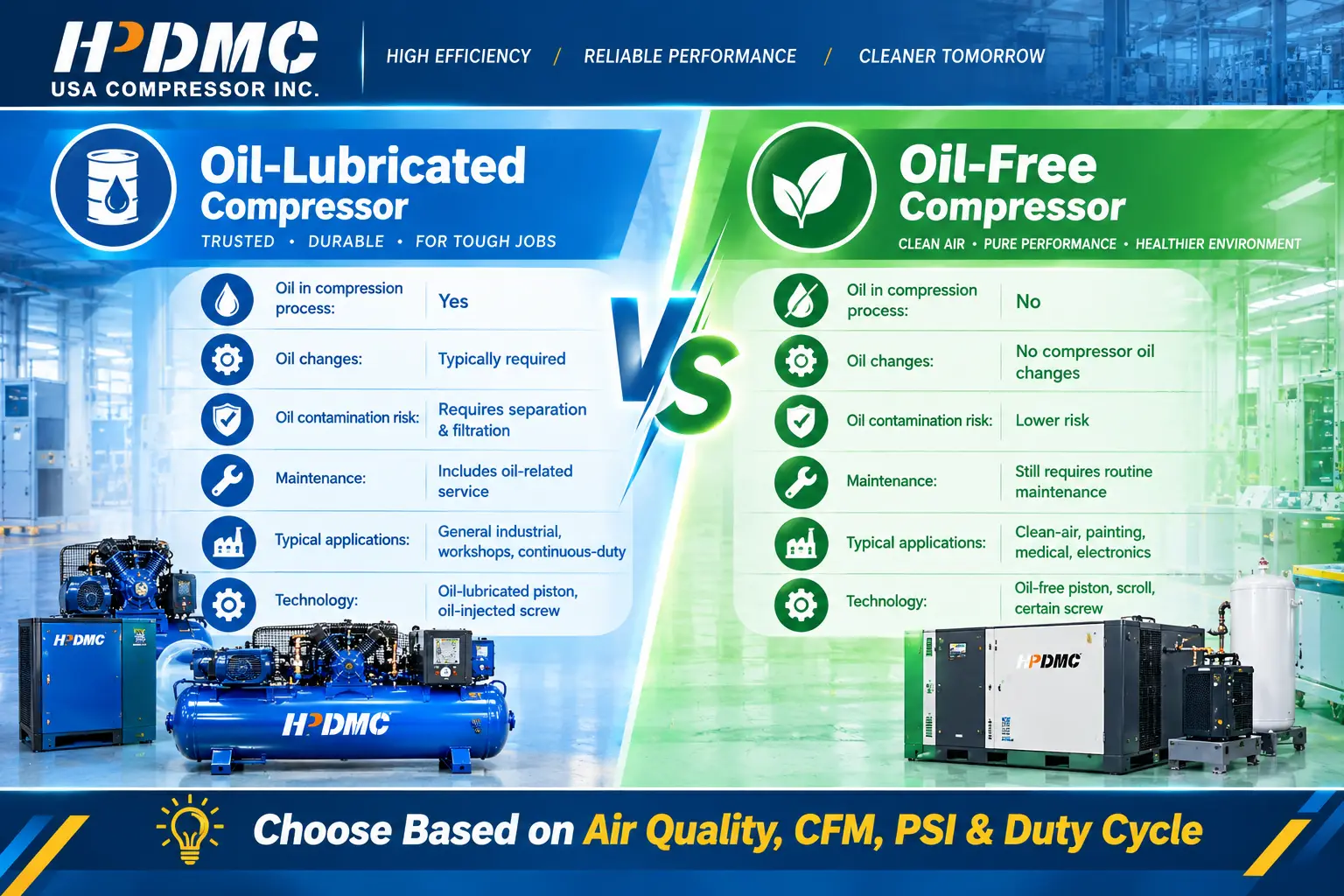
This table is a general technology comparison. Actual performance, maintenance requirements, and air purity depend on the specific compressor model and system configuration.
For a more detailed technology comparison, see HPDMC's guide to Oil vs. Oil-Free Air Compressors.
If a compressor is designed to use oil and its oil level becomes too low, continuing to operate it can cause serious mechanical problems.
⚠️ Insufficient lubrication can increase: Friction Component wear Operating temperature Risk of overheating Risk of pump damage
An oil-lubricated compressor should therefore be maintained according to the manufacturer's recommended oil level, lubricant specification, and service interval.
⚠️ Do not add oil to an oil-free compressor simply because another compressor requires oil. The compressor's design determines whether oil is required.
Yes. Oil-free does not mean maintenance-free.
Even when there is no compressor oil to change, the machine still requires routine inspection and maintenance.
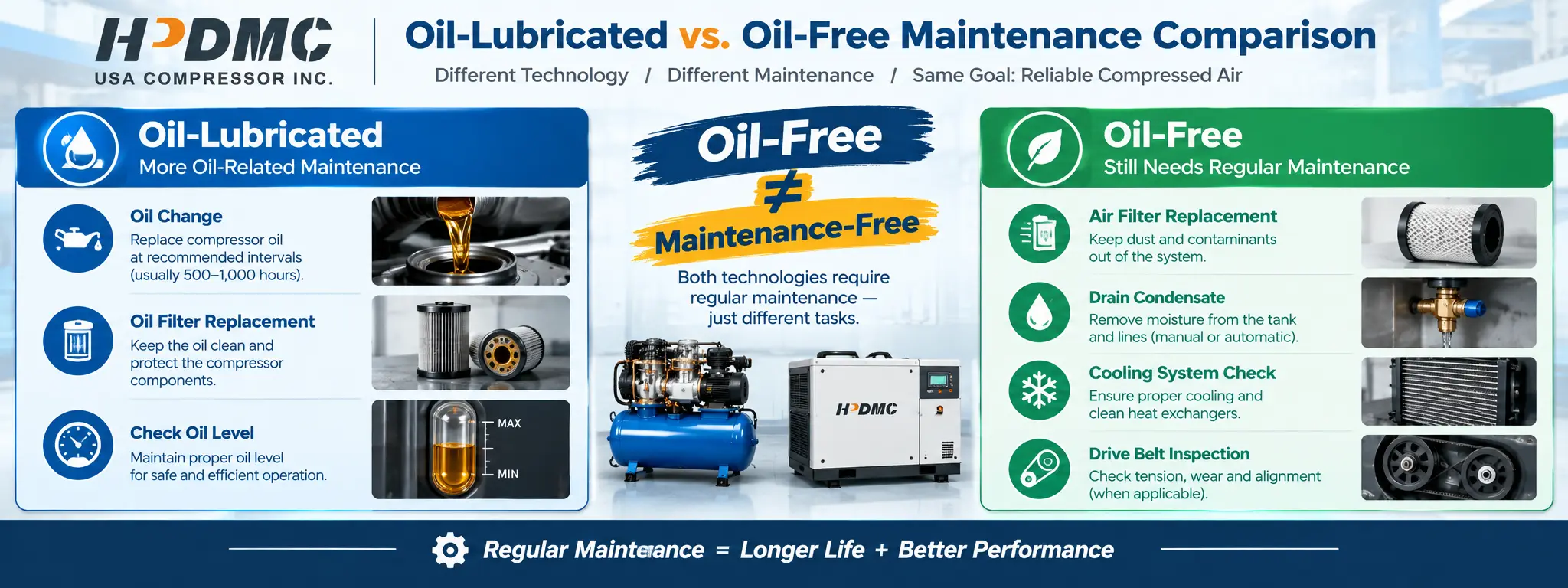
Depending on the model, maintenance can include:
HPDMC's maintenance guide recommends routine moisture control, filter maintenance, hardware inspection, and other preventive maintenance tasks for both portable oil-free and heavier-duty compressor systems.
💡 The real difference: Oil-free reduces or eliminates oil-related maintenance; it does not eliminate compressor maintenance altogether.
An oil-free compressor can be appropriate when oil contamination in the compressed-air system is a significant concern.
Typical applications can include:
💡 The appropriate compressor still depends on required CFM, PSI, duty cycle, noise, air-quality requirements, and the specific application.
Oil-lubricated compressors remain widely used for applications where their lubrication system, operating profile, and required airflow make them appropriate.
They can be suitable for:
⚠️ The key is not simply whether a compressor uses oil. Instead, consider: What will the compressed air be used for, how much air do you need, how long will the compressor run, and what air-quality level does the application require?
Before buying an air compressor, evaluate these six factors.
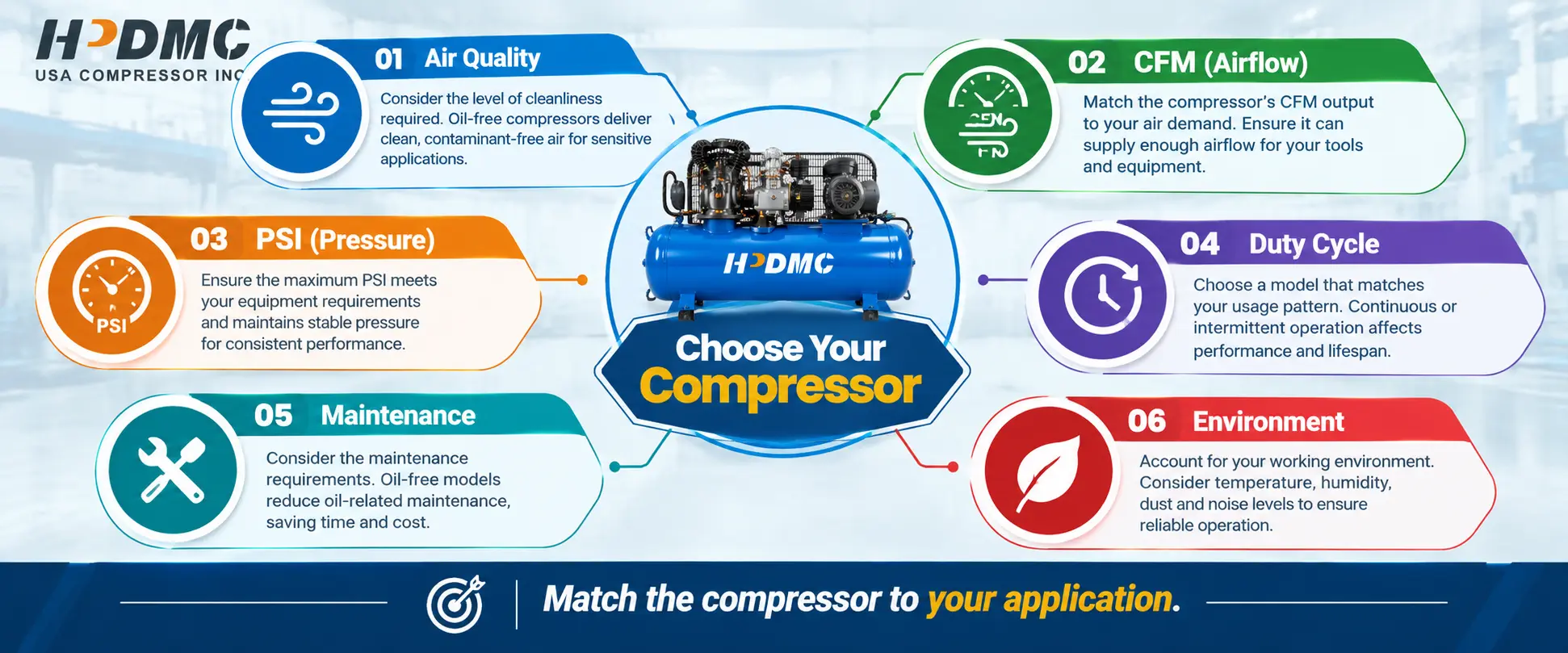
✅ 1. Air Quality — Does the compressed air come into contact with a product, process, or sensitive equipment? If yes, investigate the required air-purity specification.
✅ 2. CFM — Determine the airflow required by your pneumatic tools or equipment. A compressor with insufficient CFM may run continuously without keeping up with demand.
✅ 3. PSI — Check the required operating pressure of the equipment. Do not select a compressor based only on horsepower.
✅ 4. Duty Cycle — Will the compressor run occasionally, intermittently, or continuously? Operating profile is an important part of compressor selection.
✅ 5. Maintenance — If you want to eliminate routine compressor-oil changes, an oil-free design may simplify maintenance. However, oil-free machines still require filter, moisture, cooling, and general mechanical maintenance.
✅ 6. Application Environment — Consider noise, indoor/outdoor operation, available electrical power, space, air cleanliness, temperature, and required portability.
No. It depends on the compressor design. Oil-lubricated compressors use oil as part of their lubrication system, while oil-free compressors are designed without oil in the compression chamber.
No. Oil-free piston, scroll, and certain screw compressor designs can operate without oil being introduced into the compression chamber.
Generally, an oil-free compressor does not require oil in the compression chamber. However, some oil-free compressor designs can have separate lubrication systems for certain mechanical components. Always check the manufacturer's specifications.
No. Never add oil unless the manufacturer specifically states that the model requires it. Using oil in a compressor designed for oil-free operation can damage the machine or compromise its intended air-quality performance.
For an oil-lubricated compressor, follow the manufacturer's recommended oil type and service interval. The interval varies by compressor design, lubricant, operating conditions, and model. For details, see HPDMC's oil change guide.
No. Oil-free compressors eliminate or reduce oil-related maintenance, but they still require routine inspection, filter maintenance, moisture management, cooling-system care, and other service specified by the manufacturer.
Neither technology is universally better. The appropriate choice depends on the required air quality, CFM, PSI, duty cycle, operating environment, maintenance requirements, and application.
Get a free application assessment from HPDMC's compressor experts — we'll help you match air quality, CFM, PSI, and duty cycle to the right compressor.
✔️ Free consultation · ✔️ Application-matched recommendations · ✔️ Fast shipping from LA/Chicago
Understand the key differences in lubrication, air purity, maintenance, and operating cost. Find the right technology for your workshop, job site, or production line.
⚖️ Compare Compressor TypesQuiet, clean, 100% oil-free scroll compressors for medical, food, lab, and electronics applications. Custom configurations from 2 to 30 HP.
👉 Configure Your Scroll CompressorComplete daily, weekly, monthly, and annual maintenance checklist — for both oil-free and oil-lubricated compressors.
🛠️ Get the Maintenance Checklist1-Year Warranty
Easy Returns
US-Based Support
Lifetime Technical Support
Help & Advice
service@sales.hpdmc-compressor.com
Live Help
(888)598-0133



Find the Right Compressor for Your Needs
Find the Right Compressor for Your Needs