1. Why 30 Gallons? Real-World Scenarios in the Auto Repair Shop
1.1 30 Gallon Air Compressor for Auto Repair Shop
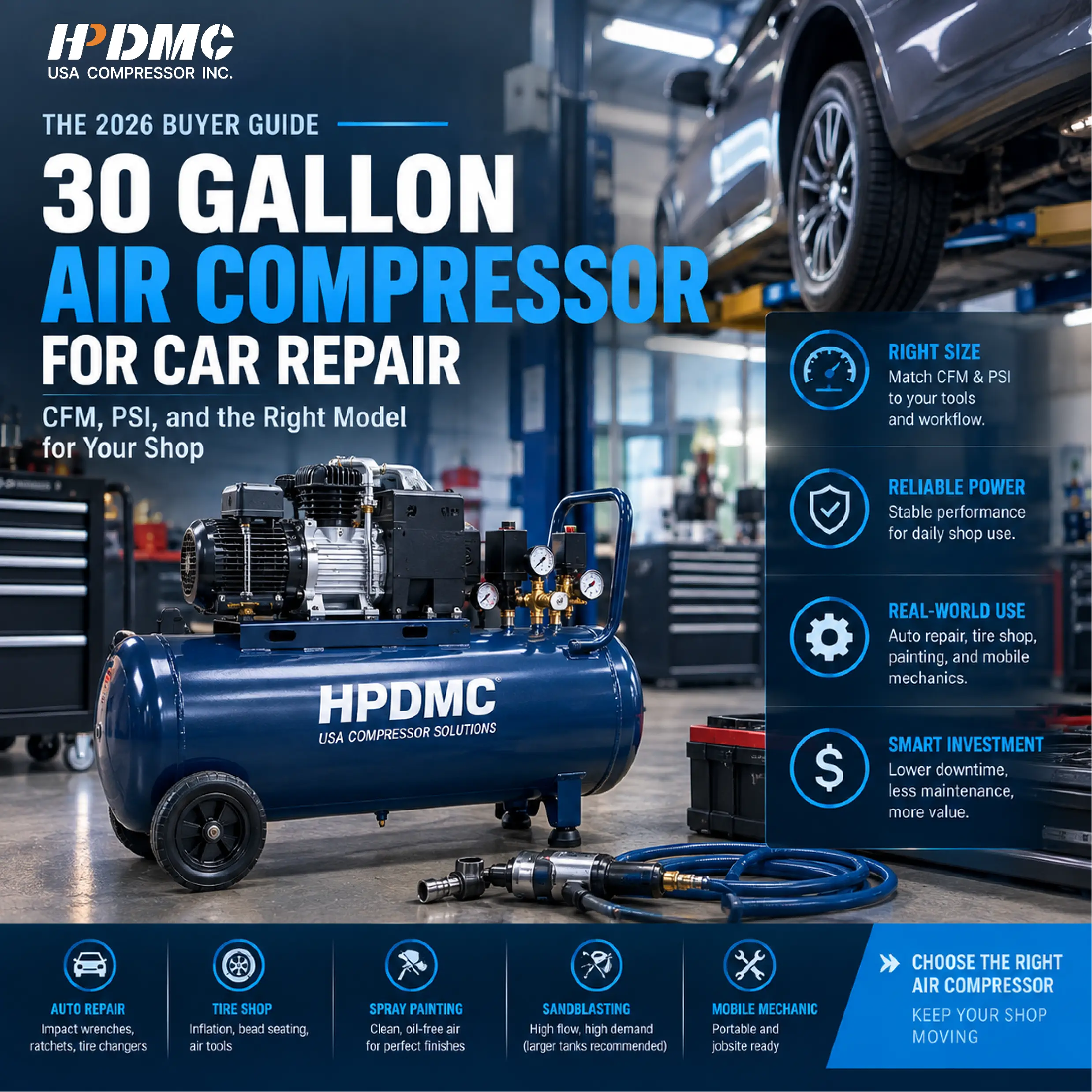
🔧 A working auto repair shop runs impact wrenches, ratchets, blow guns, and sometimes a tire changer — often two tools at once. A 30-gallon tank gives you roughly 7–9 cubic feet of stored air at 175 PSI, which translates to about 30–40 seconds of continuous impact-wrench use before the pump kicks in. That is enough to break loose a stubborn lug nut, run a ratchet for a full bolt removal, and blow down a brake rotor without stopping. A smaller 8–10 gallon tank will deplete mid-job and force you to wait; a 60–80 gallon tank is overkill for a 1–2 bay shop and takes up valuable floor space.
1.2 30 Gallon Air Compressor for Tire Shop
🛞 A tire shop has a specific demand pattern: short, high-flow bursts for bead seating and inflation, with long idle periods between. A 30 gallon air compressor handles this perfectly — the tank absorbs the spike when the bead seater fires, and the pump refills during the idle time. A typical bead seater needs 15–20 CFM for 3–5 seconds; a 30-gallon tank at 175 PSI stores enough reserve for 3–4 consecutive bead seats before recovery. For a high-volume tire shop running 2–3 bays, you may need to step up to a 60-gallon tank or add a second 30-gallon unit.
1.3 Portable 30 Gallon Air Compressor for Mobile Mechanic
🚐 A mobile mechanic needs air that goes where the vehicle is — not the other way around. A portable 30 gallon air compressor with a 13 HP gas engine gives you shop-grade air on a job site, in a driveway, or on the side of the road. No extension cords, no 230V wiring, no waiting for the customer to find an outlet. The trade-off is fuel: a 13 HP gas engine burns about 0.5–0.7 gallons/hour at full load. For a mechanic doing 3–4 jobs/day, that is under $5 in fuel — far less than the cost of turning away a job because you cannot power your tools.
1.4 30 Gallon Air Compressor for Spray Painting in a Body Shop
🎨 A body shop doing automotive paint work needs steady, pulsation-free air at 15–25 CFM for an HVLP gun. A 30-gallon tank alone is not enough — you need a compressor rated for at least 15 CFM at 90 PSI continuous, plus a water trap and regulator. For clearcoat work where oil contamination ruins the finish, pair the compressor with an oil-free pump or an inline coalescing filter.
1.5 30 Gallon Air Compressor for Sandblasting (With a Caveat)
⚠️ Sandblasting is the one scenario where a 30-gallon compressor hits its limit. A pressure-pot blaster with a 1/4-inch nozzle consumes 40–50 CFM at 90 PSI continuously. A 30-gallon tank will deplete in about 20 seconds, and the pump — even a 13 HP gas engine — cannot refill fast enough to keep up. You can do light media blasting (soda blasting, small parts) in short bursts, but for production sandblasting you need to move up to a 60+ gallon tank or a rotary screw compressor rated for 100% continuous duty.
2. How to Size a 30 Gallon Air Compressor for Car Repair
Tank size is only half the equation. The CFM and PSI ratings of the pump matter just as much — arguably more. Here is how to match all three to your shop.
2.1 Calculate Your CFM Demand
📏 List every air tool you plan to run, find the highest CFM requirement, then multiply by 1.25 for a safety margin. Common auto repair tools:
●• Impact wrench (1/2" drive): 4–6 CFM at 90 PSI
●• Air ratchet (3/8" or 1/2"): 3–5 CFM at 90 PSI
●• Tire changer (bead breaker): 4–6 CFM at 90 PSI
●• Blow gun / air blow: 2–4 CFM at 90 PSI
●• HVLP spray gun: 15–25 CFM at 90 PSI
●• Die grinder: 8–12 CFM at 90 PSI
For a single-bay shop running one impact wrench + one ratchet simultaneously (4 + 3 = 7 CFM), you need a compressor rated for at least 9 CFM at 90 PSI. A two-stage 30-gallon unit delivering 24 CFM at 175 PSI has plenty of headroom. A single-stage delivering 44 CFM at 115 PSI can handle two bays.
2.2 Choose Single-Stage vs Two-Stage
⚙️ Single-stage compressors compress air in one piston stroke, maxing out around 115–135 PSI. They deliver more CFM but at lower pressure. Two-stage compressors use two pistons to reach 175 PSI — higher pressure means more stored air in the same tank, which means longer tool run time between pump cycles. For auto repair, two-stage is generally the better choice: the higher pressure gives you more reserve in a 30-gallon tank and handles stubborn bolts more effectively.
2.3 Gas vs Electric: Which Drive for Your Shop?
⚠️ The drive choice comes down to one question: Does your shop have reliable wall power?
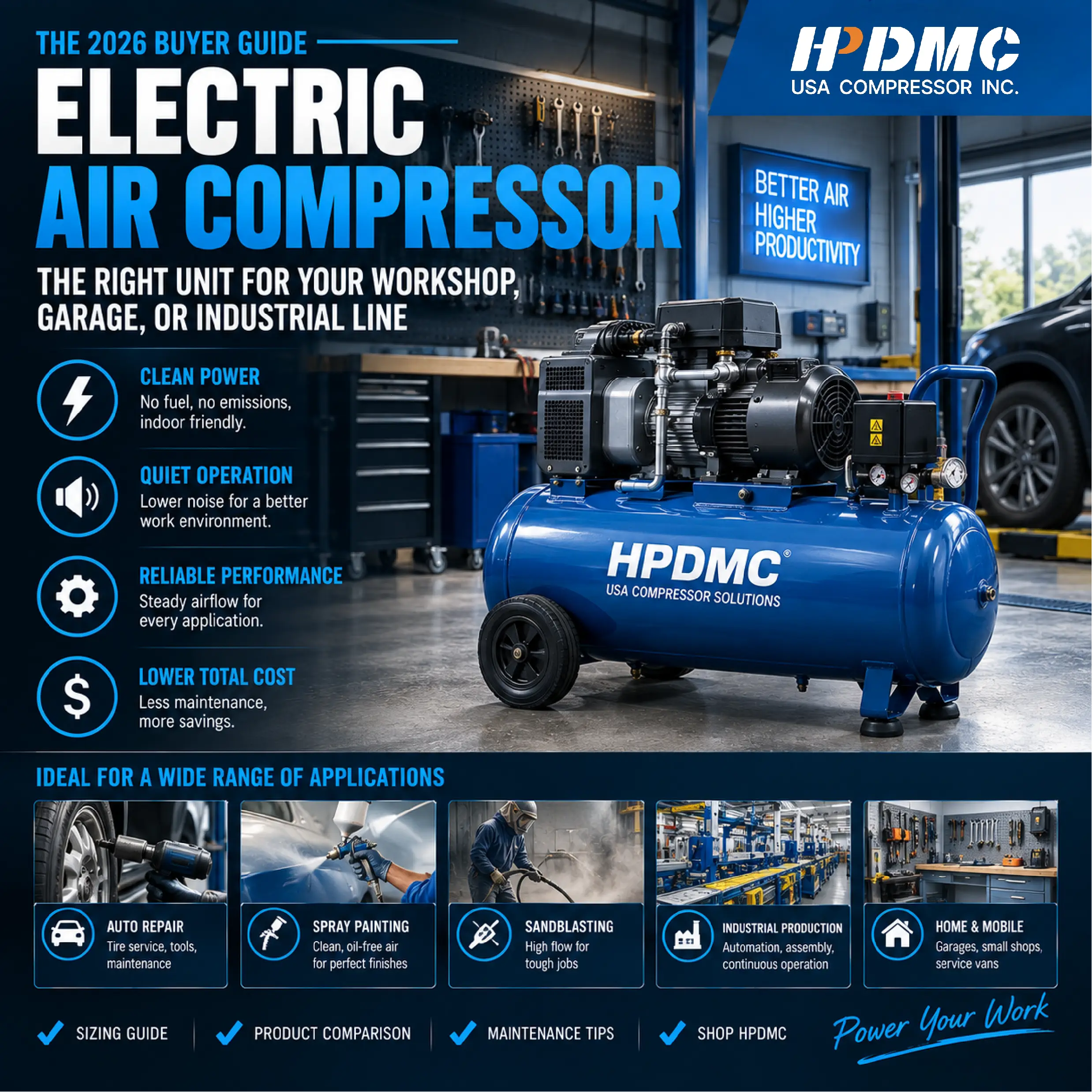
✅ Electric (230V single-phase): Best for a fixed shop with wall power. Quieter (70–80 dB), zero fuel cost, zero emissions indoors, lower maintenance. But you need a 230V circuit — a standard 110V household outlet cannot run a 30-gallon compressor.
✅ Gas (13 HP engine): Best for mobile mechanics, remote sites, and shops without 230V power. Fully portable, no cords, no electrician needed. But louder (85–95 dB), requires fuel, and must be operated outdoors or in a very well-ventilated area due to carbon monoxide.
For a detailed comparison of gas vs electric drive systems for mobile businesses, see our article on air compressor with generator vs standalone.
3. Product Comparison: Three 30-Gallon Models for Car Repair
📊 Here are three HPDMC 30 gallon air compressors built for car repair work. All feature ASME-certified 30-gallon horizontal tanks and 13 HP gas engines — the configuration most mobile mechanics and shops without 230V power choose.
| Model | Stage | Max PSI | CFM | Best For |
|---|
| HSJQY209008 | Two-Stage | 175 PSI | 24 CFM | General auto repair, impact wrenches |
| HSJQY309012 | Single-Stage | 115 PSI | 44 CFM | High-flow: tire shop, bead seating |
| HSJQY051800 | Single-Stage | 115 PSI | 13 CFM | Light duty, mobile mechanic |
4. Which 30 Gallon Air Compressor Fits Your Shop?
4.1 For a 1–2 Bay Auto Repair Shop
🔧Two-Stage Portable Gasoline Piston Air Compressor — HSJQY209008 — 30-gallon ASME tank, 13 HP gas engine, two-stage pump delivering 24 CFM at 175 PSI. This is our most recommended model for a working auto repair shop. The two-stage pump reaches 175 PSI, giving you more stored air in the same 30-gallon tank and longer tool run time between cycles. 24 CFM comfortably handles an impact wrench, ratchet, and blow gun simultaneously across 1–2 bays.
4.2 For a High-Flow Tire Shop
🛞One-Stage Portable Gasoline Piston Air Compressor — HSJQY309012 — 30-gallon ASME tank, 13 HP gas engine, single-stage pump delivering 44 CFM at 115 PSI. This is the high-flow option. Single-stage sacrifices maximum pressure (115 PSI vs 175 PSI) but nearly doubles the CFM output. For a tire shop running bead seaters, tire changers, and inflation guns back-to-back, the extra CFM matters more than the extra pressure.
4.3 For a Mobile Mechanic or Light-Duty Shop
🚐Gasoline Power Piston Air Compressor — HSJQY051800— 30-gallon ASME tank, 13 HP gas engine. A solid, no-frills 30-gallon unit for a mobile mechanic who needs reliable air for impact wrenches, inflators, and blow guns on the road. Lighter and simpler than the two-stage model, it trades maximum CFM for portability and ease of maintenance. Ideal for a single-bay mobile setup or as a backup unit in a larger shop.
5. Frequently Asked Questions
Is a 30 gallon air compressor enough for a car repair shop?
💡 For a 1–2 bay shop, yes. A 30-gallon tank at 175 PSI stores about 7–9 cubic feet of compressed air — enough to run an impact wrench through a full wheel-off cycle, a ratchet through a bolt removal, and a blow gun to clean a brake rotor without the pump cycling more than once per job. For 3+ bays or continuous-use tools like sandblasters, you should step up to a 60-gallon tank or add a second 30-gallon unit.
Can I use a 30 gallon air compressor for spray painting cars?
Yes, with the right pump and filters. An HVLP spray gun needs 15–25 CFM at 90 PSI continuous. A two-stage 30-gallon compressor delivering 24 CFM at 175 PSI can sustain an HVLP gun — but you must add a water trap and coalescing filter to remove moisture and oil from the air line. For clearcoat work, consider an oil-free pump to eliminate the risk of oil carryover ruining the finish. See our 30-gallon compressor application guide for a detailed breakdown of painting, woodworking, and automotive use cases.
Gas or electric for a 30 gallon compressor in my shop?
If your shop has a 230V circuit, go electric — it is quieter, cheaper to run, and produces no exhaust. If you are a mobile mechanic or your shop only has 110V household power, a 13 HP gas engine is the practical choice. All three HPDMC models featured in this article are gas-powered because most mobile and field repair applications do not have access to 230V power. For a comparison of gas vs electric drive options for mobile businesses, see our article on compressor with generator vs standalone.
How loud is a 13 HP gas air compressor?
🔊 A 13 HP gas engine compressor runs at approximately 85–95 dB at 1 meter — comparable to a lawn mower. OSHA requires hearing protection above 85 dB for sustained exposure. Always wear ear protection when operating a gas compressor, and position the unit at least 10 feet from the work area with the exhaust pointing away. Electric compressors of similar capacity run at 70–80 dB — quieter, but still loud enough to warrant ear protection during extended use.
What size 30 gallon compressor do I need for a 2-bay tire shop?
A 2-bay tire shop running a tire changer, bead seater, and inflation gun needs approximately 15–20 CFM at 90 PSI sustained. The HSJQY309012 (44 CFM at 115 PSI) is the better choice here — the high CFM output handles back-to-back bead seating without tank depletion. The HSJQY209008 (24 CFM at 175 PSI) also works for a lighter-volume 2-bay shop. For sizing help specific to your shop, contact our engineering team for a free review.
Ready to Choose Your 30 Gallon Air Compressor?
Tell us about your shop — how many bays, what tools you run, and whether you have 230V power or need gas. An HPDMC application engineer will match the right 30 gallon air compressor for car repair to your actual daily demand.
🛒 Get a Free Sizing Review · Browse Product Catalog
✔️ Free consultation · ✔️ ASME-certified tanks · ✔️ 24-hr shipping from LA / Chicago