1. Why Electric? Five Real-World Scenarios Where It Wins
1.1 Electric Air Compressor for Auto Repair
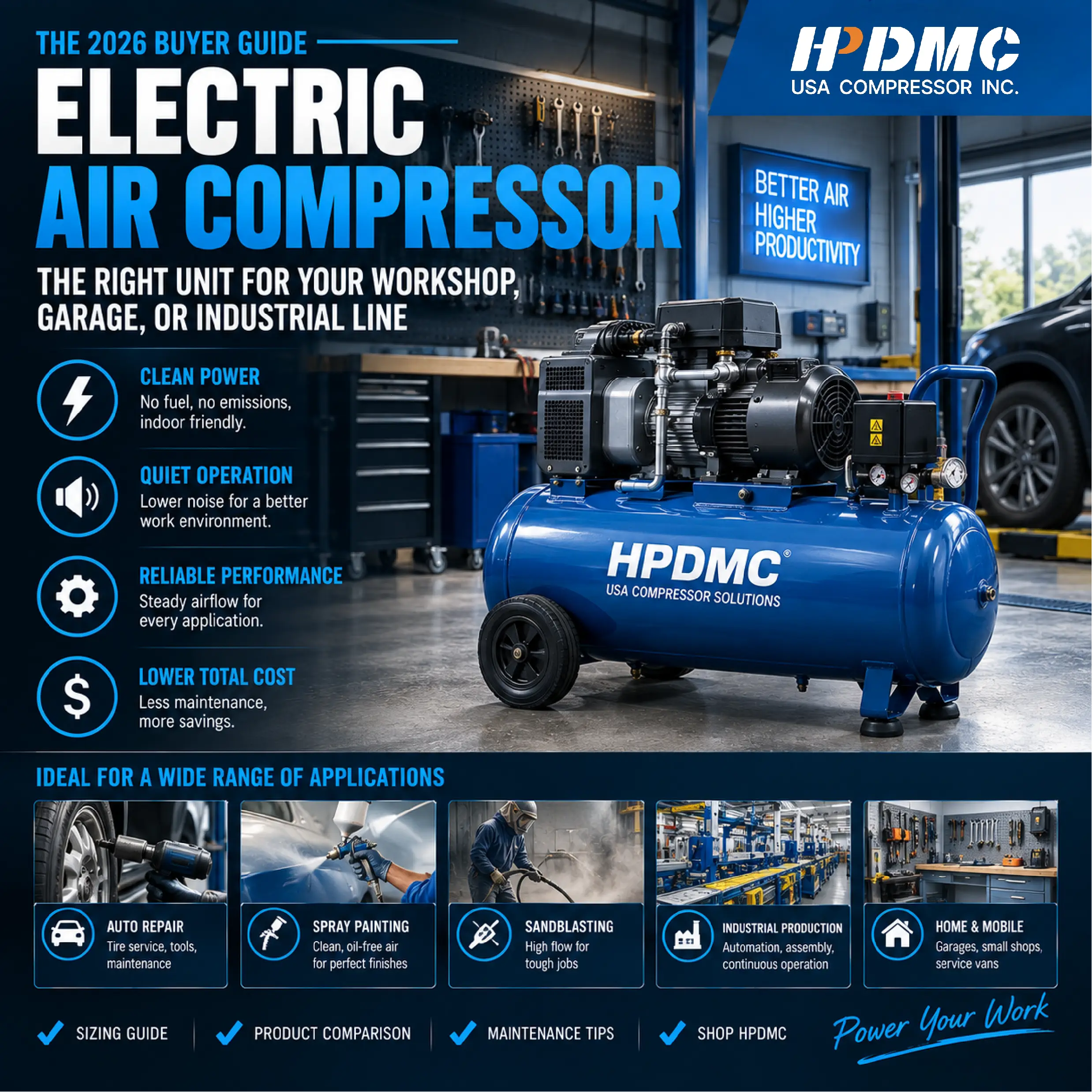
🔧 An auto repair shop runs impact wrenches, ratchets, tire changers, and blow guns — often simultaneously. A typical bay needs 15–25 CFM at 90 PSI sustained. A portable electric air compressor plugged into a 230V outlet handles this cleanly: no fuel storage, no oil changes on the power side, no carbon monoxide in the bay. For multi-bay shops, a larger electric rotary screw compressor (like our PM VSD 50 HP screw compressor) delivers 245 CFM continuously — enough for 4–6 bays with zero idle downtime.
1.2 Electric Air Compressor for Spray Painting
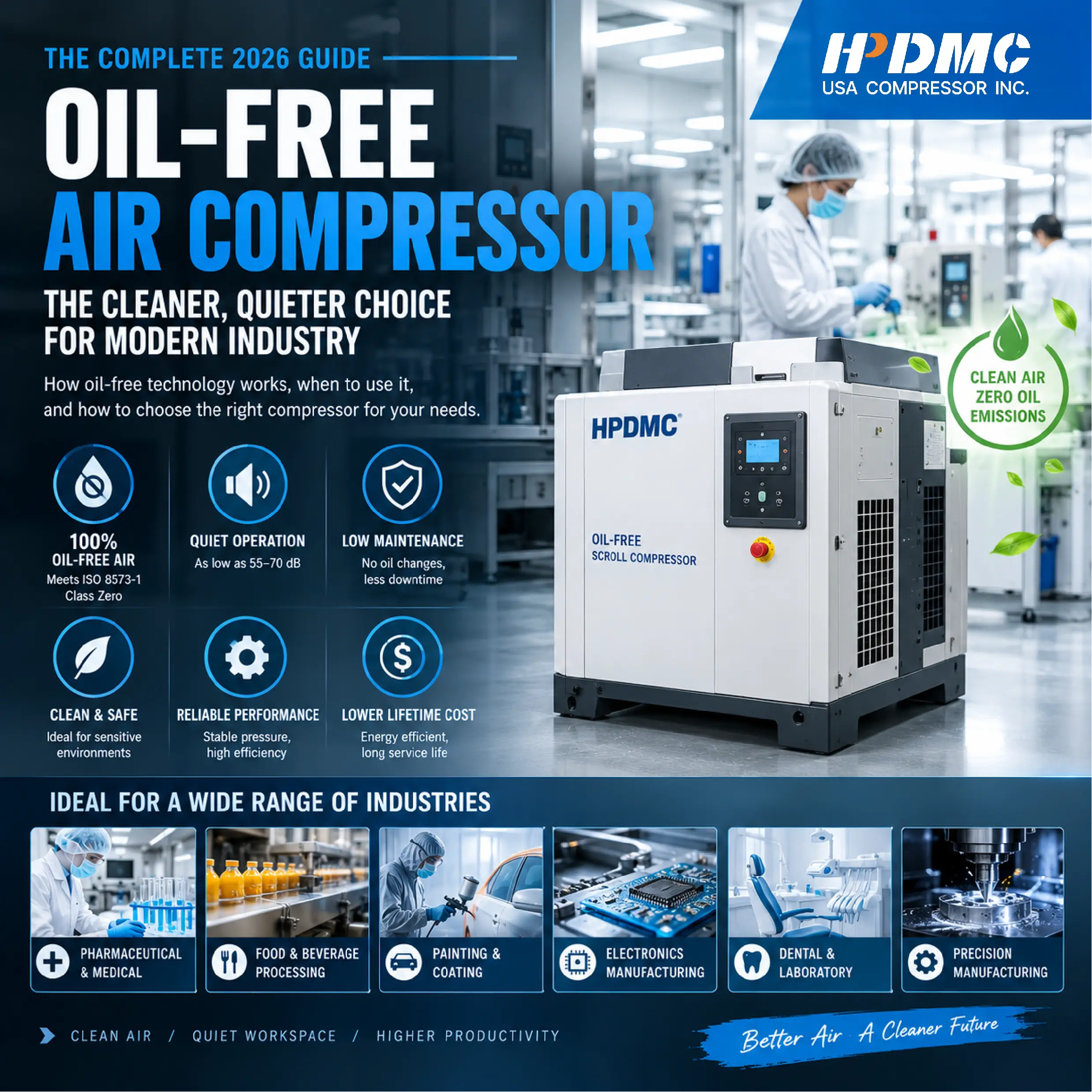
🎨 Spray painting — whether automotive clearcoat, cabinet lacquer, or furniture finish — demands steady, pulsation-free, oil-free air. Gas compressors introduce vibration, exhaust fumes, and oil carryover, all of which ruin a paint job. An electric oil-free compressor delivers smooth, clean air without any of those problems. For a home paint booth or small body shop, a quiet electric unit at 5 CFM (AWR800-18LM2, 110V, 65 dB) is enough for an HVLP gun; for a production paint line, step up to a scroll or screw unit.
1.3 Electric Air Compressor for Sandblasting
⛏️ Sandblasting is the single most air-hungry application in any shop. A pressure-pot blaster consumes 40–100 CFM at 90 PSI depending on nozzle size. A small piston electric unit will not keep up — the tank will deplete in seconds and the compressor will run continuously past its duty cycle. For sandblasting, you need either a large two-stage piston compressor (20+ HP, 460V) or an electric rotary screw compressor rated for 100% continuous duty. This is one scenario where "bigger is genuinely better" — undersizing here means stopping every 30 seconds to wait for tank recovery.
1.4 Electric Air Compressor for Tire Shop
🛞 A tire shop runs tire changers, bead seaters, and inflation guns intermittently — the duty cycle is low but the peak demand spikes. A 5–10 HP electric piston unit at 230V is the sweet spot: enough tank reserve for burst demand, quiet enough for indoor retail, and zero fuel cost. The AWR600-9L portable electric compressor (110V, 9L tank, under 60 dB) is ideal for a single-bay tire shop that needs clean, quiet air for inflation and bead seating without disturbing customers.
1.5 Portable Electric for Home and Mobile Jobs
🏠 A home garage or a mobile service van needs air that works wherever a standard wall outlet exists. A 110V electric air compressor plugs into any household receptacle — no 230V wiring, no fuel can, no exhaust. The AWR600-9LM2 ultra-quiet unit (110V, 1 phase, 4 CFM, 2.5-gallon tank) draws under 15 amps and runs finish nailers, staple guns, and tire inflators at under 60 dB. For a deeper comparison of electric vs gas-powered portable options, read our article on air compressor with generator vs standalone — it walks through the trade-offs of electric, gas, and hybrid drive systems for mobile businesses.
2. How to Size an Electric Air Compressor
Sizing an electric air compressor comes down to three numbers: CFM, duty cycle, and voltage. Get all three right and the compressor will serve you for a decade. Get any one wrong and you will be returning it within a month.
2.1 Match CFM to Your Most Demanding Tool
List every tool you plan to run, find the highest CFM requirement among them, then multiply by 1.25 for a safety margin. A framing nailer needs 3–5 CFM, an impact wrench 4–6 CFM, an HVLP spray gun 4–8 CFM, a die grinder 8–12 CFM, a sandblaster 40–100 CFM. A shop running an impact wrench plus a ratchet (5 + 3 = 8 CFM) needs a compressor rated for at least 10 CFM at 90 PSI.
2.2 Match the Voltage to Your Power Supply
⚠️ This is where most buyers get stuck: a 110V household circuit can safely deliver about 15 amps — enough for compressors up to roughly 2 HP. Above 2 HP, you need a 230V single-phase circuit (like an electric dryer outlet). Above 10 HP, you need 460V three-phase power, which is typically only available in commercial and industrial buildings. Never try to run a 460V compressor on a 230V circuit, or a 230V compressor on a 110V circuit — the motor will burn out. Check your panel before you buy.
2.3 Choose the Right Duty Cycle
Duty cycle is the percentage of time a compressor can run without overheating. A 50% duty cycle means 30 minutes on, 30 minutes off per hour. For intermittent use (nailing, inflating, tire work), a 30–50% duty cycle piston compressor is fine. For continuous-demand tools (sandblasting, grinding, spray production lines), you need a 100% duty cycle rotary screw or scroll compressor — piston units will overheat and trip their thermal protector within 15 minutes of continuous load.
👉 For a broader overview of all compressor types and how they compare, see our Air Compressor Products Complete Guide
3. Electric vs Gas: A Quick Decision Table
Not sure if electric or gas is right for your site? Here is the short version:
✅ Choose electric if: you have wall power, you work indoors, you care about noise (under 70 dB), you need clean oil-free air, or you want zero fuel/maintenance cost on the power side.
✅ Choose gas if: you work at remote sites with no grid power, you need high CFM in a truly portable package, or you run framing crews on new construction with no permanent power yet.
💡 Key insight: for 80% of workshops, garages, tire shops, dental offices, and small manufacturing lines, electric is the correct choice. Gas only wins when portability and grid independence outweigh everything else.
4. Frequently Asked Questions
Can I run an electric air compressor on a household 110V outlet?
Yes, up to about 2 HP. Compressors like the AWR600-9L and AWR600-9LM2 are designed specifically for 110V / 15-amp household circuits. Above 2 HP, the amp draw exceeds what a standard receptacle can handle continuously, and you will need a 230V circuit.
How much does it cost to run an electric air compressor?
Electricity cost depends on motor HP and run hours. A 1 HP electric motor draws roughly 1 kW. At the US average industrial rate of $0.12/kWh, a 1 HP compressor running 4 hours/day costs about $0.48/day or $175/year. A 50 HP industrial screw compressor running 8 hours/day costs about $48/day or $17,500/year — but VSD (variable speed drive) technology like our PM VSD 50 HP cuts that by 25–35% by matching motor speed to actual air demand.
Is an electric air compressor quieter than a gas one?
Significantly. An electric piston compressor runs at 55–70 dB at 1 meter; a gas-powered unit of the same capacity runs at 75–95 dB. The difference is not just comfort — OSHA requires hearing protection above 85 dB, so a quieter electric unit can be operated indoors without earplugs. Oil-free electric units like the AWR800-18LM2 run at 65 dB, quieter than a normal conversation.
Can I use an electric air compressor outdoors on a job site?
Yes, if you have a generator or site power. But if the site has no grid power at all, a gas compressor is more practical — you are essentially using the gas engine as a portable power source. See our article on compressor with generator vs standalone for a detailed comparison of the two approaches for mobile businesses.
What size electric air compressor do I need for a 2-bay auto repair shop?
A 2-bay shop running impact wrenches, ratchets, and a tire changer needs approximately 20–30 CFM at 90 PSI with at least a 60-gallon tank. This typically means a 5–7.5 HP electric piston compressor at 230V single-phase, or a small rotary screw unit. Browse the full HPDMC product catalog for models in this range, or contact us for a free sizing review.
5. Product Recommendations: Which Electric Air Compressor Fits Your Job?
Based on the scenarios above, here are four HPDMC electric air compressors that cover the full range — from a 110V home unit to a 460V industrial screw system. Compare them at a glance:
| Model | Voltage | CFM | Tank / Output | Best For |
|---|
| AWR600-9L | 110V 1-Phase | ~4 CFM | 9L tank | Home garage, DIY |
| AWR600-9LM2 | 110V 1-Phase | 4 CFM | 2.5 gal tank | Spray painting, airbrush |
| AWR800-18LM2 | 110V 1-Phase | 5 CFM | 5 gal tank | Tire shop, multi-tool |
| PM VSD 50 HP | 460V 3-Phase | 245 CFM | Screw, 100% duty | Industrial production |
5.1 For Home Garage and Light DIY
🏠 Ultra Quiet Portable Oil-Free Air Compressor (AWR600-9L) — 110V, 9L tank, under 60 dB. Handles finish nailers, staple guns, tire inflators, and airbrushes. Plugs into any household outlet. Ideal for a home garage or studio where noise matters.
5.2 For Small Workshop and Spray Work
🎨 Ultra Quiet Oil-Free Electric Compressor (AWR600-9LM2) — 110V, 4 CFM, 2.5-gallon tank. Delivers ISO 8573-1 Class Zero oil-free air at 115 PSI. Perfect for HVLP spray guns, airbrushing, and light pneumatic tools in a shared studio or small workshop.
5.3 For Tire Shop and Multi-Tool Garage
🛞 Ultra Quiet Oil-Free Pump 5-Gallon (AWR800-18LM2) — 110V, 5 CFM, 5-gallon tank, 65 dB. Steps up to handle impact wrenches, ratchets, and bead seaters in a single-bay tire shop or serious home garage. Still plugs into a standard outlet.
5.4 For Industrial Production Line
🏭 PM VSD Two-Stage Rotary Screw Air Compressor (50 HP, 460V) — 460V/60Hz/3-phase, 245 CFM at 115 PSI, permanent-magnet VSD motor with IE3 efficiency. This is the unit for multi-bay auto shops, sandblasting cabinets, food processing lines, and manufacturing facilities that need continuous high-volume clean air. The VSD drive cuts energy cost by 25–35% versus fixed-speed compressors.
Ready to Choose Your Electric Air Compressor?
Tell us about your tools, your daily air demand, and your power supply (110V / 230V / 460V). An HPDMC application engineer will match the right electric air compressor to your actual job — whether that is a 110V portable unit for a home garage or a 50 HP VSD screw system for a production line.
🛒 Get a Free Sizing Review · Browse Product Catalog · Visit HPDMC Homepage
✔️ Free consultation · ✔️ Application-matched sizing · ✔️ 24-hr shipping from LA / Chicago · ✔️ ISO 8573-1 Class Zero certified