3. Which Oil Actually Survives a Cold Start?
🛢️ Viscosity is the whole story. ISO VG grades (ISO 3448) rate oil thickness at 40°C; a VG 46 or VG 68 mineral oil that protects beautifully in July turns to cold honey at 20°F. The motor then fights the sump on every start: hard starting, tripped breakers, and a few seconds of dry running before oil reaches the bearings. A synthetic ISO VG 32 flows far sooner at low temperature while keeping its film strength at operating heat.
Our recommendation for unheated shops is HPDMC Synthetic Compressor Oil ISO VG 32 — 5-Gallon Pail: a synthetic rated for 4,000-hour service life, with anti-foam and anti-wear additives, listed for rotary screw units, reciprocating compressors up to 10 HP, vane and vacuum pumps, and CARB-compliant. One pail covers a season of oil changes for a small fleet. The full viscosity and compatibility reasoning — including which compressors should never share oil — is in our guide to oil for air compressors.
Two honest limits: oil grade does not lower the freezing point of water — a VG 32 sump will not save a tank full of condensate; and always confirm the OEM's minimum ambient temperature and viscosity spec before switching, because warranty terms follow the manual, not the internet.
4. How Do You Keep Air Lines and Tools from Freezing?
💨 The receiver is only half the system. The three rules of air compressor cold weather operation: remove water before it can freeze, keep the remaining air dry, and never let a line sit below its dew point in an unheated space.
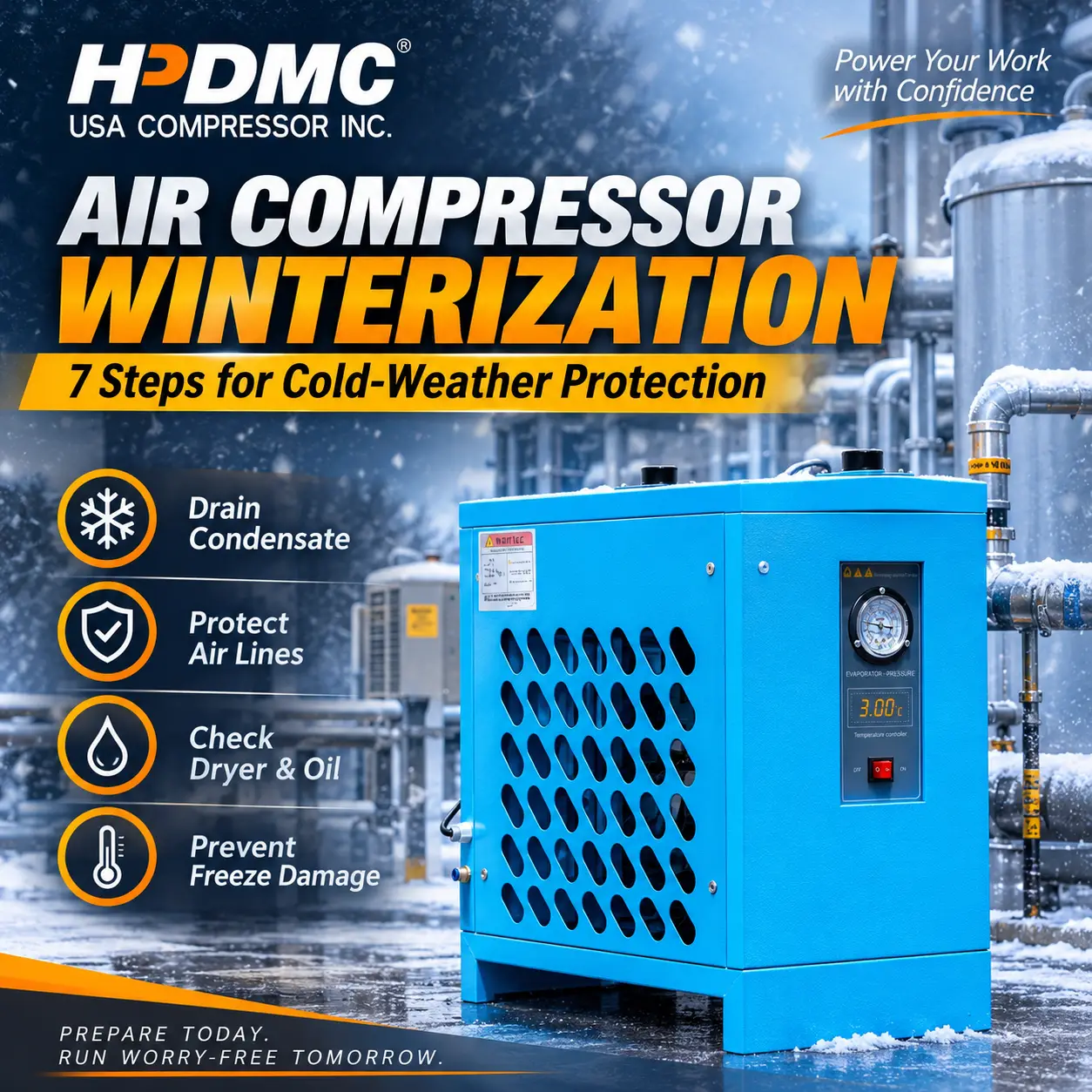
A refrigerated dryer is the workhorse. It chills compressed air so moisture condenses inside the dryer — where a drain removes it — instead of inside your piping. Our refrigerated air dryer guide walks the selection logic against ISO 8573-1 air purity classes; the short version is that a +39°F (4°C) pressure dew point protects lines in any space that stays above freezing.
4.1 Small-Shop Tier — LDGZSE-10A
The Refrigerated Air Dryer LDGZSE-10A is the non-cycling SE-series unit for small-shop compressors: R134a refrigerant, a two-stage heat exchanger, a five-stage centrifugal separator, microprocessor control with start/stop lock, and a zero-loss drain that discharges condensate without wasting compressed air. Rated pressure dew point: +39°F (4°C).
4.2 Larger Tier — LDGZSE-20A
Step up to the Refrigerated Air Dryer LDGZSE-20A when the compressor class grows — the same SE-series architecture and R134a circuit in the larger capacity tier. Match dryer capacity to your compressor's delivered flow at working pressure, not to tank size.
🌡️ The limit nobody should hide from you: a +39°F dew point does not winterize a pipe running through a -10°F yard. Downstream air is dry at 39°F, but any line colder than that can still condense residual moisture, and the dryer's own drain can ice up in an unheated room. For below-freezing runs you need desiccant drying, heat tracing, or both. Size the dryer for the room it lives in, not just the flow.
5. What Belongs on Your Pre-Freeze Checklist?
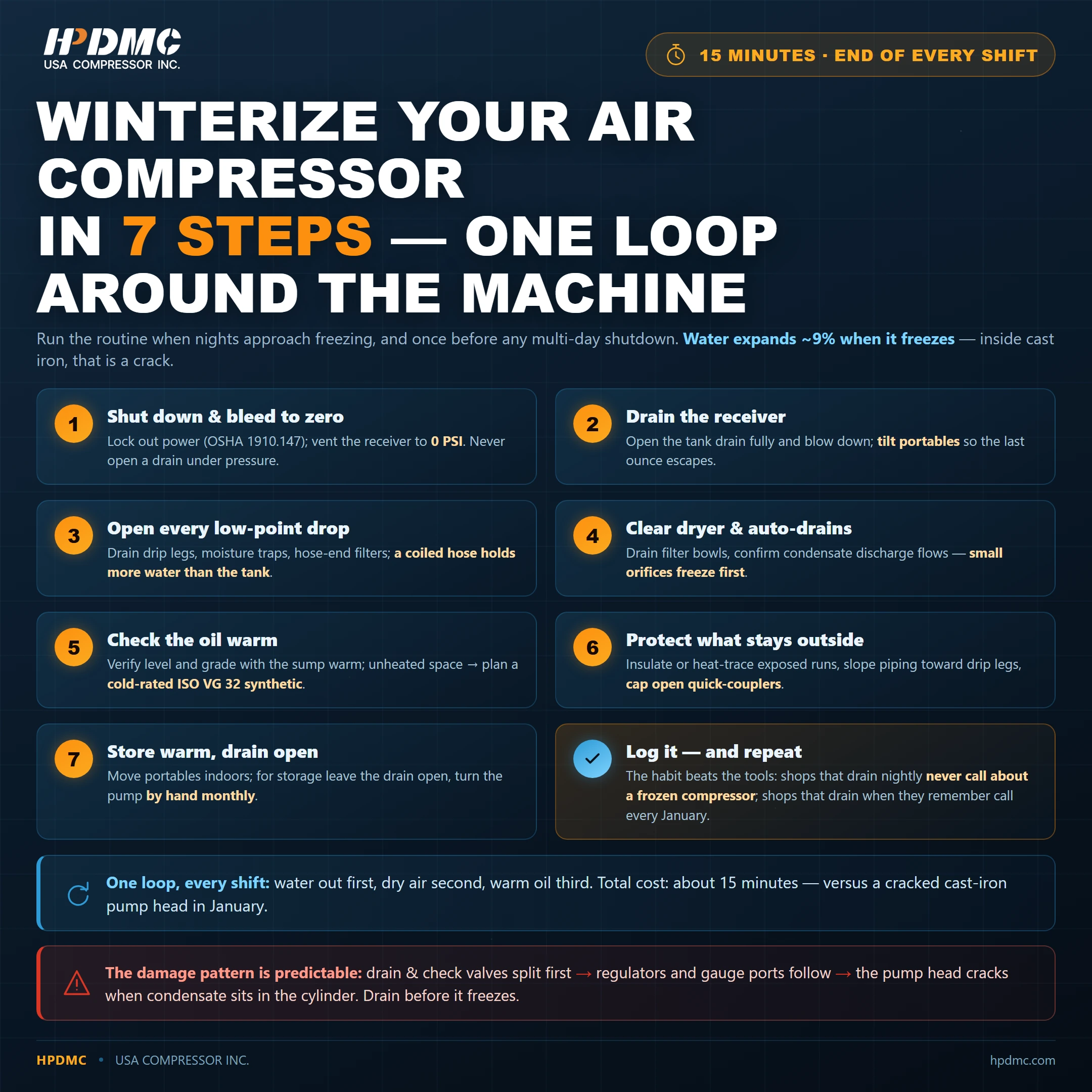
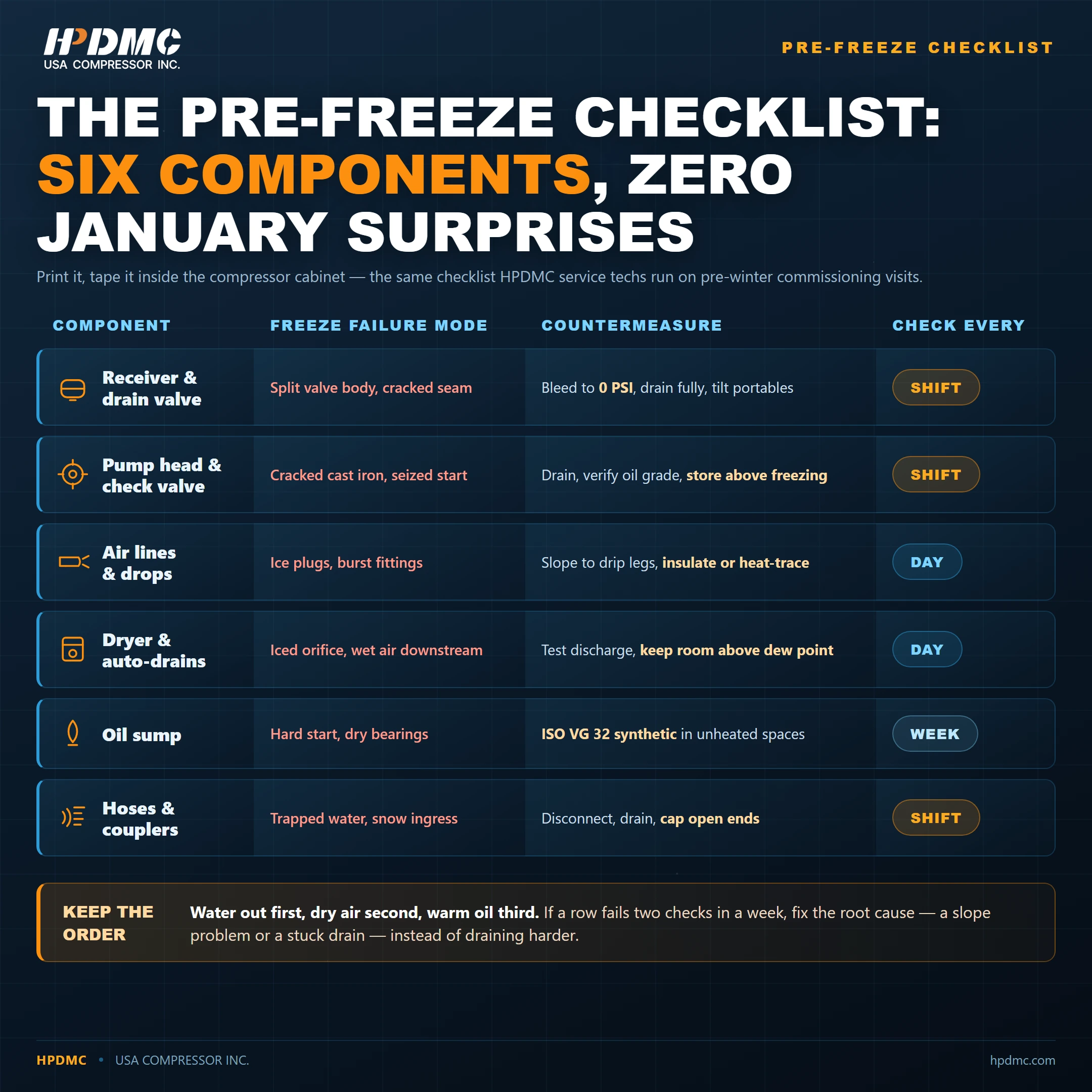
📋 Print this and tape it inside the compressor cabinet. It is the whole air compressor winterization program on one card — the same checklist our service techs run on pre-winter commissioning visits.
| Component | Freeze Failure Mode | Countermeasure | Check Every |
|---|
| Receiver & drain valve | Split valve body, cracked seam | Bleed to 0 PSI, drain fully, tilt portables | Shift |
| Pump head & check valve | Cracked cast iron, seized start | Drain, verify oil grade, store above freezing | Shift |
| Air lines & drops | Ice plugs, burst fittings | Slope to drip legs, insulate or heat-trace | Day |
| Dryer & auto-drains | Iced orifice, wet air downstream | Test discharge, keep room above dew point | Day |
| Oil sump | Hard start, dry bearings | ISO VG 32 synthetic in unheated spaces | Week |
| Hoses & couplers | Trapped water, snow ingress | Disconnect, drain, cap open ends | Shift |
If a row fails two checks in a week, fix the root cause — a slope problem or a stuck drain — instead of draining harder. And keep the order: water out first, dry air second, warm oil third.
6. Frozen Air Compressor FAQ: 5 Questions Owners Ask Every Winter
My compressor already froze overnight — what do I do first?
Do not hit start. Move the unit to a heated space and let it thaw slowly — hours, not a heat gun on cast iron, which can crack it thermally. Once thawed, drain everything, inspect the drain and check valves for splits, and change the oil if it looks milky (water reached the sump). Then start unloaded and listen: knocking or a weeping tank means stop and get it inspected.
Can I leave the tank drain open all winter?
For a machine in storage, yes — an open drain is the cheapest freeze insurance there is. For a machine in daily service, close it after each blowdown and drain at every shutdown; an open drain on a running unit just wastes air and never lets the system build pressure.
Will a refrigerated dryer stop my lines from freezing outside?
Only if the lines stay warmer than the dryer's pressure dew point — around +39°F for the SE series. In a below-freezing yard a refrigerated unit alone is not enough: add insulation and heat trace, or specify desiccant drying for sub-zero dew points. This is the most common winter mis-selection we correct.
Is antifreeze in the tank or lines ever acceptable?
No. Automotive antifreeze is toxic, attacks seals, and contaminates every tool downstream. Air-tool oil in an in-line lubricator is a different product for a different job — it protects tool vanes, not the receiver. The only safe antifreeze for a compressor system is removing the water.
How cold is too cold to start a compressor?
⚠️ Check the manual's minimum ambient first — many splash-lubricated piston units are rated to about 40°F without cold-weather provisions. Below that, warm the space or the crankcase, use the OEM-approved cold-grade oil, and start unloaded. If the motor hums but the pump will not turn, stop immediately: that is thick oil or ice, and continuing burns the motor.
First Freeze Coming — Is Your Air System Ready for It?
Send us your setup — compressor type and HP, where it sits in winter, line runs through unheated spaces, and the tools it feeds. An HPDMC application engineer will map a winterization plan for your exact system, including the honest answer when a refrigerated dryer is not enough and you need desiccant drying or heat trace instead.
🛒 Request a Winterization Check · 🔗 Browse Compressors & Dryers
✔ Spec-sheet data, named standards · ✔ 15-minute routine, 7 steps · ✔ Honest limits in freezing weather