summary
About this guide. Written and reviewed by the HPDMC compressor engineering team, which has specified rotary screw machines for manufacturing plants, multi-bay auto shops, laser-cutting cells, woodworking floors, and packaging lines across 40+ countries since 2004. Every threshold below comes from a published standard or from a machine we have installed and serviced — ISO 1217 for flow measurement, ISO 8573-1 for air purity, ASME Section VIII for receivers, OSHA 1910.95 for noise. No paid placements, and the limits of each machine class are written out.
The question that decides this purchase is not brand or horsepower — it is run-time. An industrial screw air compressor is built for one job: delivering air non-stop at a stable pressure while a piston unit cools between bursts. If your load does not run long enough to need that, the money is better spent elsewhere. This guide shows the arithmetic first, then matches three real screw machines to three real duty profiles. Browse the full range at hpdmc-compressor.com if you want to compare classes before the math.
1. The Run-Time Test That Decides Everything
1.1 Continuous Duty Is the Whole Point
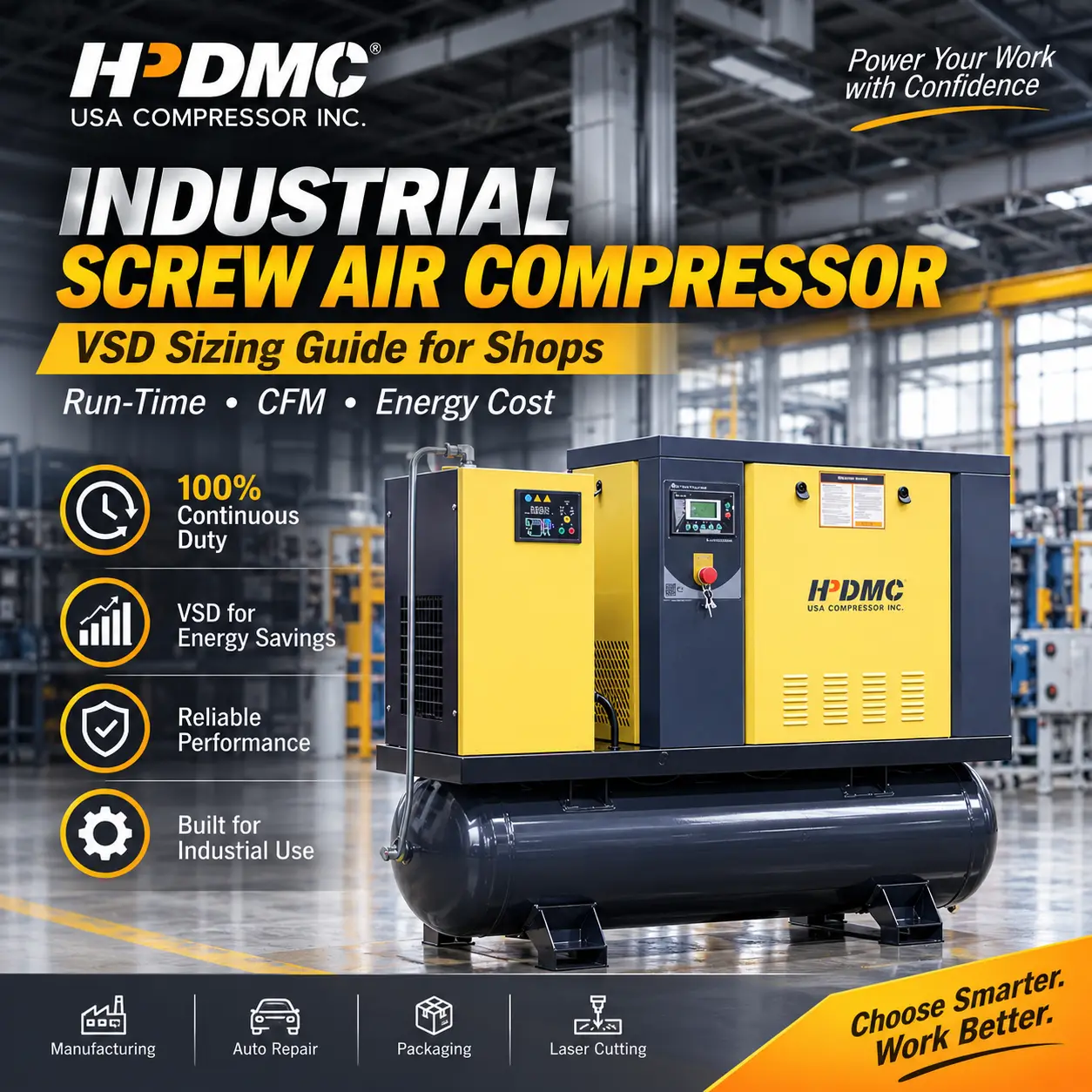
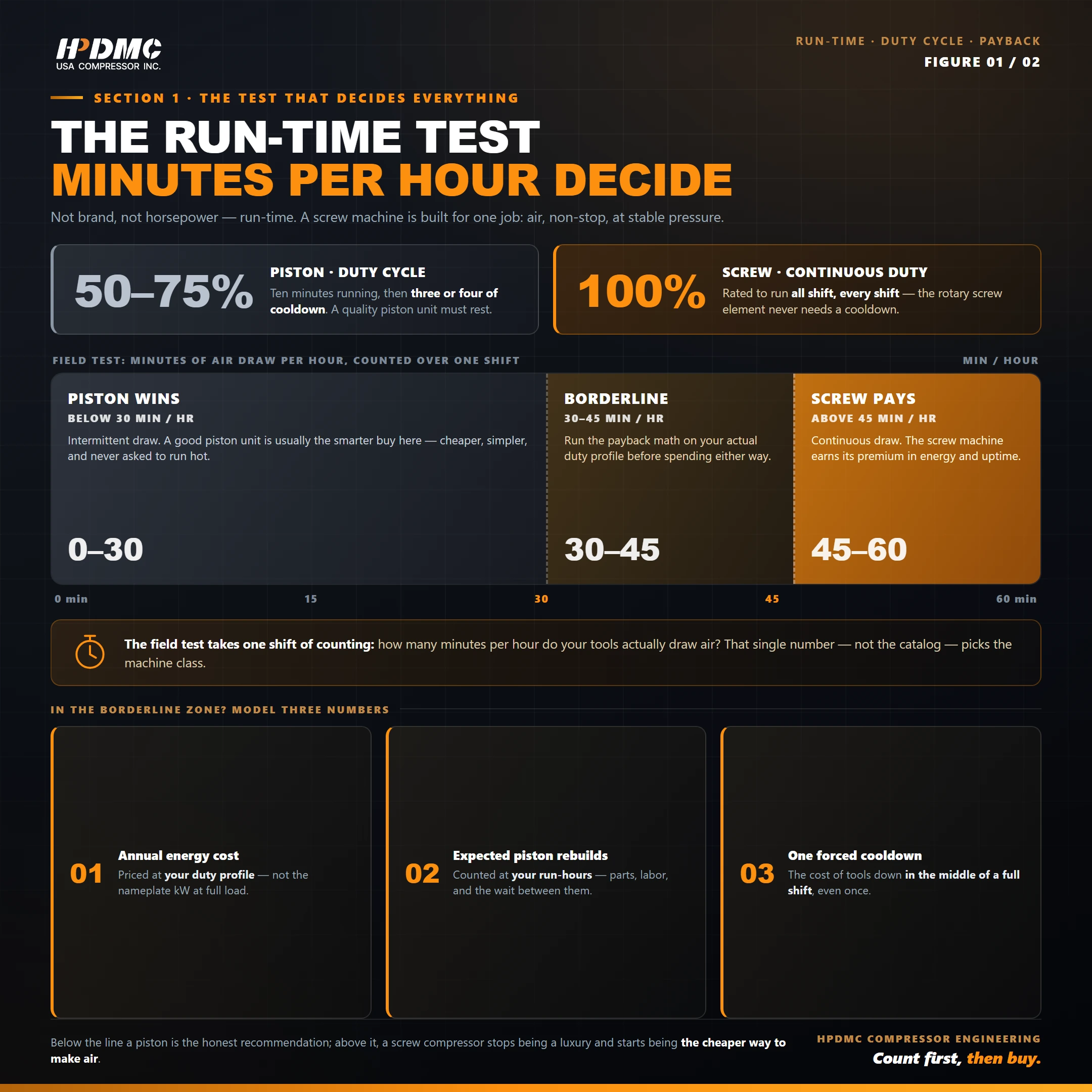
💡 A quality piston compressor is rated for a 50–75% duty cycle: ten minutes of running, then three or four of cooldown. An industrial screw air compressor is rated 100% continuous duty, because two oil-flooded helical rotors compress air in a smooth, pulse-free stream with no reciprocating parts slamming through stop-and-go every revolution. Well-built airends run 40,000+ hours between major overhauls with correct oil and cooler maintenance. That is the engineering behind the word industrial — not a bigger tank.
The field test takes one shift of counting: how many minutes per hour do your tools actually draw air? Below 30 minutes, a good piston unit is usually the smarter buy. Between 30 and 45, it is borderline — price both. Above 45, or for any process that never stops (laser assist air, packaging heads, sandblasting, dust-collection valves), a continuous-duty machine is no longer a luxury; an intermittent unit will overheat, derate, and fail early no matter what the nameplate claims.
2. Size to CFM at Your Working Pressure — Not to Horsepower
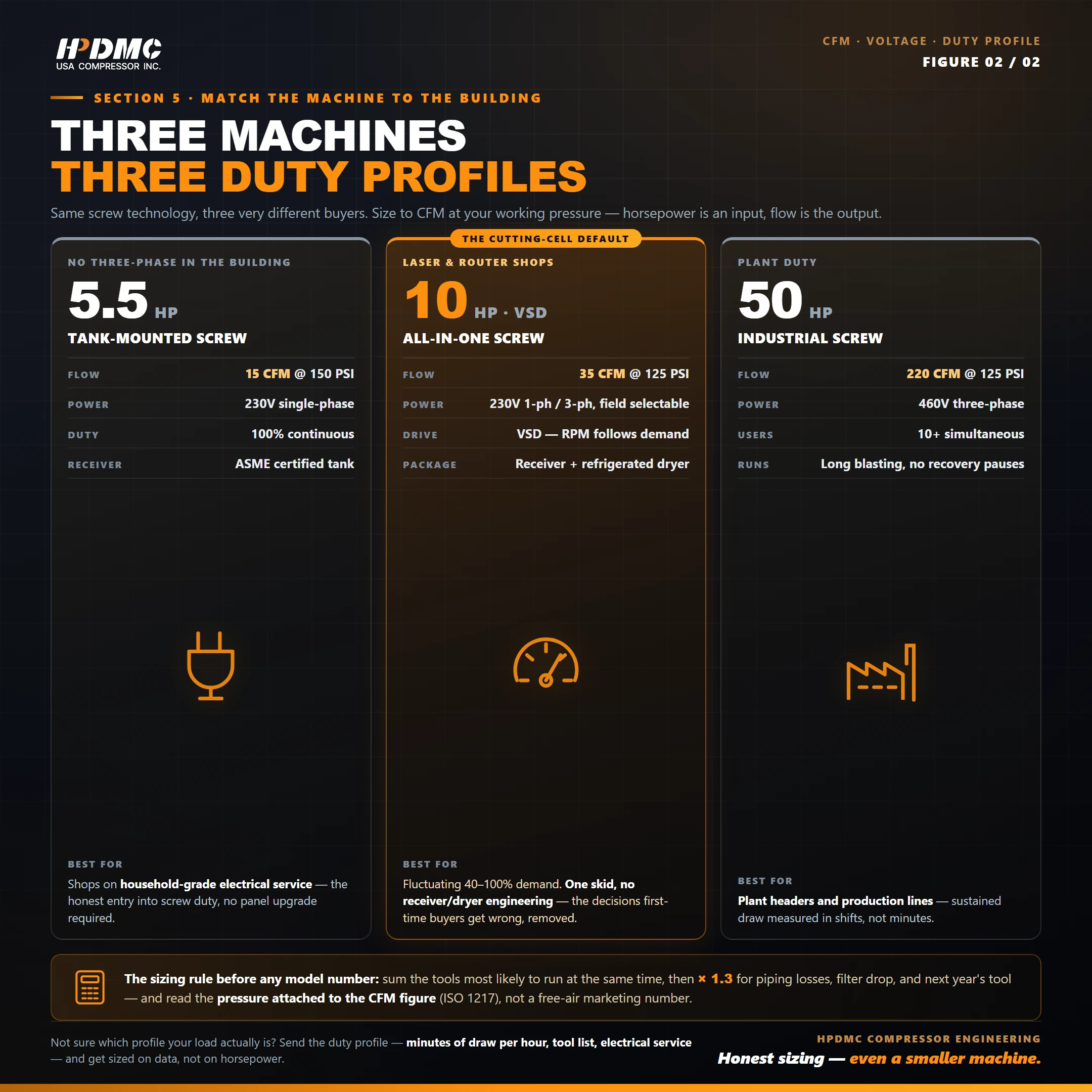
📊 Horsepower is an input; CFM at your pressure is the output you actually use. Demand the flow figure measured to ISO 1217 at the pressure your tools run at, not a free-air marketing number. These are the loads we size most often on shop-floor audits:
| Air Tool or Process | CFM Demand | Working PSI | Screw Machine Class |
|---|
| 2× 1/2-inch impact wrenches (auto shop) | 20 | 90 | 10 HP |
| Blow-gun station (fabrication) | 25–30 | 80 | 10–15 HP |
| Fiber laser cutter, assist air | 15–20 | 95 | 10 HP + dryer |
| CNC router vacuum/air valves ×4 | 30 | 90 | 15 HP |
| Pneumatic packaging heads ×8 | 40 | 90 | 15–20 HP |
| Sandblast cabinet, continuous | 25 | 90 | 15 HP |
Sum the tools most likely to run at the same time, then add 25–30% margin for piping losses, filter pressure drop, and the tool you will buy next year. And read the pressure attached to the number: a machine rated 35 CFM at 125 PSI is a materially different purchase from one quoting 35 CFM free-air. If the tool list lands under 15 CFM with bursty use, stop here and buy the piston unit — an industrial screw air compressor in that service is capital doing nothing.
3. Fixed-Speed, VSD, or All-In-One
3.1 Fixed Speed — Cheapest Buy, Steady Load
⚙️ A fixed-speed screw machine runs the motor at full RPM and modulates with load/unload control. On a demand profile that sits pinned near full load for most of the shift — a blasting operation, a single big consumer — it is the honest choice: lower purchase price, simpler electronics, nothing to lose on a drive card.
3.2 VSD — Where the kWh Money Is
A variable-speed drive matches rotor RPM to actual draw instead of cycling a full-speed motor. On the fluctuating demand of a typical job shop — 40% to 100% swings, quiet mornings, busy afternoons — VSD cuts energy use by 30–50% versus load/unload control. Our teardown of the 125 PSI VSD platform for SMEs covers the BASE controller, intelligent load/no-load logic, and the IP54 TEFC motor in detail. Rule of thumb: if your demand swings, VSD repays the price gap in two to three years of energy; if it never swings, skip it.
3.3 All-In-One — The Installation You Do Not Have to Engineer
An all-in-one packages the screw element, ASME receiver, and refrigerated dryer on one skid. It removes the three decisions first-time buyers get wrong — receiver size, dryer capacity, and the interconnecting piping — and it matters most where wet air is a process defect: laser cutting, spray finishing, and anything touching food packaging.
4. Three Scenes Where a Screw Machine Earns Its Keep
4.1 Laser and CNC Cutting Cells
🛠️ Assist air is a process gas, not a utility. Moisture and oil mist in the beam path ruin cut edges and nozzle life, so specify the pressure band (±2 PSI around setpoint), the dryer dew point, and an ISO 8573-1 class before you compare CFM figures. A 10 HP VSD all-in-one at 35 CFM carries most 1–3 kW fiber machines with headroom, and its enclosed canopy keeps noise low enough to stand next to.
4.2 Woodworking and CNC Router Shops
🪵 Dust is the failure mode here. A screw machine in a shop floor full of airborne chips needs a clean intake location or an upgraded filter, because a clogged air filter raises compression temperature and shortens oil life. Router dust-valve banks, pneumatic hold-downs, and sanders draw steadily through the shift — exactly the profile a continuous-duty airend was designed for.
4.3 Packaging and Bottling Lines
📦 On a packaging line the compressor problem never shows up as a compressor problem — it shows up as rejects: oil carryover on film, moisture in the sealing head, pressure sag during pick-and-place. Specify the purity class the product contact requires, then the filter train, then the machine. Line operators also live next to the equipment, and a 65–75 dBA enclosed screw unit against an 85–90 dBA piston pump is an OSHA 1910.95 conversation, not a comfort preference.