Need Help Choosing the Right Compressor? Contact us
Need Help Choosing the Right Compressor? Contact us
Need Help Choosing the Right Compressor? Contact us

Rotary Screw Air Compressor Sizes Explained: 10 HP, 15 HP, 30 HP & 50 HP
Choosing the right rotary screw air compressor is an important decision for any automotive workshop, manufacturing facility, or industrial operation. The right compressor can provide a reliable supply of compressed air for pneumatic tools, production equipment, and other applications. The wrong one may result in insufficient airflow, unnecessary energy consumption, or higher operating costs.
But how do you know which compressor is right for your business?
Horsepower (HP) is only one part of the equation. You also need to consider airflow (CFM), operating pressure (PSI), electrical supply, air demand patterns, and whether a fixed-speed or variable-speed model is more suitable.
In this guide, we explain how to evaluate these factors, compare common compressor sizes, and choose a rotary screw air compressor that matches your application.
🎯 Planning to upgrade your compressed air system? HPDMC is currently offering limited-time savings on selected rotary screw air compressors. Explore the HPDMC Black Friday Air Compressor Sale to see eligible models and current promotional offers.
1. What Is a Rotary Screw Air Compressor?
A rotary screw air compressor uses two interlocking helical rotors to compress air. As the rotors turn, air enters the compression chamber, becomes trapped between the rotor profiles and housing, and is compressed as the available volume decreases.
Unlike a traditional piston compressor, which produces air through reciprocating piston movement, a rotary screw compressor is designed for applications that require a more continuous supply of compressed air.
Why Choose a Rotary Screw Compressor?
Rotary screw compressors are commonly used in commercial and industrial environments for several reasons:
- Continuous operation: Suitable for applications with sustained compressed air demand when correctly sized and installed.
- Steady air supply: Designed to support production equipment and multiple pneumatic tools.
- Industrial applications: Available in a wide range of power and airflow configurations.
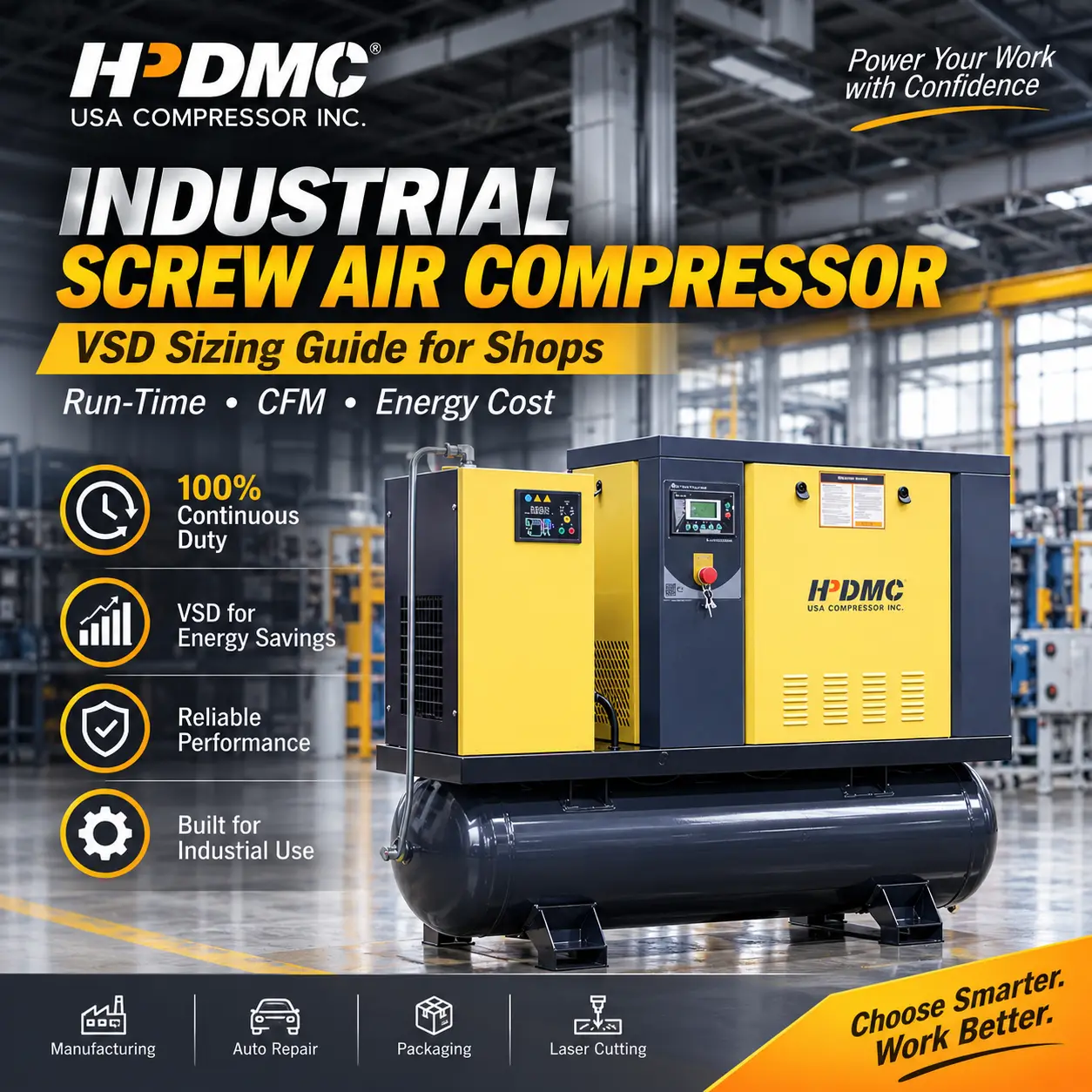
- Flexible control options: Fixed-speed and variable-frequency-drive models can accommodate different operating patterns.
- Compact equipment design: Many packaged models integrate the compressor and control components into a single unit.
💡 Rotary screw compressors are particularly useful when compressed air is an important part of daily operations and a smaller intermittent-duty compressor is no longer sufficient.
2. How to Choose the Right Compressor Size
One of the most common mistakes when purchasing an air compressor is selecting a model based only on horsepower.
Horsepower describes the motor's rated power, but it does not tell you exactly how much usable compressed air the system can deliver. To select the right model, start with your application's airflow and pressure requirements.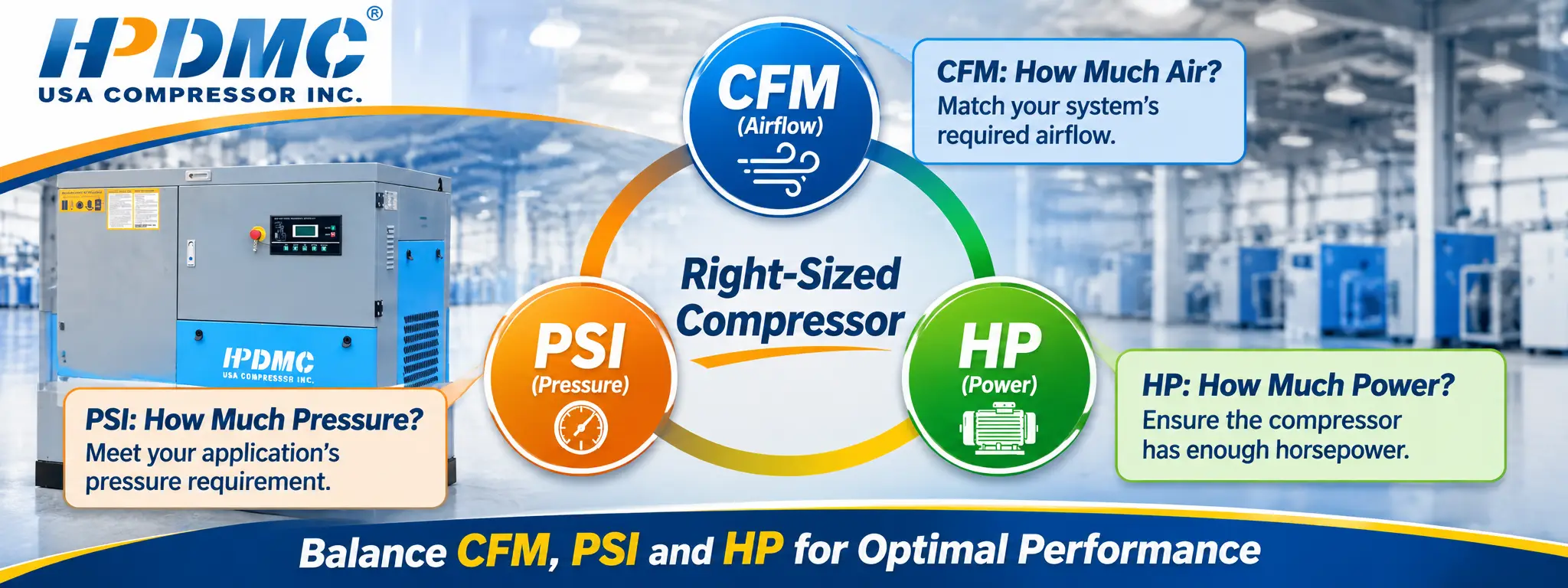
2.1 Calculate Your Required Airflow (CFM)
CFM stands for cubic feet per minute. It measures the volume of air delivered by a compressor.
Before choosing a compressor, make a list of the equipment that will use compressed air.
For example:
- Automotive repair shops may operate impact wrenches, air ratchets, grinders, and tire service equipment.
- Manufacturing workshops may use pneumatic fixtures, assembly tools, and automated production equipment.
- Industrial facilities may operate CNC machines, pneumatic conveying systems, and other air-powered processes.
- Surface preparation operations may require substantial airflow for abrasive blasting equipment.
Add the air consumption of equipment that may operate at the same time. Then account for operating patterns, intermittent demand, and an appropriate reserve capacity.
⚠️ Do not simply add every tool's maximum consumption if they will not operate simultaneously. However, do not underestimate demand either. A compressor that is too small may struggle to maintain the required pressure during busy periods.
💡 Practical tip: Compare the compressor's delivered CFM at the required operating pressure with the total demand of your application. Do not compare airflow figures without checking their pressure ratings.
2.2 Determine the Required Operating Pressure (PSI)
PSI stands for pounds per square inch and measures air pressure.
Different tools and production machines require different operating pressures. Many general pneumatic tools operate around 90 PSI, but some applications require higher pressure.
When selecting a compressor, consider:
- The minimum pressure required by your equipment
- Pressure losses through piping and fittings
- Pressure drops across filters and air dryers
- The distance between the compressor and points of use
- Any pressure requirements specific to your production process
📌 For example, if your equipment needs 100 PSI at the point of use, selecting a compressor rated at 100 PSI may not leave enough allowance for system pressure losses.
Choose a compressor pressure rating that supports your actual system requirements without unnecessarily operating at a higher pressure than needed.
2.3 Match Horsepower to Airflow and Pressure
Horsepower is useful when comparing compressor models, but it should be considered together with CFM and PSI.
Two compressors with the same horsepower rating may have different airflow capacities or pressure configurations.
For example, HPDMC's current selected rotary screw compressor range includes:
- 10 HP models with approximately 35–39 CFM, depending on configuration
- 15 HP models with approximately 56 CFM
- 30 HP models with approximately 112–140 CFM
- 50 HP models with approximately 220 CFM
⚠️ These are examples of listed configurations, not universal airflow ratings for every compressor in each horsepower class. Always compare the specifications of the exact model you intend to purchase.
3. 10 HP vs. 15 HP vs. 30 HP vs. 50 HP: Which Size Is Right for You?
Different businesses have different compressed air requirements. A small automotive workshop does not necessarily need the same compressor capacity as a manufacturing plant operating several machines.
The following comparison provides a starting point for evaluating common HPDMC compressor configurations.
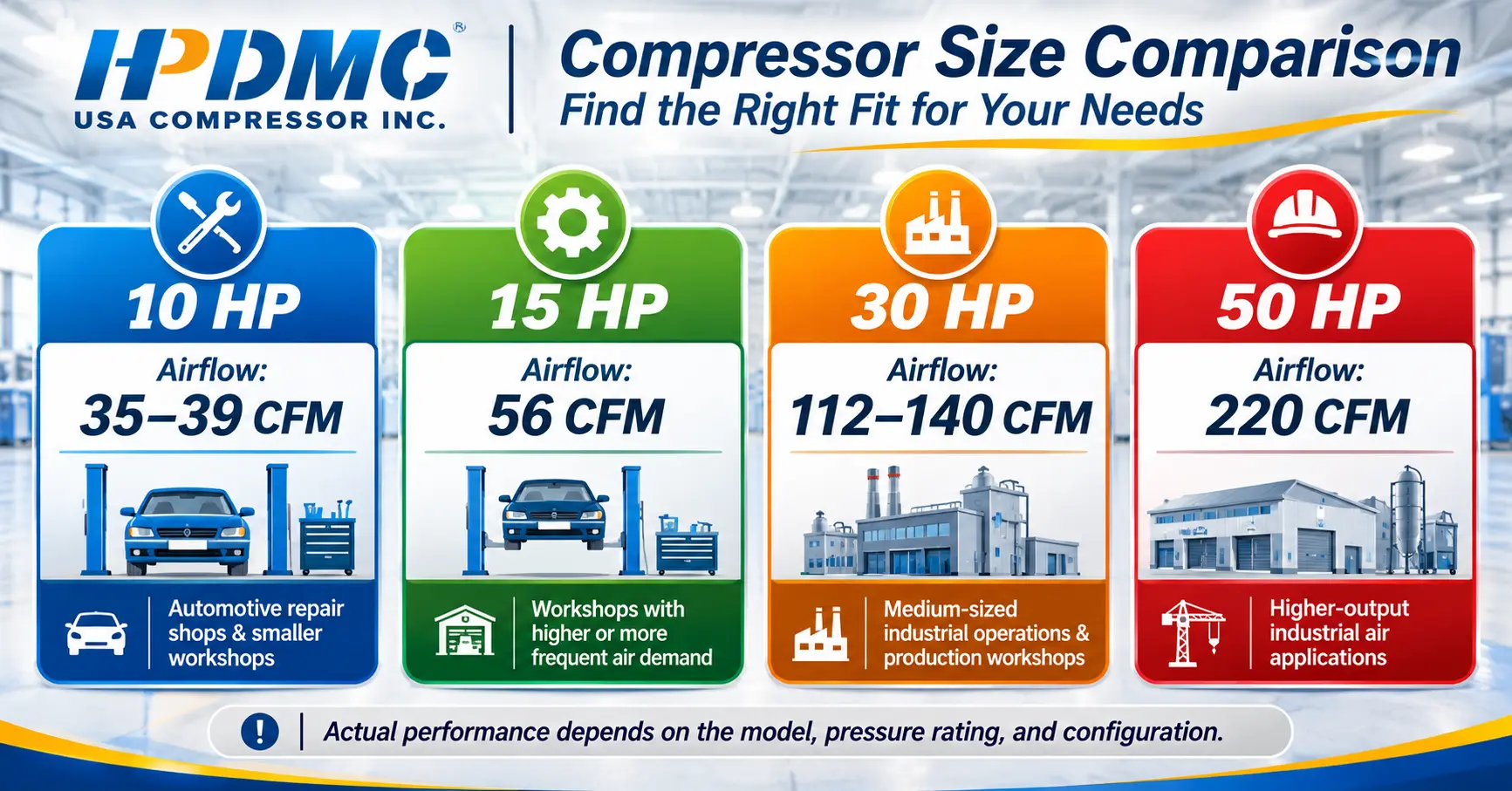
💡 Actual performance depends on the model, pressure rating, and configuration.
3.1 10 HP Rotary Screw Air Compressor: For Small Workshops
A 10 HP rotary screw compressor can be a practical option for smaller commercial operations that need a more consistent air supply than a basic intermittent-duty compressor can provide.
Typical application areas include:
- Automotive repair and maintenance shops
- Smaller woodworking workshops
- General pneumatic tool applications
- Small commercial production environments
HPDMC's listed 10 HP configurations include models delivering approximately 35–39 CFM, with pressure ratings of 115 PSI or 125 PSI depending on the model.
⚠️ When comparing 10 HP models, check the electrical configuration carefully. Some listed options are described as compatible with single-phase and three-phase power, while other models are dedicated three-phase configurations.
3.2 15 HP Rotary Screw Air Compressor: For Higher Workshop Demand
A 15 HP compressor may be worth considering when a workshop has more pneumatic equipment or higher simultaneous air consumption.
HPDMC's selected 15 HP VFD configuration is listed at approximately 56 CFM and 115 PSI.
Potential applications include:
- Busy automotive repair workshops
- Commercial maintenance facilities
- Workshops using multiple pneumatic tools
- Small production environments with changing air demand
💡 Before upgrading from 10 HP to 15 HP, compare your actual CFM requirement. A larger motor does not automatically guarantee the best result if the real issue is pressure loss, undersized piping, or inefficient air treatment.
3.3 30 HP Rotary Screw Air Compressor: For Medium Industrial Demand
A 30 HP rotary screw compressor can support more demanding applications that require higher airflow.
Selected HPDMC 30 HP configurations include:
- 120 CFM at 115 PSI
- 120 CFM at 125 PSI
- 112 CFM at 150 PSI
- 140 CFM at 115 PSI in a listed two-stage configuration
💡 These differences show why it is important to compare the exact specifications rather than choosing by horsepower alone.
A 30 HP compressor may be suitable for certain manufacturing workshops, multi-machine operations, and industrial applications. However, confirm the airflow requirements of all connected equipment before making a decision.
3.4 50 HP Rotary Screw Air Compressor: For Higher Airflow Requirements
For facilities with substantial compressed air demand, a 50 HP compressor may be a suitable option.
HPDMC's selected 50 HP configurations are listed at approximately 220 CFM and 125 PSI.
Potential application areas include:
- Larger manufacturing operations
- Multiple pneumatic production machines
- Industrial assembly environments
- Higher-demand compressed air systems
⚠️ A 50 HP compressor should be selected based on a documented demand profile. Consider simultaneous equipment operation, future capacity requirements, and whether a single compressor or a multiple-compressor arrangement is more appropriate.
📖 Compare available configurations: If you are planning an equipment upgrade, review the HPDMC Black Friday rotary screw compressor offers for selected 10 HP, 15 HP, 30 HP, and 50 HP models.
4. Fixed-Speed vs. VFD Rotary Screw Air Compressors
Another important decision is whether to choose a fixed-speed or variable-frequency-drive (VFD) compressor.
The best option depends on how your facility consumes compressed air.
4.1 Fixed-Speed Air Compressors
A fixed-speed compressor operates at a relatively constant motor speed when running.
It may be suitable for applications where compressed air demand is relatively stable and predictable.
Potential advantages include:
- Straightforward operating characteristics
- A suitable choice for consistent demand patterns
- A familiar configuration for many industrial users
⚠️ However, when air demand changes significantly, a fixed-speed compressor may spend more time in unloaded operation, depending on its control system and the application.
4.2 VFD Air Compressors
A VFD compressor adjusts motor speed in response to changes in compressed air demand.
When demand varies throughout the day, a VFD model may help reduce unnecessary energy consumption by matching compressor output more closely to actual requirements.
Potential benefits include:
- Better response to changing air demand
- More flexible output control
- Potential energy savings under suitable operating conditions
- Support for applications with fluctuating compressed air consumption
💡 Actual energy savings depend on the demand profile, operating hours, pressure settings, control strategy, and system design.
4.3 What About PM VFD Compressors?
Permanent magnet variable-frequency-drive (PM VFD) compressors combine a permanent magnet motor with variable-speed control.
They may offer additional efficiency advantages in suitable applications. However, the overall system performance should be evaluated using the manufacturer's specifications and your facility's operating conditions.
Which One Should You Choose?
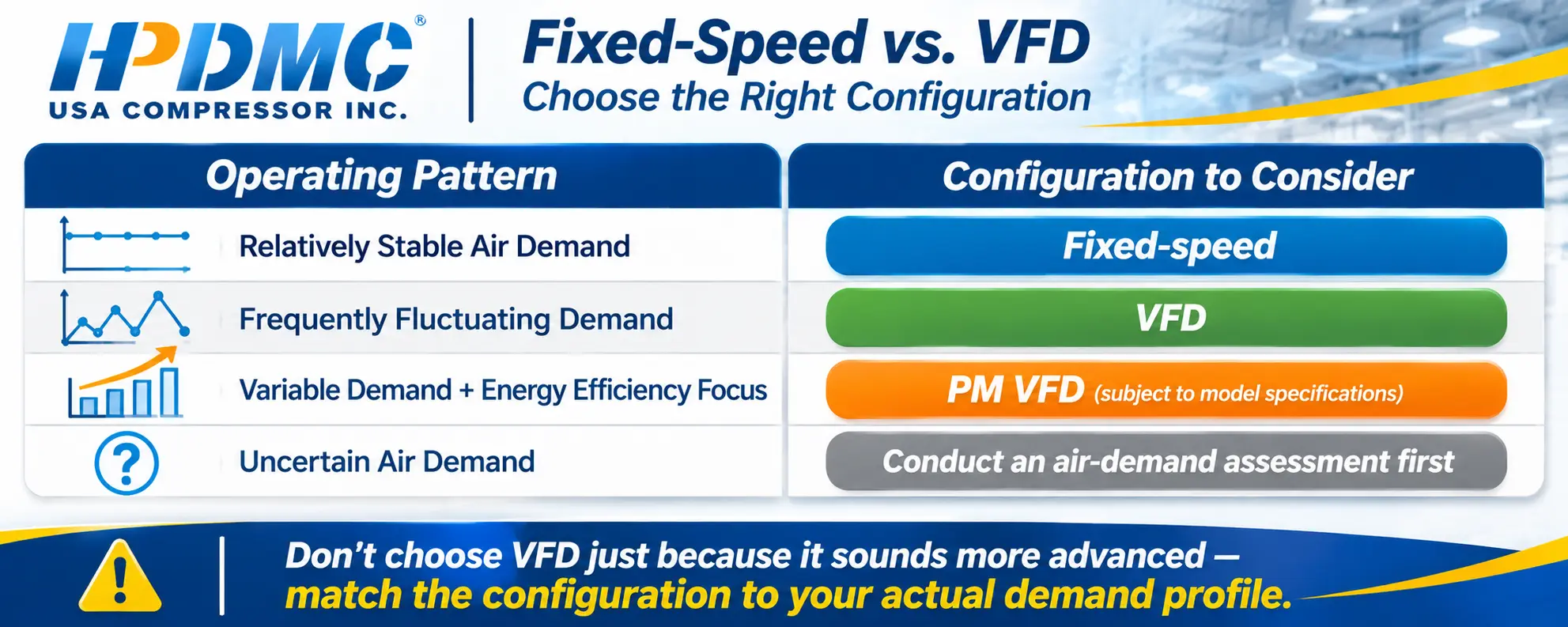
⚠️ Do not choose a VFD compressor simply because it sounds more advanced. The right decision depends on how much air your facility actually uses and when it uses it.
5. Electrical Requirements: Single-Phase vs. Three-Phase Power
Electrical compatibility is essential when selecting an industrial air compressor.
Before ordering, confirm the electrical supply available at your installation site.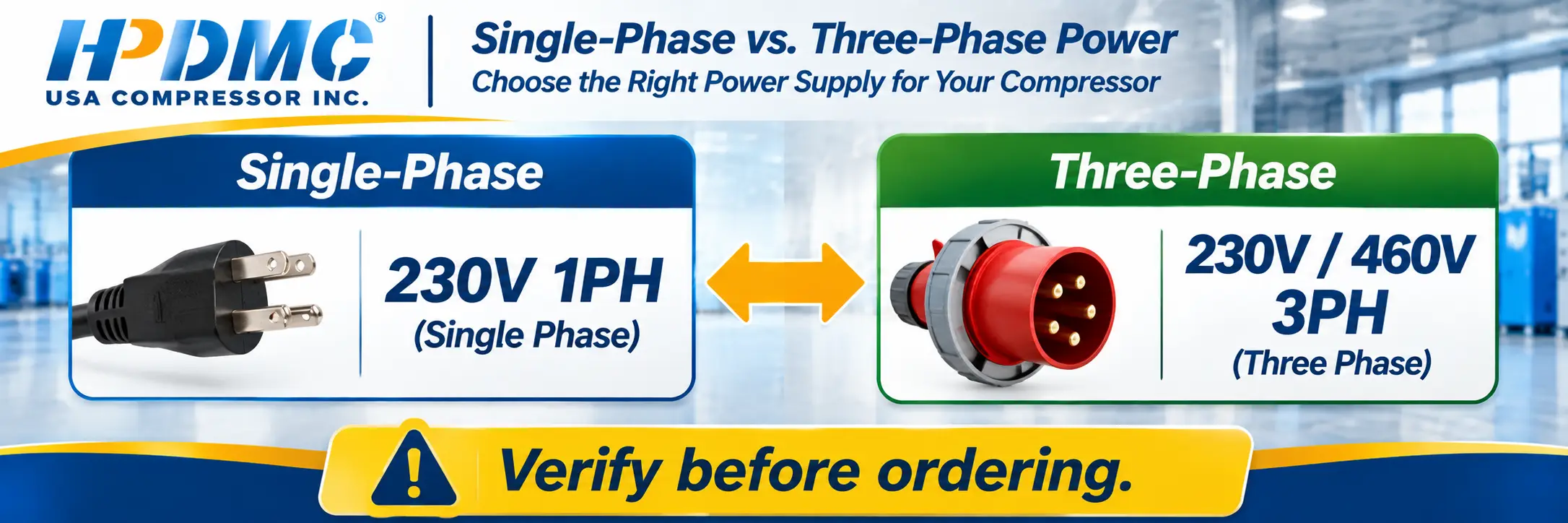
Single-Phase Power
Some smaller commercial facilities and workshops have single-phase electrical infrastructure.
⚠️ If you are considering a compressor advertised as single-phase/three-phase compatible, verify the exact voltage, wiring arrangement, motor requirements, and approved operating configuration with the supplier and a qualified electrician.
⛔ Do not assume that every 10 HP compressor can operate on a standard household outlet.
Three-Phase Power
Three-phase power is common in industrial and manufacturing environments.
HPDMC's selected 30 HP and 50 HP configurations are listed as dedicated three-phase models. Depending on the model, the available electrical configurations include 230V and 460V.
Before purchasing, check:
- Available voltage
- Number of phases
- Motor full-load current
- Circuit and disconnect requirements
- Installation and wiring requirements
- Compatibility with the compressor's control system
⚠️ A compressor that does not match your facility's electrical infrastructure may require additional electrical work before installation.
6. Other Factors to Consider Before Buying
Selecting the correct compressor capacity is only part of building a reliable compressed air system.
You should also evaluate the following factors.
6.1 Air Storage Capacity
An air receiver tank stores compressed air and helps manage short-term demand fluctuations.
A larger tank may help reduce frequent compressor cycling in certain applications, but it does not increase the compressor's continuous air production capacity.
Tank size should be selected according to compressor output, demand patterns, control strategy, and applicable safety requirements.
6.2 Air Dryers and Filters
Compressed air can contain moisture, particles, and other contaminants.
Depending on the application, you may need an air dryer and filtration equipment to achieve the required compressed air quality.
For example:
- General pneumatic tools may require basic moisture removal and filtration.
- Spray finishing may require more careful moisture and oil control.
- Manufacturing processes may require specific particle, water, or oil purity levels.
💡 Choose air treatment equipment based on the required air quality at the point of use.
📖 Explore HPDMC's air dryer solutions when planning your compressed air system.
6.3 Installation Space and Ventilation
Rotary screw compressors need appropriate installation conditions.
Before selecting a location, consider:
- Adequate ventilation and heat dissipation
- Clearance for maintenance access
- Floor loading and installation requirements
- Air intake conditions
- Noise considerations
- Compressed air piping and electrical connections
⚠️ Always follow the installation instructions for the selected compressor model.
6.4 Maintenance and Long-Term Operating Costs
The purchase price is only one part of the total cost of ownership.
Consider the expected costs of:
- Electricity consumption
- Routine maintenance
- Replacement filters and other service parts
- Air treatment equipment
- Installation
- Downtime and production interruptions
💡 A correctly sized compressor with an appropriate control strategy and well-designed air system can help manage long-term operating costs.
8. Frequently Asked Questions
1. What size rotary screw air compressor do I need?
The correct size depends on your total air consumption, simultaneous equipment usage, required operating pressure, and expected future demand. Calculate your required CFM first, then compare compressor models at the pressure your application needs.
2. Is a 10 HP rotary screw air compressor enough for an automotive shop?
It may be suitable for some smaller automotive workshops, depending on the number of tools used simultaneously and their airflow requirements. Compare the compressor's delivered CFM with the total demand of your equipment before purchasing.
3. What is the difference between a 30 HP and a 50 HP air compressor?
A 50 HP compressor generally offers greater motor capacity, but actual airflow depends on the model and pressure rating. In HPDMC's selected configurations, the listed 30 HP models range from approximately 112 to 140 CFM, while the selected 50 HP models are listed at approximately 220 CFM.
4. Is a VFD air compressor better than a fixed-speed model?
Not in every situation. A VFD compressor may be more efficient when air demand varies significantly. A fixed-speed compressor may be suitable for relatively stable demand. Evaluate your facility's operating profile before deciding.
5. Do I need an air dryer with a rotary screw compressor?
That depends on the required compressed air quality and application. Moisture can cause corrosion, affect pneumatic equipment, and create problems in certain production processes. Select an air dryer based on the required pressure dew point and operating conditions.
6. Can I install a 30 HP or 50 HP compressor in a small workshop?
It depends on available electrical capacity, installation space, ventilation, noise requirements, and actual air demand. Larger compressors may require dedicated three-phase electrical infrastructure and appropriate installation arrangements.
7. Does HPDMC offer discounts on rotary screw air compressors?
HPDMC periodically offers promotions on selected models. At the time of writing, selected rotary screw compressors are included in a limited-time Black Friday promotion with discounts of 5%–7%. Visit the HPDMC Black Friday sale page for current eligible models and terms.
Black Friday Savings on Selected Rotary Screw Compressors
For a limited time, selected HPDMC rotary screw air compressors are available with 5%–7% savings. Compare eligible 10 HP, 15 HP, 30 HP, and 50 HP models and find the right configuration for your workshop or facility.
Shop Black Friday Deals →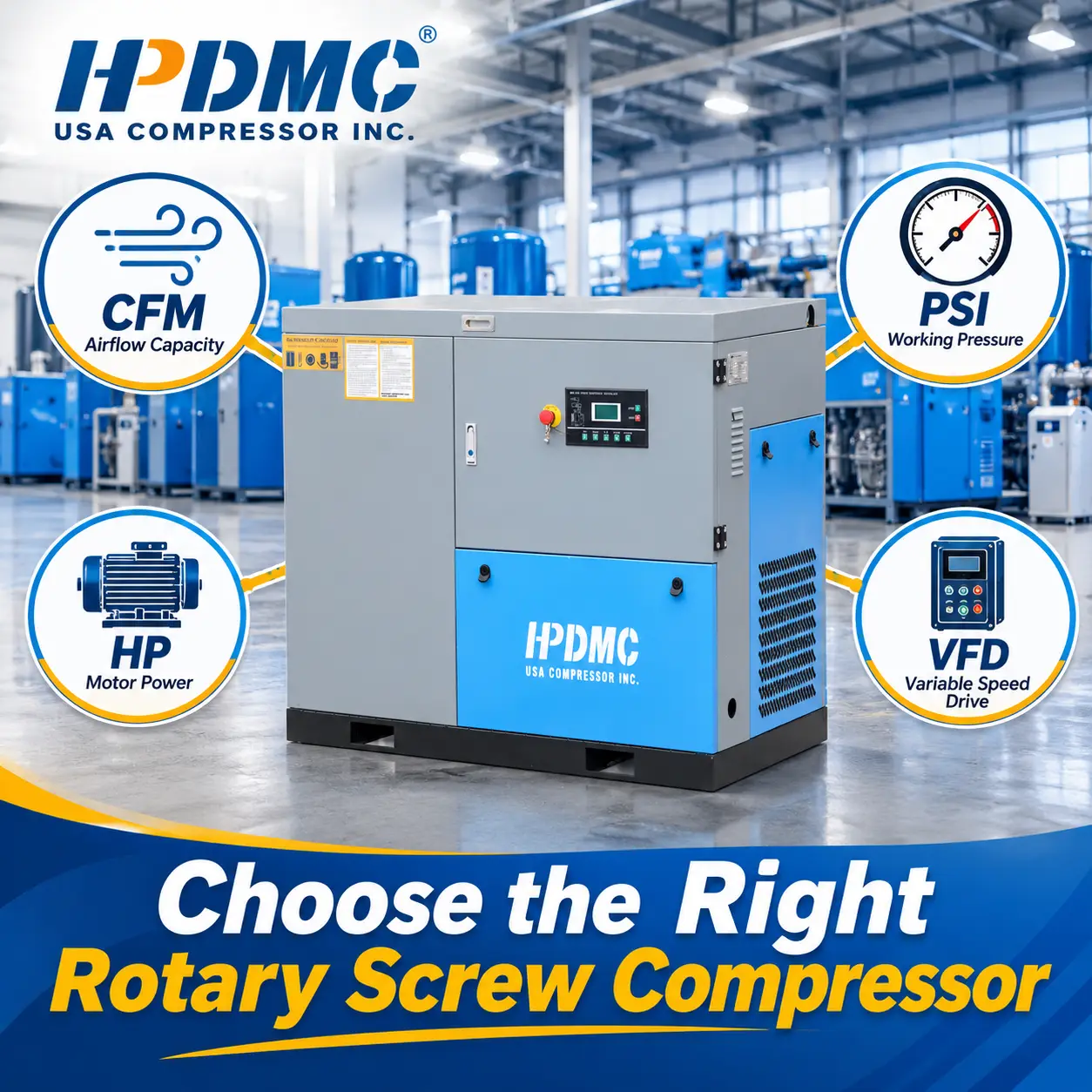

1-Year Warranty
Easy Returns

US-Based Support
Lifetime Technical Support

Help & Advice
service@sales.hpdmc-compressor.com

Live Help
(888)598-0133



Find the Right Compressor for Your Needs
Find the Right Compressor for Your Needs