30 Gallon Air Compressor Buyer's Guide
Everything you need to choose a 30-gallon compressor: CFM requirements, tank orientation, price tiers, and HPDMC's top-rated models.
📖 Read the 30 Gallon Guide⚡Free Shipping: Ultra-Quiet Portable Oil-Free Air Compressor AWR800-18LM2
Need Help Choosing the Right Compressor?
Need Help Choosing the Right Compressor?
⚡Free Shipping: Ultra-Quiet Portable Oil-Free Air Compressor AWR800-18LM2
Need Help Choosing the Right Compressor?
⚡Free Shipping: Ultra-Quiet Portable Oil-Free Air Compressor AWR800-18LM2
Many compressor owners eventually reach a point where their existing tank no longer meets their needs. Perhaps you started with a 20-gallon unit adequate for occasional tire inflation and brad nailing, but now you are running impact wrenches, paint sprayers, or multiple tools simultaneously. Your pump cycles constantly, your tools lose pressure during extended use, and you find yourself waiting — waiting for the tank to refill, waiting for pressure to recover, waiting instead of working.
⚠️ The Telltale Signs You've Outgrown Your Tank:
● Pump cycles on and off excessively (more than 6–8 times per hour)
● Tools lose power mid-use (pressure drops below 90 PSI)
● You constantly wait for the tank to recover between tasks
● You've added tools that demand more CFM than your current system can sustain
These are the signs that you have outgrown your tank — or more precisely, your pump-and-tank combination. A 30 gallon compressor represents a meaningful upgrade from the 20-gallon class: 50% more stored air volume, longer tool runtime between cycles, and (in most cases) a higher-CFM pump paired with the larger tank. For comprehensive tank guidance, see our tank sizing methodology.
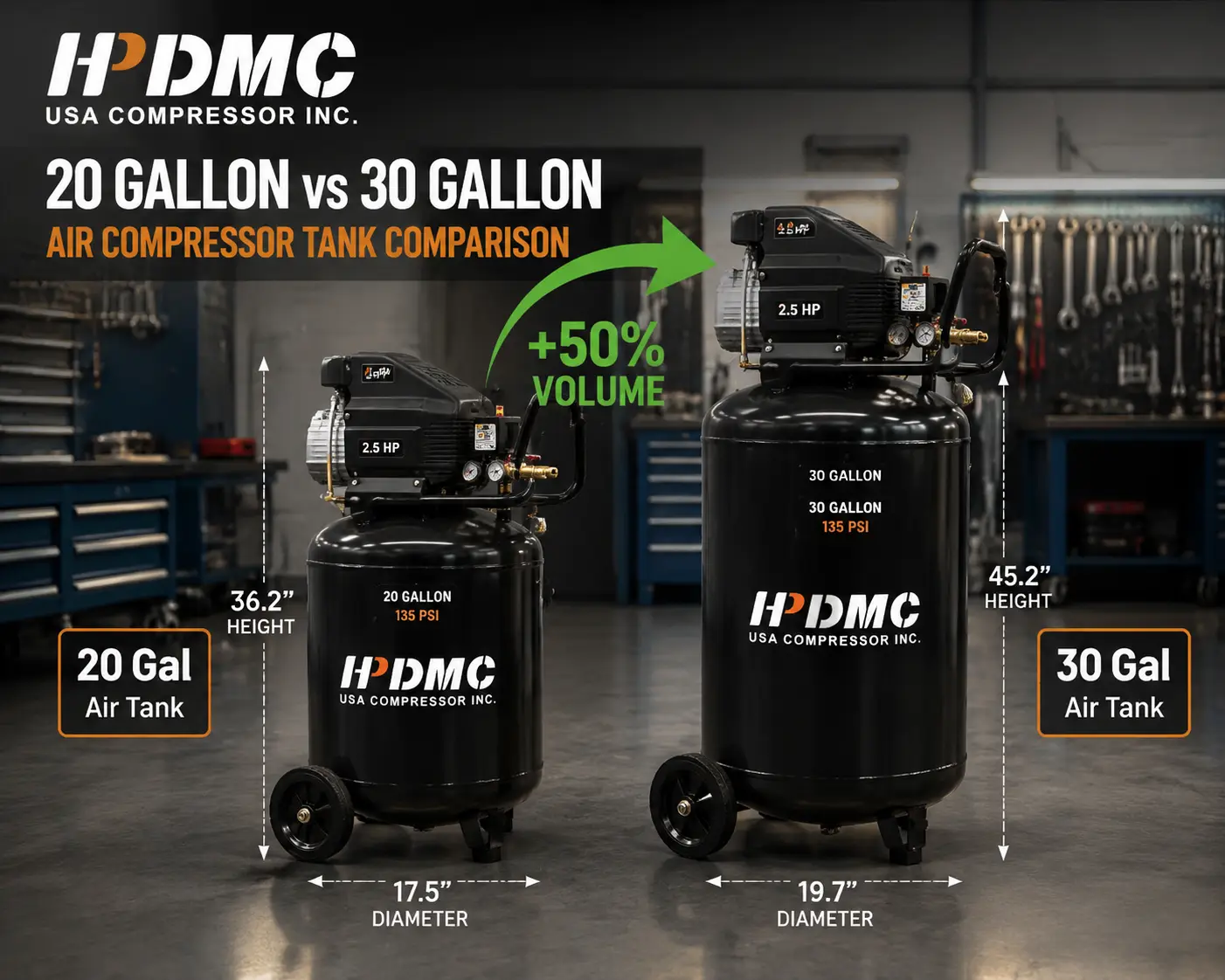
Moving from a 20-gallon to a 30 gallon compressor provides a 50% increase in stored air volume. Here is what that means in practical terms, assuming the same pump CFM output in both configurations:
| Metric | 20-Gallon Tank | 30-Gallon Tank | Improvement |
|---|---|---|---|
| Stored Air Volume | 20 gallons | 30 gallons | +50% |
| Runtime @ 10 CFM Draw (before pump cycle) | ~20–30 seconds | ~30–45 seconds | +50% tool runtime |
| Pump Cycle Frequency | Higher (shorter cycles) | Lower (longer cycles) | ~33% fewer cycles |
| Typical Pump HP Range | 1.5–2 HP | 1.5–3 HP (electric) / 6.5 HP (gas) | Broader pump options |
| Typical CFM Range @ 90 PSI | 3–5 CFM | 4–7 CFM (electric) / 18 CFM (gas) | Higher ceiling |
| Voltage (Electric Models) | 120V (most) | 120V or 240V | More power options |
| Footprint | ~5–7 sq ft | ~7–8 sq ft | Slightly larger |
💡 The Critical Insight: The 30-gallon upgrade is most valuable when paired with a pump that can capitalize on the larger tank. A 5 CFM pump on a 30-gallon tank cycles less frequently than the same pump on a 20-gallon tank — but still only delivers 5 CFM. The real capability jump comes when the larger tank is paired with a larger pump, as is typical in the 30-gallon compressor class.
See specs, prices, and top picks for 30-gallon compressors — and find the right fit for your tools.
📖 Read the 30 Gallon GuideIf your existing compressor's tank is damaged, corroded, or simply too small, you face a decision: replace just the tank, or replace the entire compressor.
● Pump/motor are in excellent condition with many years of service life remaining.
● Tank failed due to external damage (forklift strike, corrosion) while pump remains sound.
● You want to upgrade tank size while keeping proven components.
● You have fabrication skills or access to a qualified technician.
● Pump is approaching end-of-life (high hours, burning oil, low compression).
● You need more CFM, not just more tank volume (larger tank ≠ more airflow).
● The motor/engine is also worn.
● Replacement tank + labor cost approaches the cost of a new factory-assembled, warranted unit.
If you decide that a replacement air tank for air compressor is the right path, here are the non-negotiable requirements:
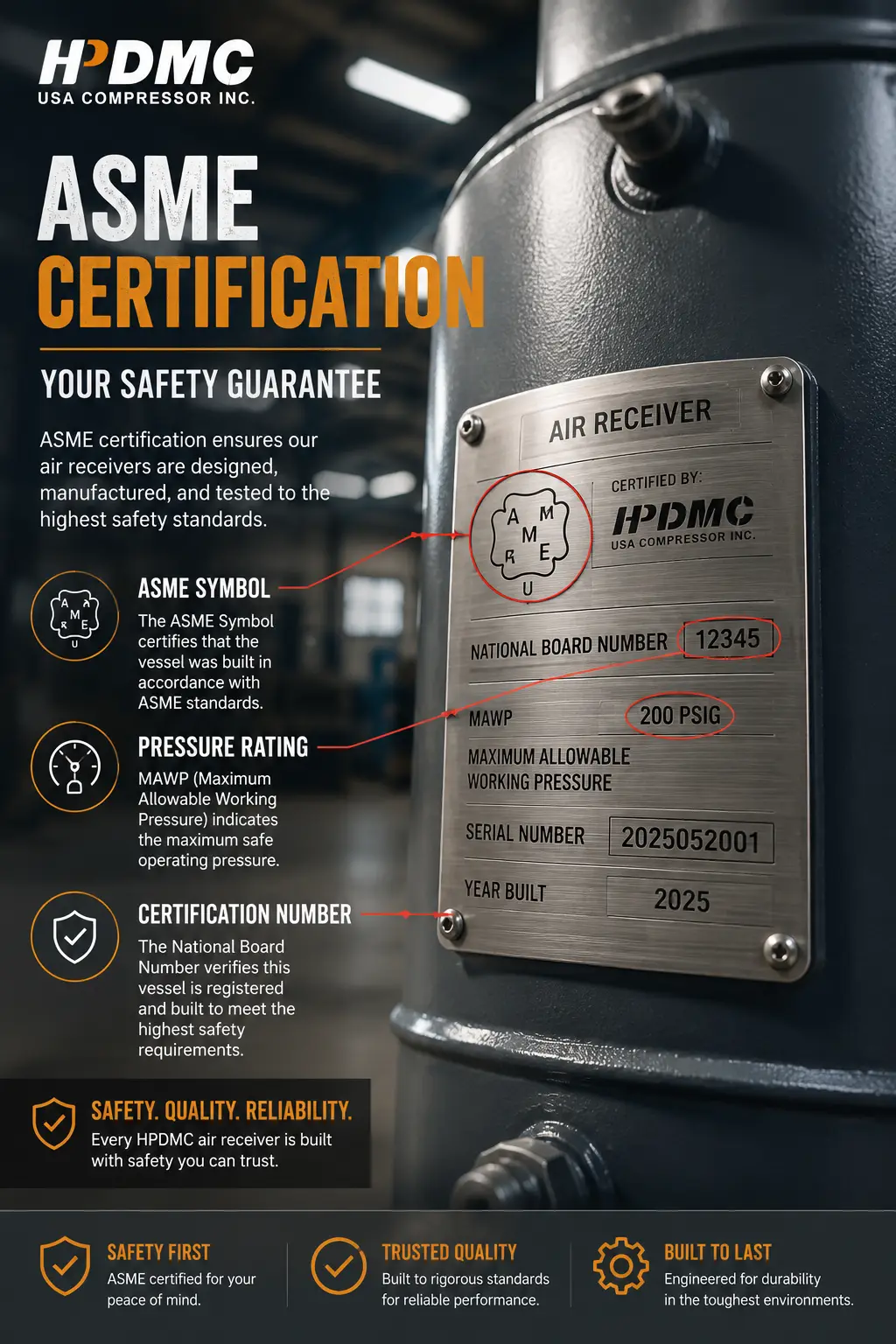
⛔ ASME Certification Is MANDATORY
Do not purchase a non-ASME replacement tank. The ASME data plate (riveted metal tag with National Board number) verifies the tank was designed, fabricated, tested (hydrostatic at 1.5× working pressure), and inspected to federal safety standards. Without it, you have no independent verification of weld quality, material specifications, or pressure rating.
● Mounting pattern: Pump/motor bolt holes must align with the replacement tank's bracket. Measure carefully — there is no standard pattern across manufacturers.
●Fitting sizes: Tank openings for pressure switch, safety relief valve, pressure gauge, drain, and outlet must match your existing components' thread sizes (NPT).
●Orientation: Horizontal vs vertical. Converting between orientations typically requires fabrication work.
●Pressure rating: The replacement tank's MAWP must equal or exceed your system's cut-out pressure.
HPDMC sells ASME-certified replacement tanks from 30 to 270 gallons, manufactured to BPVC Section VIII standards with full National Board registration. Contact our support team with your existing compressor specifications for compatibility guidance.
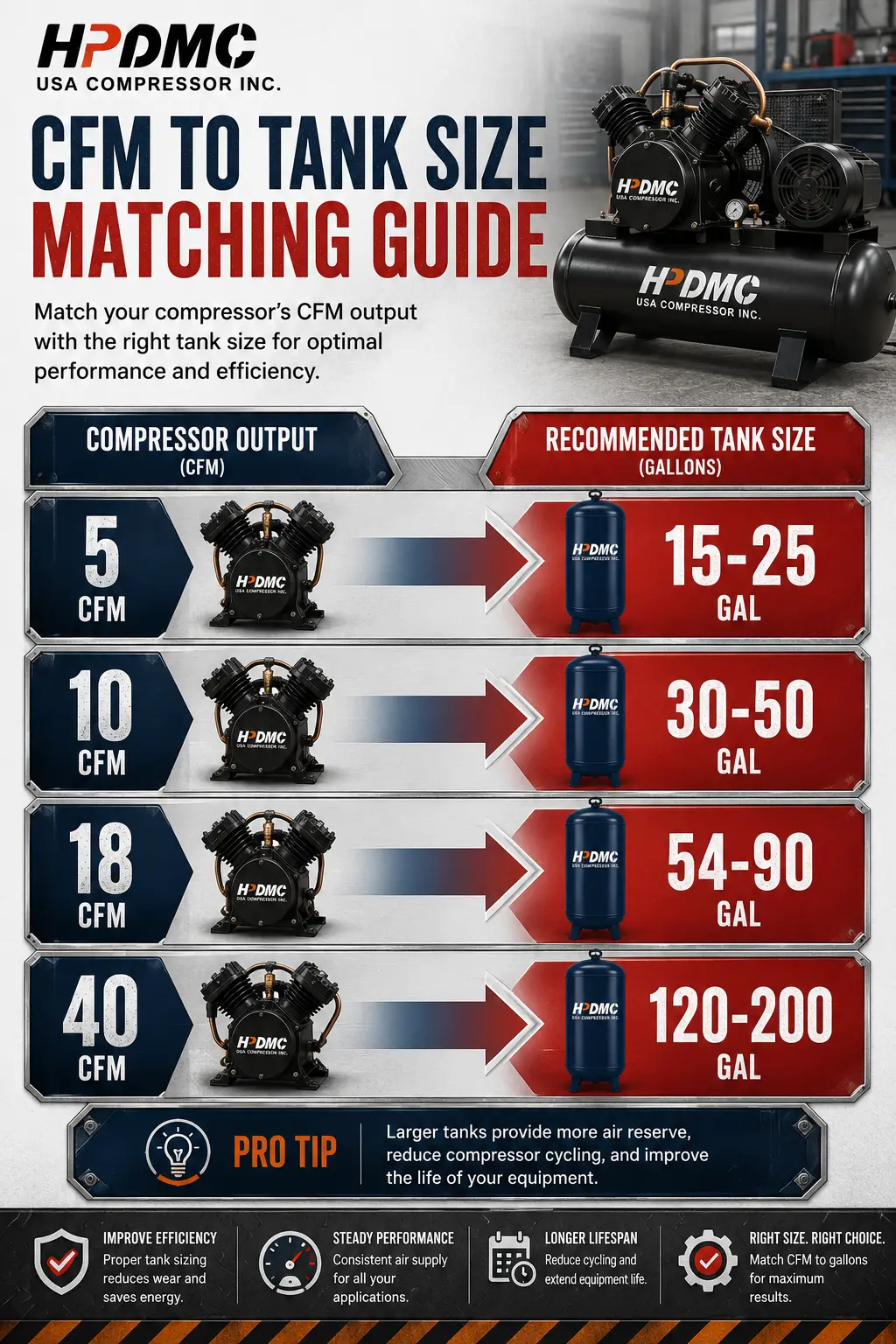
The ideal tank size for any compressor is determined by the pump CFM output. Industry best practice (Compressed Air and Gas Institute guidelines) recommends 3–5 gallons of tank capacity per CFM of pump output:
●5 CFM pump: 15–25 gallon tank (30-gallon is slightly generous — provides comfortable buffer)
●10 CFM pump: 30–50 gallon tank
●18 CFM pump: 54–90 gallon tank
● 40 CFM pump: 120–200 gallon tank
⚠️ The Portable Trade-off: HPDMC's 6.5HP gas compressor producing 18 CFM on a 30-gallon tank is deliberately under-tanked relative to the 3–5 gallon/CFM guideline — by design for portability. The cast-iron pump is engineered to handle the more frequent cycling that results from this trade-off.
Compressed air tanks have finite service lives, determined primarily by internal corrosion from accumulated moisture.
● Daily draining: The single most important tank maintenance practice. Water sitting at the bottom of a steel tank creates a corrosion cell that thins the tank wall from the inside — invisibly, until failure occurs.
● Annual internal inspection: For commercial compressors, visually inspect the tank interior with a borescope. Look for pitting corrosion, particularly at the bottom.
● Hydrostatic testing: ASME-certified tanks are tested at manufacture (1.5× MAWP). Some jurisdictions may require periodic retesting.
● Replacement indicators: Replace the tank if wall thickness decreased by >25%, pitting exceeds 1/16" depth, or the tank fails a hydrostatic test. Never attempt to weld or repair a pressure vessel — replacement is the only safe option.
⛔ NEVER use a propane tank, water heater tank, or other repurposed vessel as an air tank. They are NOT designed, fabricated, or certified for compressed air service. The risks include unknown material specs, unknown weld quality, internal corrosion, lack of safety relief valve, and OSHA violations. Only use purpose-built, ASME-certified air receiver tanks.
HPDMC's ASME-certified tanks are designed for decades of service when properly maintained. The primary threat to tank longevity is not manufacturing defects but owner neglect — specifically, failure to drain accumulated moisture.
Yes, if the pump is appropriately sized. A 5 CFM pump on a 30-gallon tank will cycle less frequently than on a 20-gallon tank, which is beneficial for pump longevity (less thermal cycling). However, this upgrade does NOT increase your CFM output — if your tools demand more air than your pump produces, a larger tank only delays the inevitable pressure drop. Ensure the replacement tank is ASME-certified, has compatible mounting dimensions, and is rated for your system's maximum pressure.
An ASME-certified 30-gallon replacement tank typically costs $200–$600, depending on orientation, pressure rating, and manufacturer. 60-gallon ($400–$800), 80-gallon ($500–$1,000). Non-ASME tanks are cheaper but not recommended — the safety and legal implications outweigh the cost savings. Factor in $100–$300 for labor if a technician transfers components. For many users, a complete new compressor with warranty is more cost-effective if the pump and motor are also aging.
Warning signs: (1) Deep external rust with pitting — surface rust is cosmetic; deep pitting is structural. (2) Rusty brown water from the tank drain — indicates active internal corrosion. (3) Pinhole leaks — IMMEDIATELY depressurize and replace. (4) Audible "pinging" or creaking during pressurization — may indicate a failing weld. Definitive assessment: have a qualified pressure vessel inspector perform ultrasonic thickness testing. If wall thickness has decreased more than 25% from original at any point, replace the tank immediately.
Industry guideline: 3–5 gallons of tank capacity per CFM of pump output for stationary applications. A 5 CFM pump pairs with a 15–25 gallon tank; a 10 CFM pump with a 30–50 gallon tank; a 20 CFM pump with a 60–100 gallon tank. For portable compressors, the ratio may be lower (2–3 gallons per CFM) as a deliberate trade-off for reduced size and weight — HPDMC's 18 CFM gas compressor on a 30-gallon tank is an example of this trade-off.
Yes. HPDMC sells ASME-certified air receiver tanks from 30 to 270 gallons as standalone units — ideal for replacement air tank for air compressor applications, system expansion, or custom builds. All HPDMC tanks carry ASME BPVC Section VIII certification with National Board registration, include a safety relief valve and pressure gauge, and ship from our Los Angeles and Chicago warehouses.
Yes — connecting multiple ASME-certified tanks in parallel is a common way to increase stored air capacity. Each auxiliary tank must have its own ASME certification, safety relief valve, pressure gauge, and condensate drain. Connect tanks with tee fittings and piping rated for the system's pressure. Do NOT connect in series — this creates flow restrictions. Total system capacity is the sum of all connected tank volumes, but CFM output remains limited by the pump.
Get a free, no-obligation sizing consultation from HPDMC's tank experts — we'll help you match tank capacity to your pump and tools.
✔️ Same‑day quotes · ✔️ ASME-certified · ✔️ 24‑hr shipping from U.S. Local Warehouse
Everything you need to choose a 30-gallon compressor: CFM requirements, tank orientation, price tiers, and HPDMC's top-rated models.
📖 Read the 30 Gallon GuideCompare power sources side by side. Understand portability, noise, and best applications for each type.
Confirm Current Offer
🔌 Compare Power OptionsFind portable electric and gas models for home, workshop, or job site.
👉 Find Your Portable Compressor


Find the Right Compressor for Your Needs
Find the Right Compressor for Your Needs