
Air Compressor Pumps Replacement Restoring Output Without Replacing the Whole Machine
Summary
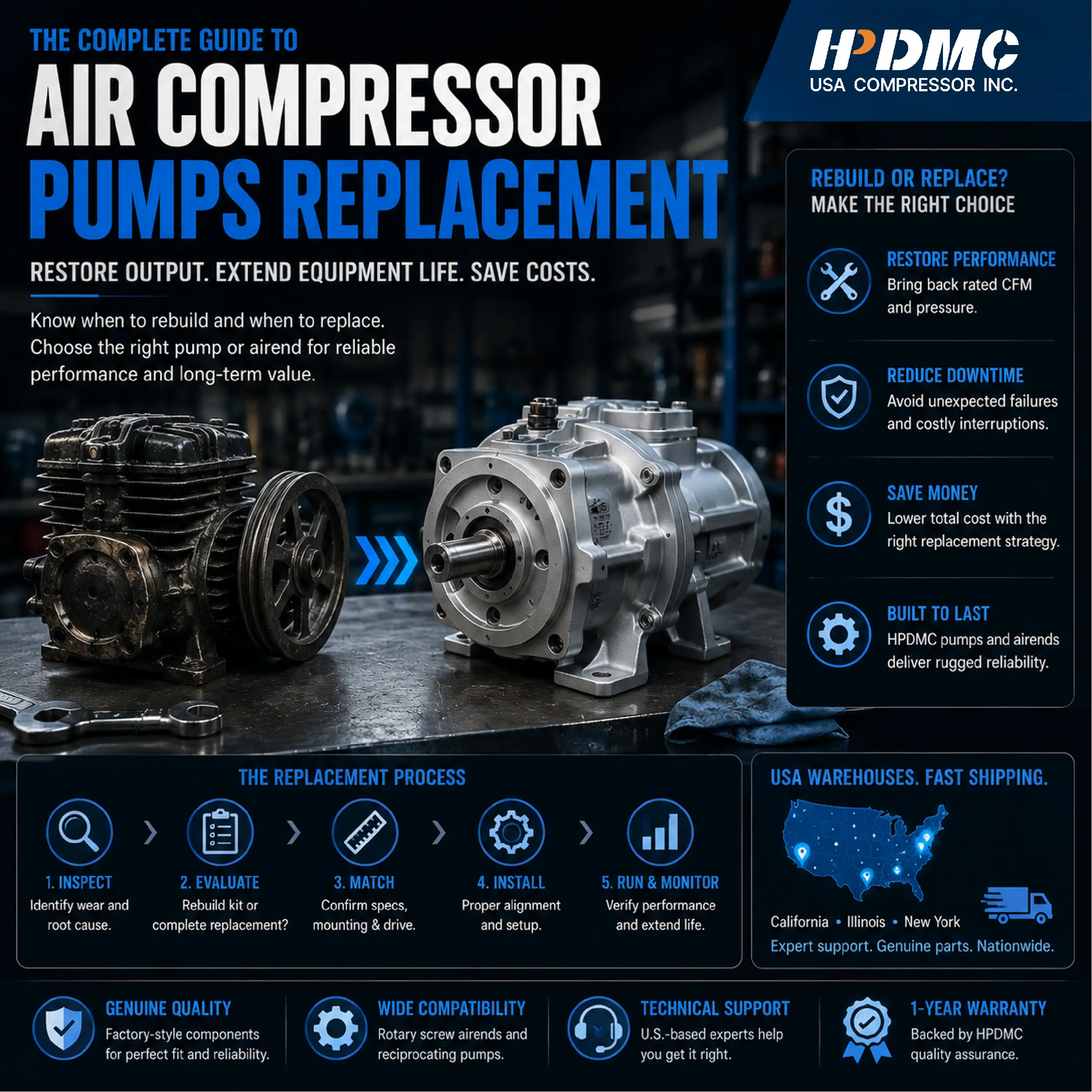
When tank fill times stretch longer, oil consumption climbs, or unusual knocking appears under load, the compression element itself is often the culprit. Air compressor pumps replacement lets you restore CFM and pressure without discarding a still-sound motor, tank, and frame. This guide explains the warning signs, how to choose between a rebuild and a new airend or pump, what specifications must match, and which HPDMC replacement ends ship from US warehouses for rotary screw and reciprocating machines.
1. Recognizing When the Pump or Airend Has Reached the End of Service Life
The pump on a piston compressor and the airend on a rotary screw unit do the real work of compression. Everything else supports that core. Over thousands of hours, clearances widen, seals harden, bearings develop play, and volumetric efficiency falls.
⚠️ Typical field indicators include longer run times to reach cut-out pressure, inability to hold pressure when demand is steady, rising discharge temperature, metal particles in the oil, or a rhythmic knock that was not present when the unit was new. On oil-lubricated piston pumps, blue smoke or oil carryover into the air line often points to worn rings or a scored cylinder. On screw machines, a sudden jump in specific power or a high differential across the oil separator can signal internal wear in the airend.
Ignoring these signals rarely saves money. A failing pump continues to draw full motor amperage while delivering less air, which raises energy cost and stresses the drive. Planning air compressor pumps replacement before catastrophic seizure protects the motor and the rest of the package.
A practical field check is to compare current fill time from a known pressure band against the original specification or against a log taken when the machine was new. A 20 to 30 percent increase in fill time under similar ambient and demand conditions is a strong indicator that volumetric efficiency has declined and that the compression element deserves inspection.
2. Rebuild Kit Versus Complete Pump or Airend Replacement
Not every worn compression element needs a brand-new assembly. The right choice depends on hours, damage pattern, and parts availability.
📌2.1 When a Rebuild Still Makes Sense
🛠️ Piston pumps with intact cylinder bores and crankshafts often respond well to a ring, valve plate, and gasket kit. If the bore is still within hone limits and the crank bearings show only normal wear, a quality rebuild restores sealing and valve action at a fraction of the cost of a complete pump. The same logic applies to some screw airends when rotors remain within clearance and only bearings, seals, and the shaft seal require attention.
Rebuild economics work best when labor is available in-house or from a trusted local shop and when the original design is still supported with current parts. Always compare the total of parts plus labor against the price of a new matched pump or airend before committing.
📌2.2 When Full Replacement Is the Better Path
Deep scoring of the cylinder, cracked heads, bent rods, or rotor-to-housing contact usually rule out an economical rebuild. Obsolete models with no kit support also push the decision toward a complete replacement unit. In those cases, air compressor pumps replacement with a current-production end restores performance and brings a fresh warranty.
For rotary screw packages, a factory-style airend exchange or a new matched airend eliminates the risk of residual clearance issues that can remain after a field rebuild. Matching the new end to the existing motor speed, coupling, and oil circuit is essential for reliability.
📌2.3 Documenting the Existing Unit Before Ordering
Before any order, record the compressor model, serial number, pump or airend casting numbers, shaft diameter, rotation direction, mounting bolt pattern, and nameplate CFM and PSI. Photographs of the pulley or coupling end and the mounting feet prevent costly mismatches. HPDMC technical support can help cross-reference these details to the correct replacement when the original markings are worn.
3. Matching Specifications for a Successful Air Compressor Pumps Replacement
A replacement that looks similar but differs in critical dimensions will not deliver the expected life or output.
➡️3.1 Flow Pressure and Drive Compatibility
The replacement pump or airend should meet or exceed the original free air delivery at the operating pressure. Undersizing leaves the system short of air; oversized ends can overload the motor if the drive ratio is unchanged. Confirm motor horsepower, RPM, and whether the drive is direct or belt. Shaft diameter, keyway, and rotation must match the existing coupling or pulley.
➡️3.2 Mounting Footprint and Port Locations
Bolt patterns and center distances vary between manufacturers and even between generations of the same brand. Measure the existing footprint and the distance from the shaft centerline to the mounting surface. Inlet and discharge port sizes and orientations affect piping changes. Allow time in the project plan for minor bracket or pipe adaptation if the new end is not a drop-in.
➡️3.3 Lubrication and Cooling Interfaces
Oil-injected screw airends require correct oil feed and return connections and often a specific separator design. Piston pumps need the correct oil capacity and splash or pressure lubrication path. Cooling air or water connections must remain unobstructed. Using the lubricant grade specified for the new end protects the warranty and the bearings.
If the original package used a particular oil separator or filter arrangement, confirm that the replacement airend works with the existing separator or plan to upgrade the separator at the same time. Mismatched oil return rates or separator efficiency can cause carryover or oil starvation even when the airend itself is new.
HPDMC stocks replacement compression elements suitable for many industrial packages, including the Rotary Screw Air Compressor End YNT55A and the larger Rotary Screw Air Compressor End YNT114A. For reciprocating duty, the Reciprocating Gas Compressor Pump Air End 5-10hp provides a complete pump air end option for mid-range horsepower frames.
4. Practical Steps for Safe Removal and Installation
Even a correct replacement part can fail early if installation shortcuts are taken.
🔒 Always lock out electrical power and relieve all system pressure before opening any connection. Drain oil completely and capture it for proper disposal. Label or photograph hose, tube, and electrical positions so reassembly is unambiguous. Support the old pump or airend during unbolting so shafts and flanges are not stressed.
Clean the mounting surfaces thoroughly. Check coupling alignment or belt tension with the new end in place rather than relying on the old settings. Soft-foot conditions on the base can misalign a new airend even when the coupling looks correct, so verify that all mounting feet sit flat before final torque. Prime oil systems on screw machines before the first start according to the manufacturer procedure. Run the unit unloaded initially and verify oil pressure, temperature, and absence of unusual vibration before returning it to production duty.
After the first few hours of operation, recheck belt tension or coupling alignment and inspect for oil seepage at seals and flanges. Early correction of minor leaks or looseness prevents secondary damage and keeps the new compression element operating within design clearances.
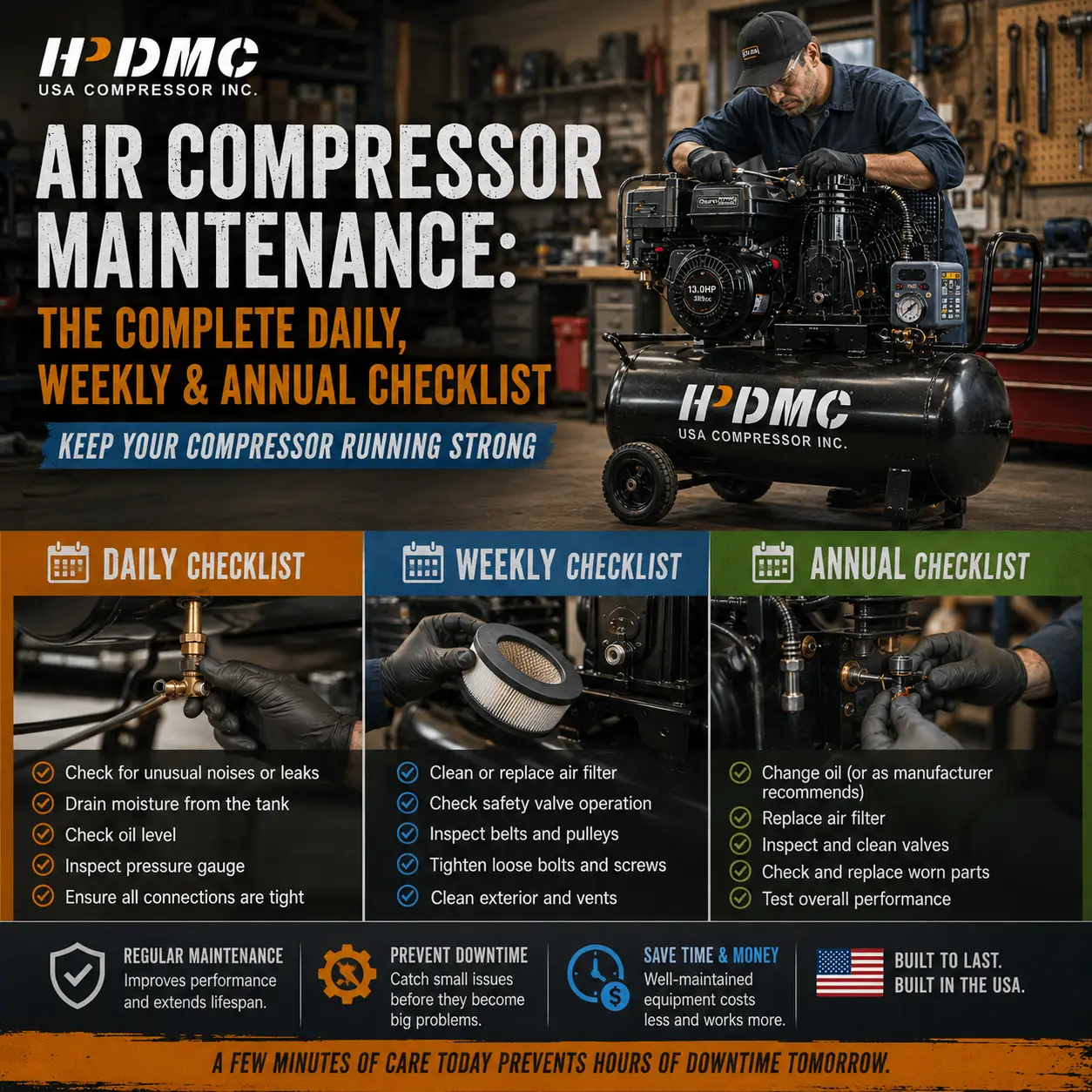
After replacement, return to a disciplined maintenance rhythm. HPDMC resources on rotary screw maintenance differences and the complete daily weekly and annual checklist help protect the new investment over the long term.
5. Shop HPDMC Air Compressor Pumps Replacement Parts Ready for US Delivery
When the decision is made to replace rather than rebuild, HPDMC offers genuine compression ends and related components from US inventory.
🛒•Rotary Screw Air Compressor End YNT55A – Compact rotary screw airend suitable for many industrial replacement and rebuild projects.
🛒•Rotary Screw Air Compressor End YNT114A – Larger capacity screw airend for higher CFM packages requiring a complete airend change-out.
🛒•Reciprocating Gas Compressor Pump Air End 5-10hp – Reciprocating pump air end designed for 5 to 10 horsepower gas or industrial compressor frames.
🛒•Browse the Pumps Category – Full selection of compressor pumps and related ends available through HPDMC.
Pair the new pump or airend with a matching drive motor when needed. HPDMC also lists air compressor motors that can complete a full power-end refresh when both pump and motor show age-related wear.
6. Learn More and Source Parts on the Official HPDMC Website
Successful air compressor pumps replacement starts with accurate information and reliable supply.
•HPDMC Home – 🏠Company overview, industrial product families, and contact channels for technical questions.
•Product Overview – 💡Navigate rotary screw, piston, pumps, motors, dryers, and filters in one catalog.
US warehouse stock and real support help shops and plants complete replacements with less downtime and fewer guesswork orders.
7. Frequently Asked Questions About Air Compressor Pumps Replacement
Q: How do I know if I need a full pump replacement instead of a simple rebuild kit?
A: If the cylinder bore is deeply scored, the crankshaft is damaged, or major castings are cracked, a kit will not restore sealing or alignment. When the cost of parts plus professional labor approaches or exceeds half the price of a new matched pump, full air compressor pumps replacement is usually the more durable and economical choice.
Q: Can I replace only the airend on a rotary screw compressor and keep the existing motor and package?
A: Yes, provided the new airend matches shaft size, rotation, mounting, oil connections, and design speed. Many industrial packages are designed so the airend can be exchanged as a module. Confirm alignment and oil circuit compatibility before the first start.
Q: What information should I collect before ordering a replacement pump or airend?
A: Record the compressor model and serial number, pump or airend identification numbers, shaft diameter and keyway, rotation direction viewed from the shaft end, mounting bolt pattern, pulley or coupling type, and nameplate CFM and pressure. Clear photos of the mounting area and drive end reduce ordering errors.
Q: Will a higher CFM replacement pump improve my system performance?
A: Only if the motor and drive can safely deliver the extra load and the rest of the system can use the additional air. An oversized pump on an undersized motor will trip overload protection or overheat. Match or modestly exceed original ratings unless the motor and electrical service are upgraded at the same time.
Q: How soon after installation should I change oil and filters on a newly replaced screw airend?
A: Follow the manufacturer break-in guidance. Many recommend a first oil and filter service after a short run-in period so that any residual assembly debris is removed. After that, return to the normal interval based on hours and operating conditions.
8. Keep Production Moving with Timely Air Compressor Pumps Replacement
A worn pump or airend silently steals capacity and raises operating cost long before it stops the machine completely. Planned air compressor pumps replacement restores airflow, protects the motor, and avoids emergency downtime. HPDMC supplies rotary screw airends, reciprocating pump ends, and supporting motors from US stock so American workshops and plants can complete the job with confidence.
Review the pumps category or visit the HPDMC homepage to confirm the correct replacement end for your model and to arrange fast shipping from domestic warehouses.



Find the Right Compressor for Your Needs
Find the Right Compressor for Your Needs