
Electric Air Compressor Buying Guide: How To Choose The Right Model
Choosing the right electric air compressor is about more than selecting the highest horsepower or largest tank. The right model depends on your required CFM, working pressure, power supply, duty cycle, application, and available installation space.
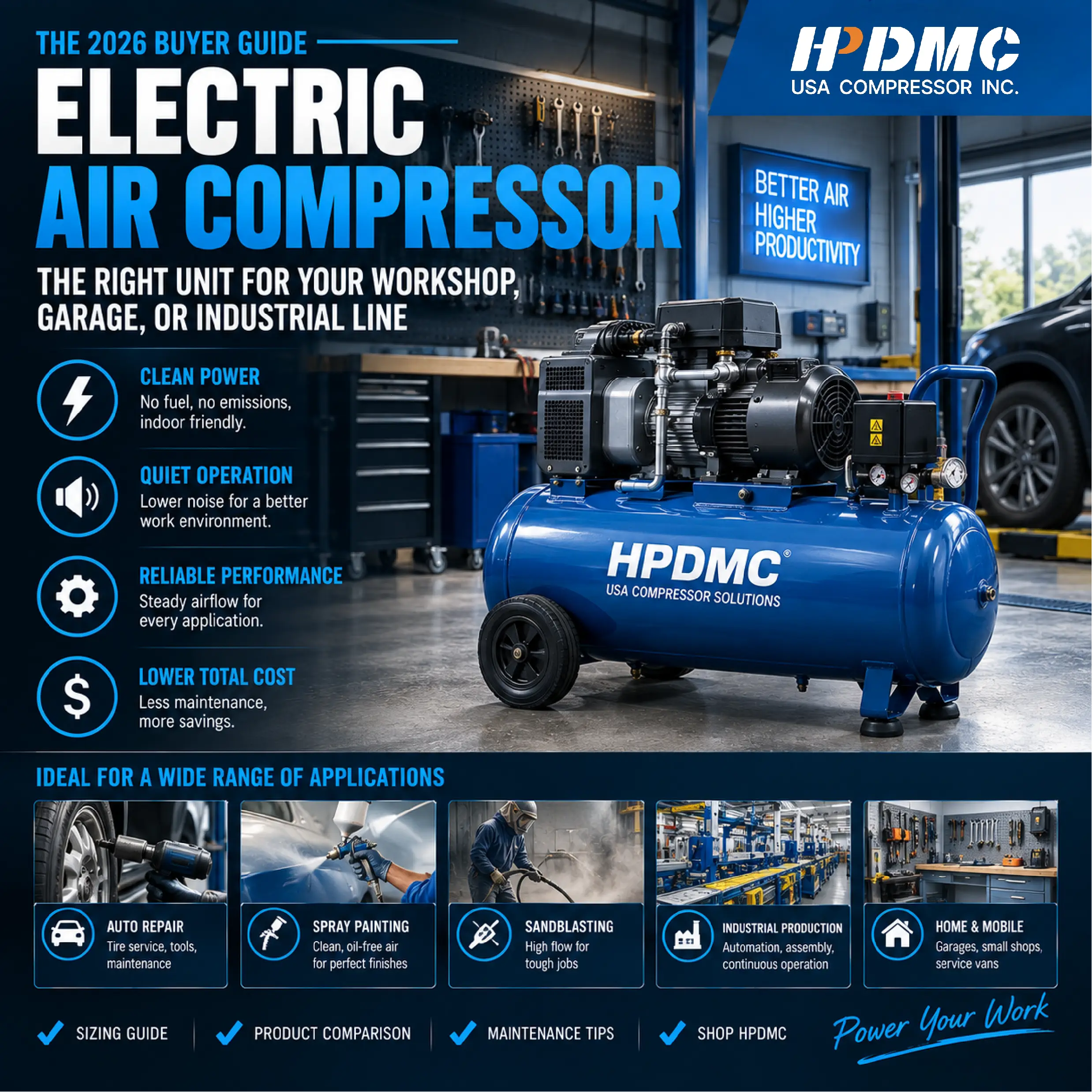
Electric air compressors are widely used in garages, automotive repair shops, workshops, manufacturing facilities, and other applications where reliable compressed air and access to electrical power are available.
In this guide, we explain how to choose an electric air compressor based on your actual air requirements and operating environment.
1. What Is An Electric Air Compressor?
An electric air compressor uses an electric motor to drive the compressor pump or compression element. Instead of relying on gasoline or diesel fuel, it connects to an electrical power supply to generate compressed air.
Electric compressors are particularly suitable for fixed workshops, garages, factories, and other locations with reliable electrical service.
Depending on the application, electric air compressors are available in different configurations, including piston compressors, oil-free compressors, and rotary screw compressors.
💡 The best choice depends on how much air you need, how often you use the compressor, and whether your application requires intermittent or continuous operation.
2. Why Choose An Electric Air Compressor?
🔌 Reliable Power For Stationary Applications
When electrical power is readily available, an electric compressor provides a convenient and consistent source of compressed air without requiring gasoline storage or engine refueling. This makes electric compressors a practical choice for workshops, garages, and industrial facilities.
🔇 Suitable For Indoor Workspaces
Electric compressors can be a better choice for indoor applications where operating environment and noise are important considerations. HPDMC rotary screw models are designed with low-noise and vibration-resistant operation, making them suitable for indoor workshops and industrial environments.
⚙️ Designed For Different Operating Requirements
Electric compressors are available in a wide range of sizes and configurations. A smaller single-phase model may be appropriate for a workshop, while larger three-phase rotary screw compressors can provide continuous compressed air for manufacturing and industrial applications. The key is matching the compressor to your actual air demand instead of simply choosing the largest available model.
3. How To Choose An Electric Air Compressor — 7 Steps
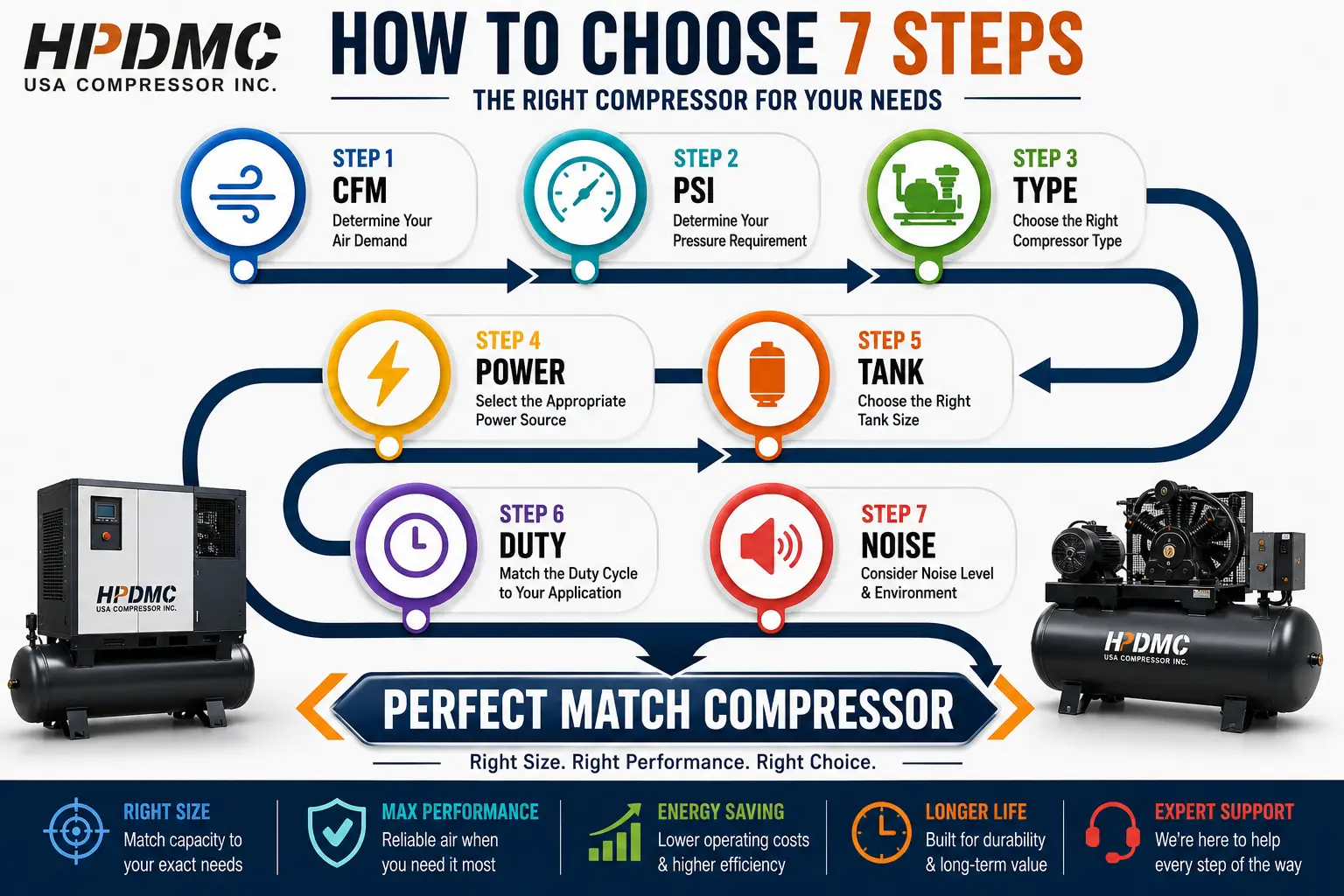
1. Determine How Much CFM You Need
CFM, or cubic feet per minute, is one of the most important specifications when choosing an air compressor. It indicates how much compressed air the compressor can deliver at a specified pressure.
Your compressor should provide enough CFM to meet the requirements of the pneumatic tools or equipment you plan to operate.
● Light-duty nailers and inflators generally require relatively low airflow.
● Impact wrenches and air ratchets require more airflow.
● Spray guns and grinders may require a higher and more consistent air supply.
● Manufacturing equipment and continuous-duty pneumatic systems may require substantially higher CFM.
⚠️ Tip: For applications using multiple pneumatic tools, consider the total expected air demand rather than sizing the compressor for only one tool. Compare the compressor's delivered CFM at the working pressure you actually need.
2. Check The Required PSI
PSI measures the pressure produced by the compressor. Most workshop pneumatic tools operate within a relatively common pressure range, but some applications require higher pressure.
When comparing compressors, look at:
● Maximum pressure
● Operating pressure
● CFM at the required pressure
💡 Do not choose a compressor based only on its maximum PSI. A compressor that delivers sufficient CFM at your required working pressure is generally more useful than one with a high maximum PSI but insufficient airflow.
3. Choose The Right Compressor Type
Electric air compressors can use different compression technologies. The three most important choices for many buyers are piston, oil-free, and rotary screw compressors.
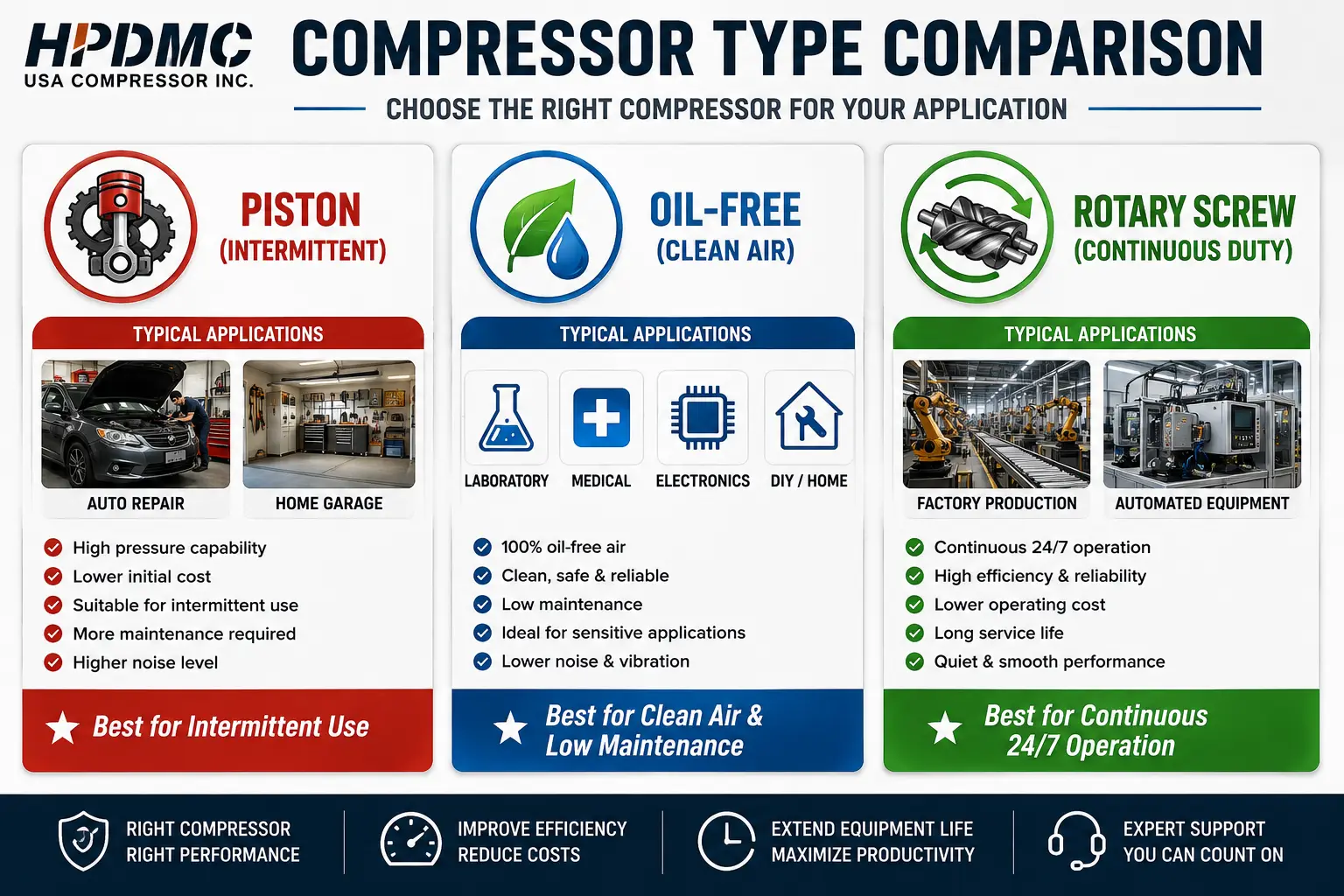
💡 When Should You Choose A Rotary Screw Compressor?
A rotary screw compressor is worth considering when: your compressor runs for extended periods, your facility has steady air demand, you need continuous compressed air, pressure fluctuations need to be minimized, or downtime significantly impacts production. For occasional garage use, a piston compressor may be more practical and economical.
4. Consider Your Electrical Supply
Electrical requirements are another critical factor. Before purchasing an electric air compressor, check:
● Voltage
● Phase
● Frequency
● Required amperage
● Available electrical capacity
💡 Example: HPDMC's 5.5 HP rotary screw configuration with 230V single-phase power is suitable for applications where three-phase electrical service is not available. Larger industrial compressors commonly use three-phase power — always confirm your site's electrical supply before selecting the compressor.
5. Choose The Right Tank Size
For piston compressors, tank capacity can have a significant impact on how the compressor behaves during intermittent air demand. A larger tank provides more stored compressed air and can reduce how frequently the compressor needs to cycle during short-duration applications.
Common tank sizes include:
● Small portable tanks for light-duty applications
● 20–30 gallon tanks for garages and workshops
● 60–80 gallon tanks for larger workshop applications
● Larger receivers for industrial compressed air systems
⚠️ Important: Tank size should not be used as a substitute for adequate CFM. A large tank cannot compensate for a compressor that cannot keep up with the actual air demand.
6. Consider Duty Cycle
Duty cycle describes how long a compressor can operate compared with how long it needs to rest. This is especially important when choosing between piston and rotary screw compressors.
💡 The key question is not simply: "How powerful is the compressor?"
Instead ask: "How much compressed air do I need, and for how long?"
7. Consider Noise And Operating Environment
Noise can be especially important in garages, workshops, and indoor workspaces. If the compressor will operate close to workers, customers, or residential areas, consider the compressor's sound level before purchasing.
🔇 Example: HPDMC's ultra-quiet portable oil-free model is rated at less than 60 dBA with a 2.0 HP oil-free pump and 11-gallon tank. For larger industrial applications, HPDMC rotary screw compressors are designed with low-noise and vibration-resistant operation.
5. Electric vs. Gas Air Compressor
One of the most common questions when choosing an air compressor is whether to buy an electric or gas-powered model.
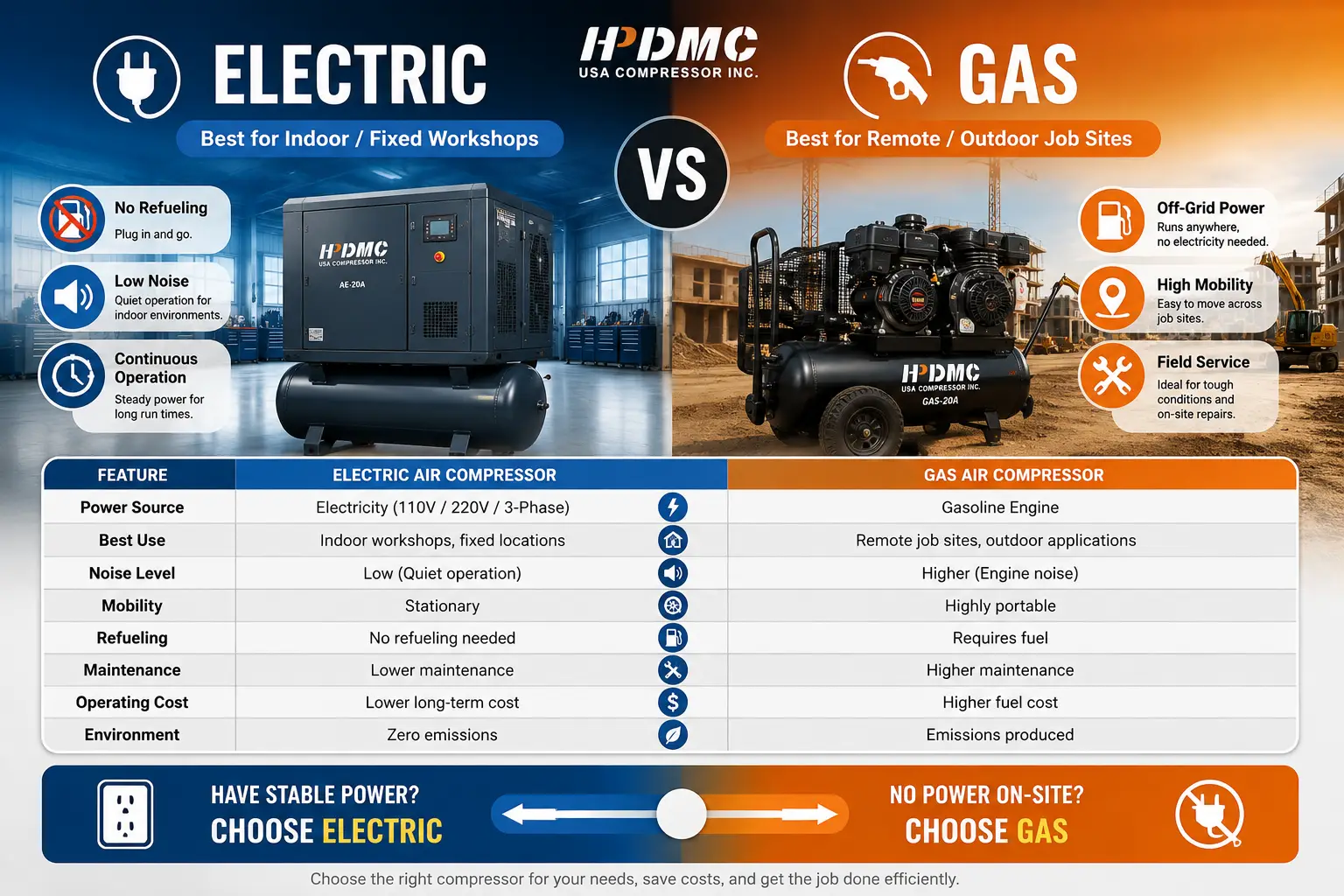
💡 Key Takeaway: If you have reliable electrical power and the compressor will remain in a garage, workshop, or factory, an electric compressor is often the more convenient solution. If you regularly work at remote jobsites where electrical power is unavailable, a gas-powered compressor may be a better fit.
6. Electric Air Compressor Applications
Electric compressors are suitable for a wide range of applications.
💡 For intermittent tool use, a properly sized piston compressor may be sufficient. For higher and more continuous air demand, consider a rotary screw compressor.
7. Electric Air Compressor Buying Checklist
Before purchasing an electric air compressor, check these specifications:
💨Airflow (CFM): Choose a compressor that provides enough CFM for your tools or equipment.
📊Pressure (PSI): Confirm that the compressor can deliver the required PSI at the operating point.
⚡Power Supply: Check voltage, phase, and frequency before ordering.
🔧Compressor Type: Choose piston, oil-free, or rotary screw technology based on your application.
🛢️Tank Capacity: Select the receiver size based on your air demand and duty cycle.
⏱️Duty Cycle: Determine whether your application requires intermittent or continuous operation.
🔇Noise Level: Consider sound level if the compressor will operate indoors or near people.
📐Installation Space: Check compressor dimensions, tank configuration, ventilation, and service access.
Frequently Asked Questions About Electric Air Compressors
What is CFM and why does it matter when choosing an electric air compressor?
CFM (Cubic Feet per Minute) measures the volume of compressed air the compressor can deliver at a specific pressure. It is the single most important specification for matching a compressor to your tools. If your compressor's CFM is too low, your tools will lose power mid-use, the pump will cycle excessively, and you'll experience frustrating delays waiting for pressure to recover. Always choose a compressor that delivers at least the total CFM required by your highest-demand tool — or the sum of all tools you plan to run simultaneously.
How do I calculate the CFM I need for my workshop?
Step 1: List all pneumatic tools you plan to use. Note each tool's CFM requirement at 90 PSI (found in the tool manual or on the tool label).
Step 2: Identify the tool with the highest CFM requirement — this is your baseline.
Step 3: If you ever run multiple tools simultaneously, add their CFM requirements together.
Step 4: Add a 20–30% safety margin to account for future tool additions and system leaks.
Example: Impact wrench (5 CFM) + Die grinder (6 CFM) = 11 CFM × 1.25 = 14 CFM minimum compressor output.
Should I buy an electric or gas air compressor?
Choose electric if: you have reliable electrical power, the compressor will stay in a fixed indoor location (garage, workshop, factory), you prefer lower operating costs, quieter operation, and minimal daily maintenance.
Choose gas if: you work at remote job sites without electrical access, need maximum portability, operate in outdoor construction or agricultural settings, or require high CFM without electrical infrastructure.
For most fixed workshops, electric is the clear winner due to lower operating costs and indoor safety.
What's the difference between a piston and a rotary screw compressor?
Piston (reciprocating) compressors use pistons driven by a crankshaft to compress air in bursts. They are best for intermittent use — tire inflation, impact wrenches, nailers, and DIY projects. They are generally lower in initial cost but have higher maintenance requirements and cannot run continuously without overheating.
Rotary screw compressors use two intermeshing screws to compress air continuously. They provide pulse-free airflow, run 24/7, and are the standard for manufacturing, automotive production, and any application with steady, continuous air demand. They have higher upfront costs but lower total cost of ownership in continuous-use scenarios.
Why are rotary screw compressors more expensive than piston compressors?
Rotary screw compressors are more expensive because they are precision-engineered for continuous-duty operation. Key cost drivers include: (1) Precision-machined rotors with tight tolerances (micron-level), (2) High-efficiency motors (often IE3 or IE4), (3) Complex oil-injection and separation systems, (4) Advanced cooling and control systems, and (5) Higher-grade materials to withstand continuous thermal stress. While the initial investment is higher, rotary screw compressors deliver significantly lower cost per CFM over their lifespan — especially in applications running 2,000+ hours per year.
Are electric air compressors loud?
Noise levels vary significantly by type. Piston compressors typically range from 75–85 dBA, which is noticeable but not unbearable. Oil-free direct-drive models can be louder (80–90 dBA). Belt-drive piston compressors are quieter (70–78 dBA). For the quietest operation, consider oil-free scroll compressors (under 60 dBA) or rotary screw compressors with sound-dampening enclosures (65–75 dBA). If the compressor will operate in a residential garage or near occupied workspaces, prioritize models with low decibel ratings — the difference between 75 dBA and 85 dBA is perceptually significant.
Can I use an electric air compressor in my home garage?
Absolutely. Most home garages have 120V or 240V single-phase power, which supports a wide range of electric compressors. For typical home use (tire inflation, nailers, light impact tools), a 20–30 gallon piston compressor with 4–6 CFM is usually sufficient. If you have 240V power available, consider a 3–5 HP model for significantly better performance. For noise-sensitive neighborhoods, look for belt-drive or oil-free models — they are substantially quieter than direct-drive oil-free units. Always verify your garage's electrical circuit capacity before purchasing.
How often do I need to maintain an electric air compressor?
Daily: Drain moisture from the tank (non-negotiable).
Weekly: Check oil level (oil-lubricated models), clean or replace air filter, inspect belts and fasteners.
Monthly / 50 hours: Change engine oil (gas models), clean cooling fins.
Annually / 300 hours: Change pump oil, inspect tank internally, replace spark plugs (gas), check belts.
Oil-free compressors require less maintenance (no oil changes) but still need tank draining and filter cleaning. Proper maintenance is the single biggest factor in compressor lifespan — a well-maintained piston compressor can last 10–15 years; a well-maintained rotary screw can last 20+ years.
What size tank do I need for my electric air compressor?
Industry guideline: 3–5 gallons of tank capacity per CFM of pump output for stationary applications.
5 CFM pump → 15–25 gallon tank (30-gallon is generous)
10 CFM pump → 30–50 gallon tank
18 CFM pump → 54–90 gallon tank
40 CFM pump → 120–200 gallon tank
Important: A larger tank does not increase CFM output — it only provides a longer buffer between pump cycles. If your tools demand more air than your pump produces, a larger tank will only delay the inevitable pressure drop, not solve the underlying CFM deficiency.
What electrical supply do I need for an electric air compressor?
Electrical requirements vary by compressor size:
1.5–2 HP → 120V, 15–20 amp circuit (standard household outlet)
2–3 HP → 240V, 20–30 amp circuit (needs electrician)
3–5 HP → 240V, 30–40 amp dedicated circuit
5+ HP → Often 240V or 480V three-phase
Always verify your site's available voltage, phase, and amperage before ordering. A dedicated circuit is strongly recommended for any compressor above 2 HP to prevent tripping breakers and ensure safe operation. If you're unsure, consult a licensed electrician before purchasing.



Find the Right Compressor for Your Needs
Find the Right Compressor for Your Needs