1. The Short Answer: Tank Size by Use Case
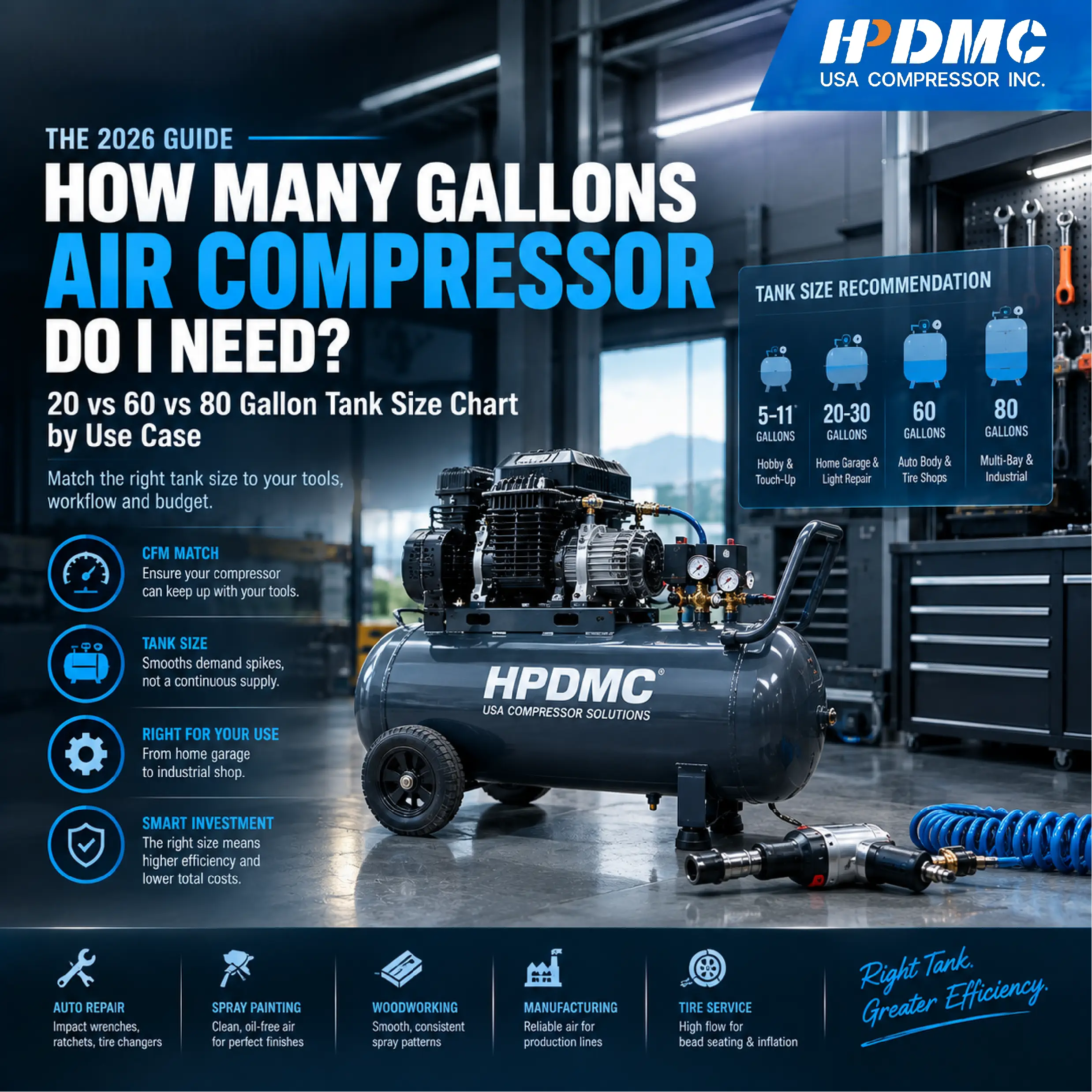
1.1 Hobby, Airbrush, and Touch-Up Work — 5 to 11 Gallons
🎨 For an airbrush, a brad nailer, a blow gun, or light touch-up spraying, a 5–11 gallon tank is genuinely enough. These tools draw 1–5 CFM, so the tank only needs to smooth out short gaps between trigger pulls. A small tank also recovers fast — from empty to full in about two minutes — which matters more than storage capacity when your tool runs for ten seconds at a time. Anything larger is wasted floor space and wasted money.
1.2 Home Garage and Light Auto Repair — 20 to 30 Gallons
🔧 A home garage running a 1/2-inch impact wrench, an air ratchet, and a blow gun lands in the 20–30 gallon band. The reason is burst behavior: an impact wrench pulls 4–6 CFM in short hard pulses, and a 20-gallon tank absorbs those pulses so the pump does not short-cycle every few seconds. Below 20 gallons, the pump cycles constantly and runs hot; above 30 gallons, you are paying for storage your tools will never drain.
1.3 Professional Auto Body and Tire Shops — 60 Gallons
🛞 A 60-gallon vertical receiver is the working standard for a professional shop running two bays — impact wrenches, a tire changer, bead seating, and blow guns used back to back. The 60-gallon size is not arbitrary: it is the smallest standard ASME vertical tank that absorbs a bead-seating spike (15–20 CFM for a few seconds) without dropping system pressure below the tool's minimum. Vertical orientation also keeps the footprint small in a bay that already has a lift in it.
1.4 Multi-Bay Shops and Fabrication Cells — 80 Gallons
🏭 An 80-gallon tank is the right choice when three or more tools run at the same time, or when a single tool has a very large appetite — a sandblaster, a plasma cutter's assist air, or a pneumatic conveyor. At this level the tank is doing double duty: buffering demand spikes and giving the pump a longer, cooler duty cycle. In practice, 80-gallon packages almost always pair a screw pump with a variable-speed drive, because a fixed-speed pump that large would short-cycle just as badly as a small one.
2. The Actual Sizing Math (So You Can Check Our Numbers)
2.1 Step One: Tank Size Is a Buffer, Not a Supply
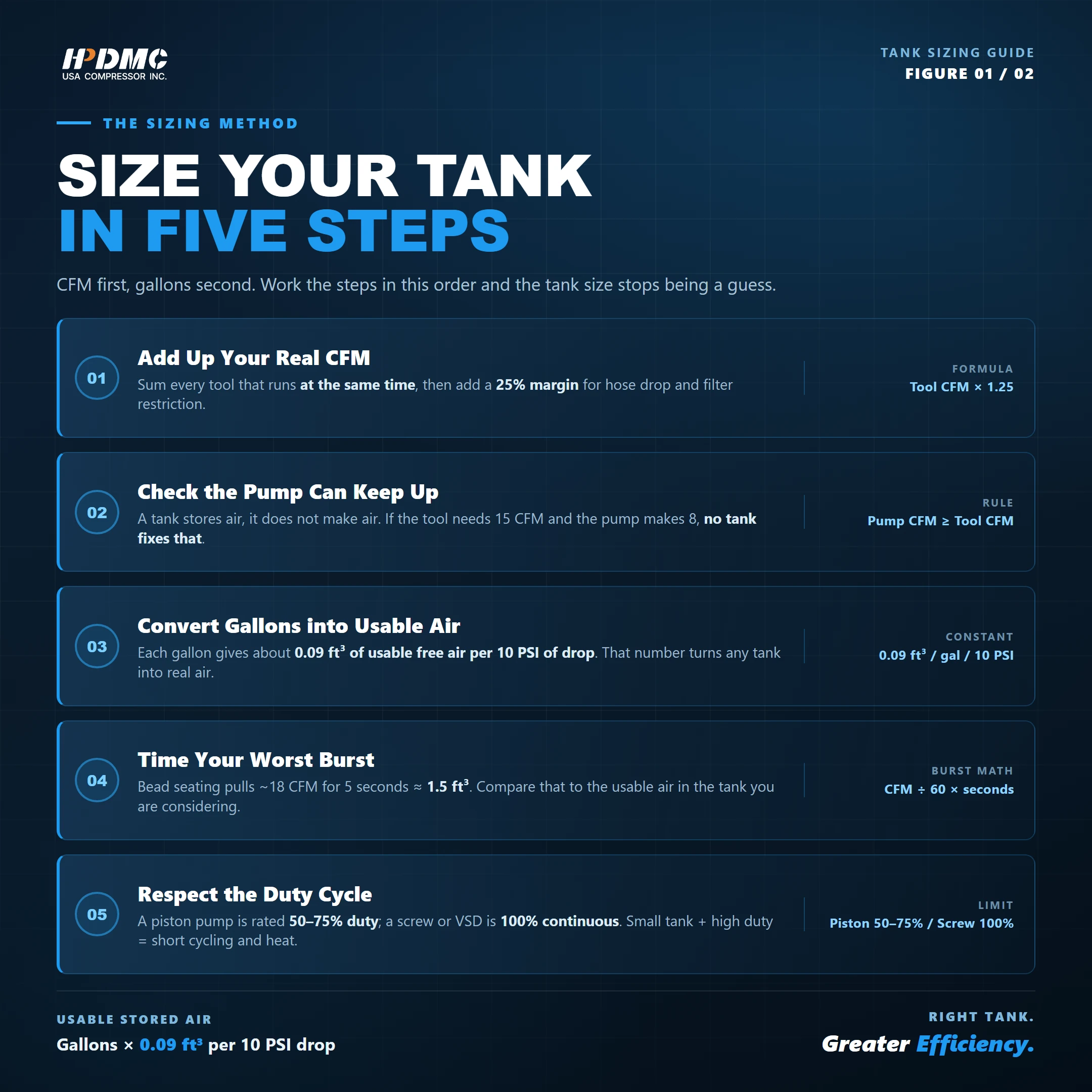
💡 Here is the single most important idea in this article: a tank stores air, it does not make air. If your pump delivers 8 CFM and your tool needs 15 CFM, no tank size on earth fixes that — the pressure will fall until the tool stalls, whether the tank holds 20 gallons or 200. A tank only helps when the demand is intermittent. It buys you seconds, not minutes. Buy gallons for bursts; buy CFM for sustained load.
2.2 Step Two: Calculate Usable Stored Air Per Gallon
📐 One gallon of tank volume holds 0.1337 cubic feet. Compressed to pressure, the free air available is that volume multiplied by the pressure ratio. Working the numbers through the standard pressure band (a 10 PSI drop before the pressure switch restarts the pump) gives a clean, repeatable constant:
Each gallon of tank yields about 0.09 cubic feet of usable free air per 10 PSI of pressure drop. That is the number to memorize. It converts any tank size into real, usable air:
• 20-gallon tank → 1.8 ft³ usable per 10 PSI drop
• 60-gallon tank → 5.4 ft³ usable per 10 PSI drop
• 80-gallon tank → 7.3 ft³ usable per 10 PSI drop
The inverse is just as useful. A 20-gallon tank at 115 PSI, drawing 5 CFM with the pump off, holds usable air for about 54 seconds before it hits 90 PSI. The same draw on an 80-gallon tank runs about 3.6 minutes. That is the real difference you are paying for.
2.3 Step Three: Run Two Worked Examples
Example A — bead seating on a tire. A bead seater pulls about 18 CFM for roughly 5 seconds (0.083 minutes), so it needs about 1.5 ft³ of air. If the pump contributes 5 CFM during that burst, the deficit is about 1.1 ft³ — which a 20-gallon tank covers comfortably. This is why a 20-gallon unit can seat a tire even though its pump is far smaller than the burst.
Example B — sandblasting a large frame without stopping. A 3/8-inch nozzle pulls 15 CFM continuously. If the pump delivers 8.5 CFM, the deficit is 6.5 CFM — for two minutes that is 13 ft³ of stored air, which would require a 143-gallon tank to cover, and only if it started fully charged. No practical tank solves this. The pump has to be bigger. Example A and Example B side by side are the whole lesson: tanks absorb seconds, pumps carry minutes.
2.4 Step Four: Confirm Your CFM Before You Pick Gallons
⚙️ Add the CFM of every tool you will run simultaneously, then add a 25% margin for pressure drop in hoses and filter restriction. Only after you know that number should you size the tank. For a detailed walkthrough of the CFM side of this calculation — including how altitude and heat change the result — see our HP, PSI and CFM selection guide. If the pump and tool budgets are also open questions, the industrial compressor cost guide breaks down what each class of machine actually costs to own.
2.5 Step Five: Respect the Duty Cycle
⏱️ A piston pump is typically rated for 50–75% duty cycle — it needs to cool between runs. A screw or VSD pump is rated 100% continuous duty. This interacts directly with tank size: a small tank on a piston pump means the pump cycles constantly, which shortens its life no matter how good the pump is. If your work is continuous, do not try to save money with a small tank and a piston pump — the honest answer is a screw pump with a larger receiver.
3. Five Scenarios, Five Different Answers
3.1 For Auto Repair and Tire Shops
Two bays, an impact wrench, a tire changer, and bead seating: 60 gallons. With four bays and two technicians working simultaneously: 80 gallons. The driving factor is not total air per shift — it is how many bursts land at the same moment. Two bead seaters firing within a few seconds of each other is exactly the case a 60-gallon receiver handles and a 20-gallon unit does not.
3.2 For Spray Painting and Body Shops
For spraying, tank size matters less than steady pressure and dry air. An HVLP gun wants a non-pulsing 90 PSI, so a larger tank helps damp pressure swings — but the priority is an oil-free pump plus a dryer, not a bigger receiver. A 20–30 gallon tank with a clean, correctly sized pump outsprays an 80-gallon tank fed by an oily pump every time. Buy the air quality first, then the gallons.
3.3 Home Garage and DIY
A homeowner running an impact wrench, a nailer, and a blow gun on weekends needs 20–30 gallons, and should spend the difference on a quieter, oil-free pump instead of more tank. The most common DIY mistake is buying 60 gallons of storage for tools that never consume more than 5 CFM — then discovering the compressor is too loud and too big for the garage it lives in.
3.4 Woodworking, CNC, and Fabrication
CNC tool changers, vacuum tables, and pneumatic clamps demand pulse-free air at steady pressure rather than high burst volume. That profile points to a screw pump with a 60–80 gallon receiver, not a piston unit. If your CNC also uses a laser or plasma assist gas, confirm the pressure rating — some packages run 150–230 PSI, which changes both the pump and the tank specification.
3.5 Multi-Bay Industrial and High-Demand Cells
Once you pass three simultaneous users, tank sizing stops being about bursts and becomes about system stability. At this scale an 80-gallon receiver behind a VSD screw pump keeps pressure within a narrow band across the whole shop, which protects tools from cycling and keeps finish quality consistent. Below that level, a VSD drive with a smaller tank can work — but the control logic, not the tank, is doing the stabilizing.
4. Tank Size Comparison: 20 vs 60 vs 80 Gallons
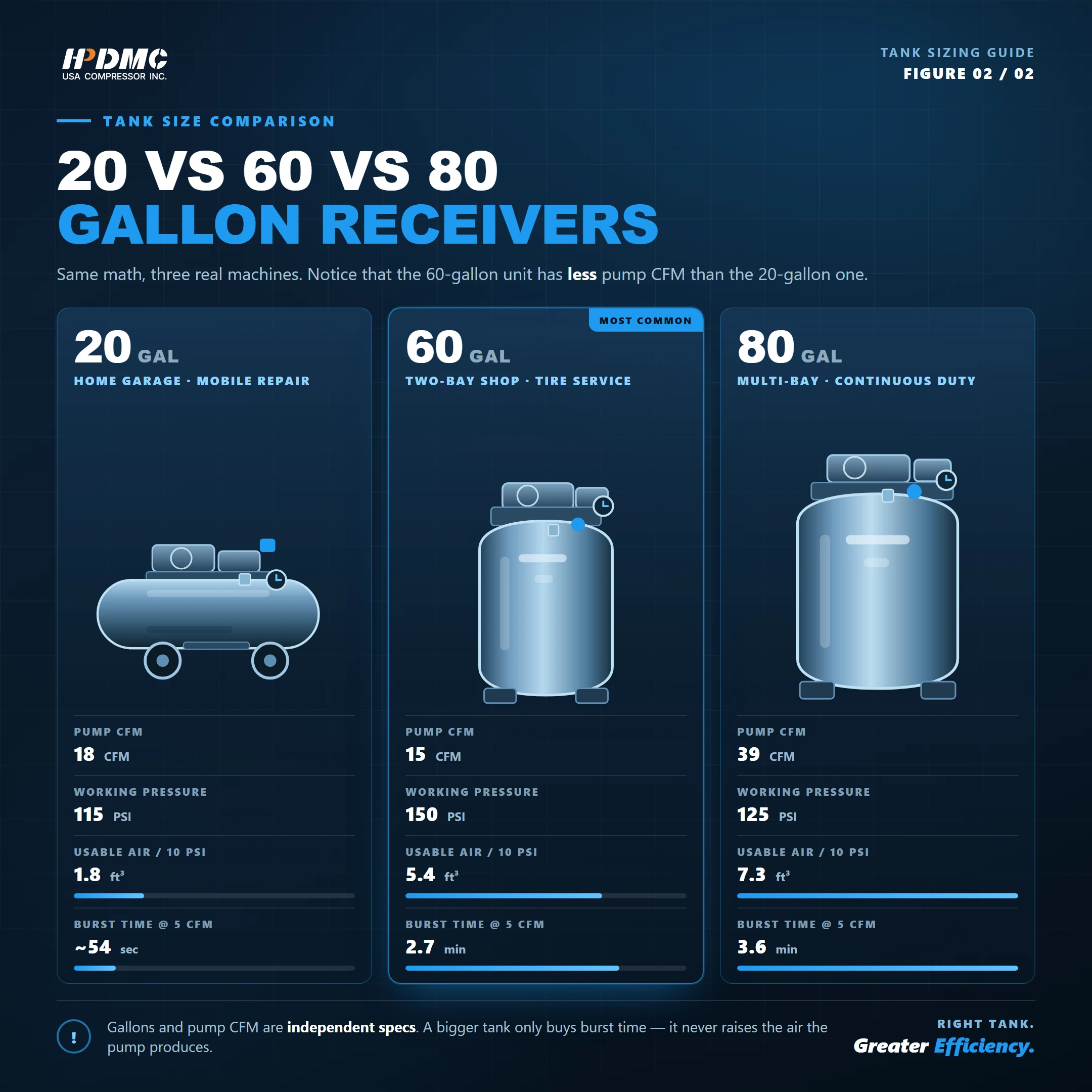
📊 Here is the same math from Section 2 applied to three real machines, so you can see where the numbers land in practice.
| Tank | Pump CFM | PSI | Usable Air | Burst Time | Best For |
|---|
| 20 gal | 18 CFM | 115 PSI | 1.8 ft³ | ~54 sec | Home garage, mobile repair, light auto |
| 60 gal | 15 CFM | 150 PSI | 5.4 ft³ | 2.7 min | Two-bay shop, tire service, fabrication |
| 80 gal | 39 CFM | 125 PSI | 7.3 ft³ | 3.6 min | Multi-bay shop, multi-tool, continuous duty |
Read the table left to right and notice that the 60-gallon unit has a lower pump CFM than the 20-gallon unit — and that is exactly the point. Tank gallons and pump CFM are independent specs. A larger tank does not guarantee more air.
5. Three Tank Sizes, Three Different Jobs
5.1 For Mobile Work and a Home Garage — 20 Gallons
🚐 20-Gallon Portable Gasoline Compressor — HSJQY306518 — 6.5 HP gasoline engine, 18 CFM at 115 PSI, 20-gallon tank, 240 lbs on pneumatic wheels. This is the answer for a mobile mechanic, a truck mounted service rig, or a home garage that needs real air away from an outlet. 18 CFM covers an impact wrench, a ratchet, and a blow gun with margin, and 20 gallons absorbs the burst without bloating the machine. It is the only unit in this lineup that does not need power at the job site.
5.2 For a Two-Bay Shop — 60 Gallons
🛞 60-Gallon Rotary Screw with Vertical ASME Tank — LGJGP004005 — 5 HP three-phase, 15 CFM at 150 PSI, 60-gallon vertical ASME receiver, 100% continuous duty. This is the professional workhorse for a shop running multiple tools back to back. The vertical tank keeps the footprint narrow in a bay, the 150 PSI rating gives you headroom for hose losses, and the screw pump runs continuous duty so the machine does not need cool-down between jobs. Requires 230V three-phase power — confirm your service panel before ordering.
5.3 For a Multi-Bay Shop — 80 Gallons
🏭 80-Gallon VSD Rotary Screw with Tank — LGJBP-7TV — 10 HP, 39 CFM at 125 PSI, 80-gallon vertical ASME tank, variable-speed drive, runs on 230V single or three phase. This is the answer for a shop where three or more tools run at once — or for a facility without three-phase service, since the field-selectable input removes the electrical upgrade that usually kills an 80-gallon project. The VSD matches pump speed to actual demand, which keeps the pressure band tight across the whole shop instead of cycling between fixed setpoints.
6. Frequently Asked Questions
How many gallons air compressor do I need for a home garage?
For a home garage running an impact wrench, air ratchet, and blow gun, 20 to 30 gallons is the right range. It is enough to absorb the 4–6 CFM pulses of an impact wrench without the pump short-cycling, and it recovers quickly. Only go bigger if you plan to add a sandblaster or run two high-demand tools at once — otherwise the extra capacity is unused and the machine is simply heavier and louder than you need.
Is a bigger tank always better?
No — and this is the most expensive myth in compressor buying. A larger tank only helps with intermittent demand. If your pump cannot keep up with a continuous tool, a bigger tank just delays the pressure drop. Worse, an oversized tank paired with a small pump means longer recharge times: after a heavy burst, the pump runs longer to refill 80 gallons than 20. Match the tank to your burst profile and spend the rest of the budget on pump CFM and air quality.
Can I add a second tank instead of buying a bigger compressor?
Sometimes, and it is a legitimate cost-saving move — if your pump already has the CFM. Adding an auxiliary ASME receiver downstream increases buffer capacity for bursts without replacing the pump. What it cannot do is create airflow. If the problem is that your tool drains the system during continuous use, adding tank volume wastes money. Also check the pressure rating match on the added receiver and keep it ASME-certified; mixing an uncertified tank into a working system is a safety and insurance problem.
How many gallons do I need for spray painting?
An HVLP gun needs steady pressure more than it needs storage, so 20–30 gallons with a properly sized oil-free pump covers most painting setups, and larger receivers help only by damping pressure swings. The bigger factor is air quality: an oil-free pump plus a dryer matters more than tank size, because oil and moisture ruin finishes regardless of how much air is stored behind them.
Does tank size affect CFM?
No. CFM comes from the pump, not the tank. Tank volume changes how long the system sustains a draw before pressure drops — it does not change the rate at which air is produced. This is why two compressors with identical 60-gallon tanks can have completely different real-world performance: one pump delivers 15 CFM, the other 5 CFM, and the tank is identical in both. Always compare pump CFM ratings at the same pressure before comparing tank sizes.
How long will a 20-gallon tank last at 90 PSI?
Using the 0.09 ft³ per gallon per 10 PSI constant from Section 2: a 20-gallon tank charged to 115 PSI and drawn down to 90 PSI gives about 4.5 ft³ of usable air. At a 5 CFM draw with the pump off, that is roughly 54 seconds. An 80-gallon tank under the same conditions lasts about 3.6 minutes. In real use the pump restarts partway through the draw, so these are worst-case figures — but they are the right numbers to size against.
Still Not Sure How Many Gallons You Need?
Send us your tool list, how many run at once, and your power available — single-phase or three-phase. An HPDMC application engineer will calculate your CFM requirement, convert it into usable stored air, and tell you which tank size and pump combination actually fits your shop. If a smaller tank with a stronger pump is the better answer, we will say so.
🛒 Get a Free Tank Sizing Review · Browse Product Catalog
✔️ Math shown, not guessed · ✔️ ASME-certified tanks · ✔️ Honest sizing — no overselling