Gas vs Electric Air Compressor
Compare portability, noise, maintenance, and operating cost for gas and electric models.
🔌 Compare Power Options⚡Free Shipping: Ultra-Quiet Portable Oil-Free Air Compressor AWR800-18LM2
Need Help Choosing the Right Compressor?
Need Help Choosing the Right Compressor?
⚡Free Shipping: Ultra-Quiet Portable Oil-Free Air Compressor AWR800-18LM2
Need Help Choosing the Right Compressor?
⚡Free Shipping: Ultra-Quiet Portable Oil-Free Air Compressor AWR800-18LM2
When shopping for 30 gallon air compressors, the first fork in the decision tree — before you even consider CFM ratings, pump types, or brand names — is the power source. Will your compressor plug into a wall outlet or burn gasoline in an engine? This single choice cascades through every aspect of ownership: where you can use the machine, how much noise it makes, what it costs to operate, how much maintenance it requires, and ultimately, whether it will actually serve your needs or sit unused because it is impractical for your situation.
⚠️ The Core Question: The electric vs gas debate is not a matter of one being universally superior. Both have natural domains where they are the clearly correct choice, and both have applications where they are the clearly wrong choice. The key is matching the power source to your specific operating environment, air demand, and tolerance for noise and maintenance.
HPDMC manufactures both electric and gas 30 gal air compressor models, and we have equipped thousands of U.S. workshops and job sites with both types. We have no power-source bias — our only interest is matching you with the machine that will serve your needs reliably for years. This guide draws on our direct field experience to provide an objective, data-driven comparison. For detailed model information, see our 30-gallon compressor overview.
An electric motor (typically 1.5–3 HP) drives the compressor pump via a belt or direct coupling. The motor draws power from the building's electrical system — 120V for smaller motors (up to ~2 HP) or 240V for larger motors (3 HP and above). The pump compresses air into the 30-gallon ASME-certified tank, cycling on and off via a pressure switch.
● Lowest operating cost: Electricity costs approximately $0.10–$0.25 per operating hour, compared to $1.00–$2.00 per hour for gasoline. Over 1,000 annual hours, the difference is $750–$1,750 in fuel savings alone.
● Quiet operation: Belt-drive electric compressors produce 70–78 dBA — quiet enough for conversation in the same room. This is 10–20 dBA quieter than gas compressors and 15–25 dBA quieter than direct-drive oil-free units.
● Indoor-safe: Zero emissions at the point of use. No carbon monoxide, no exhaust fumes, no fuel vapors. Electric compressors can operate safely in enclosed workshops — the only environmental concern is heat rejection and noise.
● Minimal daily maintenance: No fuel mixing, no oil level checks (beyond the pump oil), no spark plugs, no air filters to clean. Daily electric compressor maintenance consists of draining the tank moisture and visually checking belts.
● Instant start: Flip a switch, the motor spins, and you have air in approximately 30 seconds. No choke, no pull cord, no warm-up period.
● Long motor life: A quality induction motor (IE3 rated) can run 20,000+ hours with bearing replacements as the only wear item. No overhaul cycles like an internal combustion engine.
● Tethered to power: The compressor lives where the electrical outlet is. For job sites without temporary power, this is a deal-breaker.
● Limited CFM on 120V: A 120V, 15-amp circuit can support approximately 1.5 running horsepower — producing 4–5 CFM. This runs impact wrenches and nailers but struggles with continuous high-demand tools. 240V models produce more CFM but require an electrician.
● Startup current: Electric motors draw 3–5× their running current at startup. A 15-amp motor may momentarily draw 45–75 amps, which can trip breakers on circuits shared with other loads. A dedicated circuit is strongly recommended.
● Voltage sensitivity: Low voltage (brownout conditions, long extension cords) causes motors to draw higher amperage, overheat, and potentially burn out. Electric compressors should never be operated on extension cords longer than 25 feet or lighter than 12-gauge.
A gasoline engine (typically 6.5–13 HP in the 30-gallon format) drives the compressor pump. The engine operates independently of any external power source — fueled by gasoline from an onboard tank. On HPDMC models, industrial-grade Kohler or Lonxin engines provide continuous-duty capability with cast-iron cylinder sleeves and pressurized lubrication.
● Complete mobility: Operate anywhere — new construction sites without temporary power, remote agricultural locations, roadside service calls, disaster response staging areas.
● Higher CFM output: A 6.5HP gas engine can deliver 12–18 CFM at 90 PSI — 2–3× the output of a 120V electric compressor. This means a gas 30-gallon compressor can run multiple framing nailers, an impact wrench and air hammer simultaneously, or support light sandblasting operations.
● No electrical infrastructure: No electrician, no circuit installation, no concern about panel capacity or three-phase power availability. Fill the tank with gas and go.
● Proven engine platforms: Kohler Command PRO engines on HPDMC premium models are backed by 10,000+ U.S. service dealers and a three-year commercial warranty. Parts are on shelves nationwide.
● Outdoor use only: Carbon monoxide from engine exhaust is lethal in enclosed spaces. Gas compressors must be operated outdoors with exhaust directed away from building openings and occupied areas.
● Higher operating cost: Gasoline costs approximately $1.00–$2.00 per operating hour versus $0.10–$0.25 for electric. Over 1,000 annual hours, the fuel cost difference is $750–$1,750.
● Louder: Gas compressors produce 85–95 dBA — hearing protection is required for sustained exposure per OSHA standards. This is 15–20 dBA louder than belt-drive electric models.
● More daily maintenance: Engine oil checks, air filter cleaning, spark plug inspection, fuel management, and seasonal storage procedures add approximately 5–10 minutes of daily maintenance versus 2 minutes for electric.
● Fuel management: Gasoline degrades over time (especially ethanol-blended fuel), requires stabilizer for storage, and presents fire safety hazards. Fuel logistics — keeping fresh gas available, managing fuel cans — adds a layer of operational complexity.
● Cold starting: While modern engines with electronic ignition start reliably, pulling a recoil starter in freezing temperatures is never pleasant. Electric compressors have no such issue — they start with a switch regardless of temperature.
Go deeper on power source and tank size — then find the right compressor for your workflow.
🔌 Compare Power Options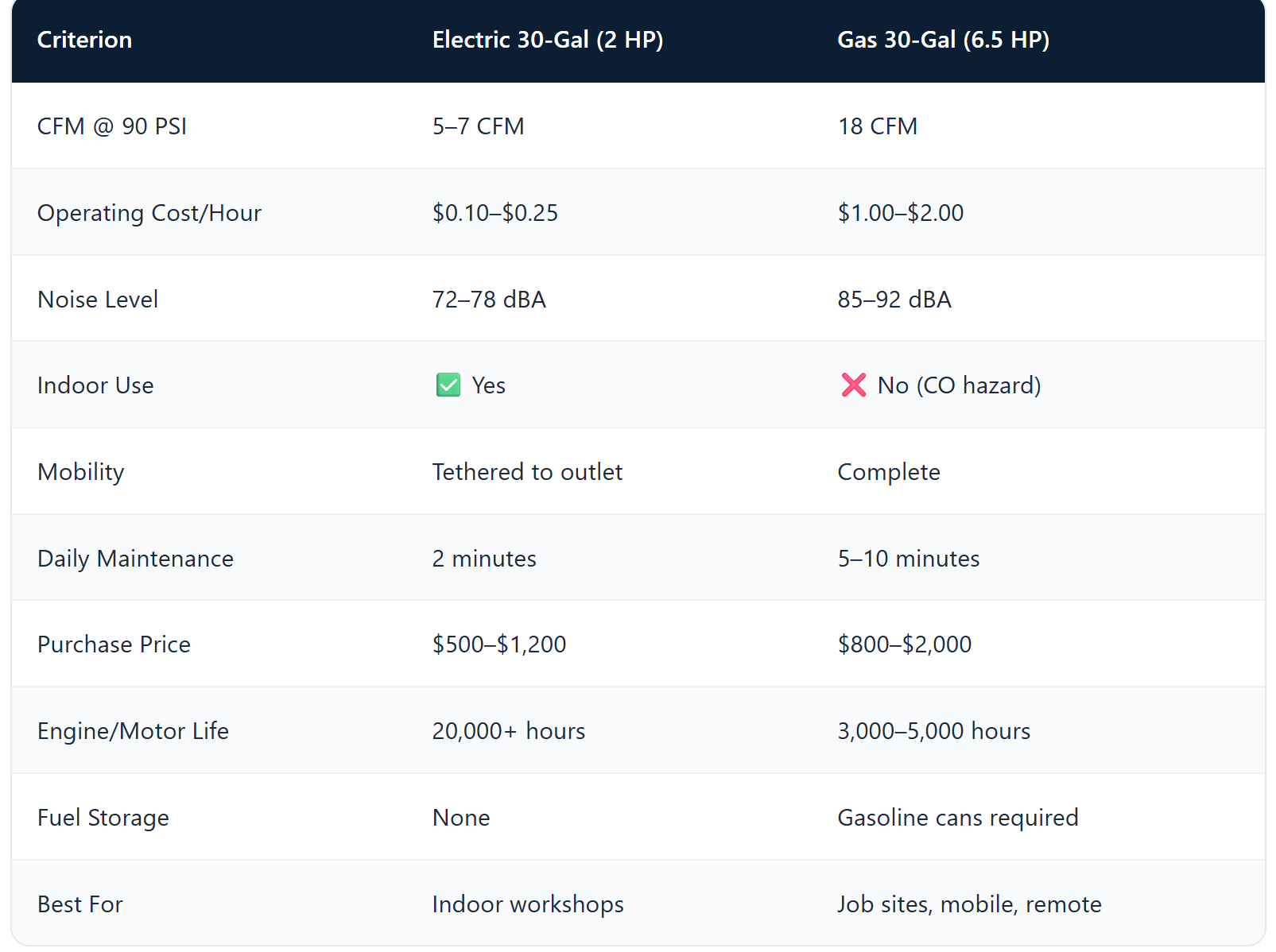
Choose an electric 30 gal air compressor if any of these describe your situation:
● Your compressor lives in a garage or shop with available power. If the compressor will spend its entire life within 25 feet of an electrical outlet, you are paying a mobility premium for gas that you will never use.
● You value quiet operation. The 15–20 dBA difference between electric belt-drive and gas is perceptually dramatic — an electric compressor allows conversation; a gas compressor requires shouting.
● You work on vehicles indoors. Automotive repair in an enclosed garage requires electric — you cannot operate a gas engine indoors, period.
● Your air demand is moderate (5–7 CFM). If your tools are impact wrenches, air ratchets, nailers, and inflation — all well within the capability of a 5–7 CFM electric compressor — gas power is overkill.
● You want minimal maintenance. An electric compressor's daily routine: drain the tank, glance at the belt. That is it. No fuel, no oil checks (beyond pump oil every 300 hours), no spark plugs, no carburetor.
● You have 240V power available. A 240V, 3–5 HP electric motor produces 10–15 CFM — approaching gas compressor output without the noise, fuel, or maintenance penalties.
Choose a gas-powered 30-gallon compressor if any of these describe your situation:
● You work on job sites without power. This is the gas compressor's core use case. New construction, remote agricultural work, roadside service — anywhere the electrical grid does not reach.
● You need 12+ CFM and lack 240V power. A gas compressor delivers high CFM without electrical infrastructure. If you need to run multiple nailers, texture sprayers, or impact tools and only have 120V available, gas is your path to adequate air volume.
● Your compressor moves between locations. A portable gas compressor on a trailer provides air wherever the truck goes. An electric compressor must be unloaded, positioned near power, and connected.
● You work in agriculture or rural settings. Farms, ranches, and rural properties often lack power at the point of use. A gas compressor on a utility vehicle or trailer is the practical solution.
● You need backup capability during power outages. In regions prone to weather-related outages, a gas compressor continues working when the grid fails. This is particularly relevant for essential services (equipment repair, emergency response).
HPDMC is uniquely positioned to provide unbiased guidance on the electric vs gas decision because we manufacture and sell both types — and we have no incentive to push you toward one over the other. Both our electric and gas 30 gallon air compressors feature the same cast-iron pumps, ASME-certified tanks, and factory-direct pricing model:
● HPDMC Electric 30-Gallon: IE3 motor, cast-iron belt-drive pump, 5–7 CFM, 72–78 dBA — the quiet, low-maintenance workshop standard.
● HPDMC 13HP Gas 30-Gallon: Kohler or Lonxin industrial engine, cast-iron pump, 18 CFM, portable frame with pneumatic tires — the mobile powerhouse for job sites and remote operations.
Electric is dramatically cheaper to operate — approximately $0.10–$0.25 per hour versus $1.00–$2.00 per hour for gasoline. At 500 annual operating hours, the annual fuel cost difference is $450–$875. Over a 10-year compressor lifespan, the electric unit can save $4,500–$8,750 in fuel costs alone. However, this assumes the electric compressor can do the job — if your application requires the higher CFM of a gas compressor, operating cost is irrelevant because the electric unit simply cannot perform the work. The operating cost comparison only matters when both power sources can meet your CFM requirements.
No. Even with the garage door fully open, a gas compressor produces carbon monoxide that can accumulate in the garage space, particularly on calm days without wind to disperse the exhaust. CO is approximately the same density as air and does not simply "flow out" an open door — it mixes with the ambient air. The only safe operating location for a gas compressor is fully outdoors, positioned at least 20 feet from any door, window, or air intake, with exhaust directed away from the building. For indoor compressed air needs, use an electric 30 gallon air compressor or run a long air hose from an externally positioned gas compressor.
It is not inherent to gas engines — it is a practical limitation of electrical circuits. A 120V, 15-amp household circuit can deliver approximately 1.5 HP continuously. A 240V, 30-amp circuit can deliver approximately 5 HP. But a 6.5HP gas engine is not limited by circuit amperage — it can deliver its full rated power wherever it operates. Gas compressors in the 30-gallon format typically use 6.5–13 HP engines because that is the power level that makes sense for the tank size. An equivalent electric motor (6.5 HP) would require a 240V, 50-amp circuit — beyond what most residential panels can support. So while an electric 30-gallon compressor could theoretically match gas CFM output, the electrical infrastructure required makes it impractical for home and small commercial settings.
Gas compressors are 15–20 dBA louder than belt-drive electric models (85–92 dBA vs 70–78 dBA). Perceptually, every 10 dBA increase is perceived as roughly twice as loud — so a gas compressor sounds 2–3× louder than an electric equivalent. This difference has practical implications: an electric compressor allows normal conversation in the workshop; a gas compressor requires raised voices or hearing protection. In residential settings, the noise difference can be the deciding factor — an electric compressor is unlikely to disturb neighbors through walls; a gas compressor almost certainly will. For noise-sensitive environments, electric belt-drive is the clear choice. See our OSHA noise safety guide.
Yes. HPDMC manufactures and sells both electric and gas 30 gallon air compressors. Our electric models feature IE3 efficiency motors, cast-iron belt-drive pumps, and ASME-certified tanks — available in 120V (1.5–2 HP) and 240V (2–3 HP) configurations. Our gas models feature Kohler Command PRO or Lonxin industrial engines (6.5–13 HP), cast-iron pumps, ASME-certified tanks, and portable frames with pneumatic tires. Both power sources are available at factory-direct pricing from our Los Angeles and Chicago warehouses. Because we manufacture both types, our technical team can provide objective guidance on which power source matches your application — we have no bias toward either.
Gas compressors require all the maintenance of an electric compressor (pump oil, tank draining, belt checks) plus engine-specific maintenance: engine oil changes every 50 hours, air filter cleaning/replacement, spark plug inspection/replacement (100–200 hours), fuel system maintenance (carburetor cleaning, fuel stabilizer for storage, fuel line inspection), and seasonal storage procedures (drain or stabilize fuel). Gas engines also have components that electric motors do not: carburetors, ignition systems, recoil starters, and fuel tanks — each a potential failure point requiring diagnosis and repair. Estimated additional annual maintenance time: 5–10 hours per year for a compressor running 500 hours.
Technically possible but economically impractical. Converting would require replacing the motor/engine, fabricating new mounting brackets, changing the drive pulley (different shaft sizes and RPM ranges), and potentially modifying the belt guard and frame. The cost of a new engine/motor plus fabrication labor approaches or exceeds the cost of a new compressor. Additionally, the conversion voids any remaining warranty. If you need a different power source, sell your existing compressor and purchase the correct configuration — it is faster, cheaper, and preserves warranty coverage.
Get a free, no-obligation consultation from HPDMC's compressor experts — we'll analyze your power availability, CFM needs, and budget to recommend the optimal power source.
✔️ Same‑day quotes · ✔️ Factory‑direct pricing · ✔️ 24‑hr shipping from Local Warehouse
Compare portability, noise, maintenance, and operating cost for gas and electric models.
🔌 Compare Power OptionsSpecs, prices, and top picks. Learn what CFM, PSI, and tank size you need for your tools.
📖 Read the 30 Gallon GuideFind portable electric and gas models for home, workshop, or job site.
👉 Find Your Portable Compressor


Find the Right Compressor for Your Needs
Find the Right Compressor for Your Needs