⚡Free Shipping: Ultra-Quiet Portable Oil-Free Air Compressor AWR800-18LM2
Need Help Choosing the Right Compressor?
Need Help Choosing the Right Compressor?
⚡Free Shipping: Ultra-Quiet Portable Oil-Free Air Compressor AWR800-18LM2
Need Help Choosing the Right Compressor?
⚡Free Shipping: Ultra-Quiet Portable Oil-Free Air Compressor AWR800-18LM2

30 Gallon vs 60 Gallon vs 80 Gallon Air Compressors: How to Choose the Right Tank Size
The Tank Size Dilemma: Bigger Is Not Always Better
One of the most common questions HPDMC receives from first-time compressor buyers is a variation of: "Should I get the 60-gallon or the 80-gallon?" Underlying this question is an assumption that bigger tanks are inherently better — more air storage means more capability, and if some is good, more must be better. This assumption is wrong in ways that can cost you thousands of dollars in unnecessary expenditure, wasted floor space, and electrical upgrades you do not actually need.
⚠️ The Golden Rule: An undersized tank means your pump cycles constantly, overheating and wearing prematurely. An oversized tank means you paid for storage capacity you never use, dedicated floor space to a machine larger than necessary, and possibly installed 240V electrical service for a compressor that could have run on 120V.
This guide provides a rigorous, application-based comparison of the three most common stationary compressor tank sizes. We will examine how tank volume affects tool runtime, pump duty cycle, electrical requirements, physical footprint, and total cost. By the end, you will know exactly which tank size — 30 gal air compressor, 60-gallon, or 80-gallon — matches your specific workshop needs. For the core 30-gallon context, see our 30-gallon compressor overview.
Tank Size Basics: What Gallons Actually Mean
Before comparing specific sizes, it is essential to understand what the tank does and does not do:
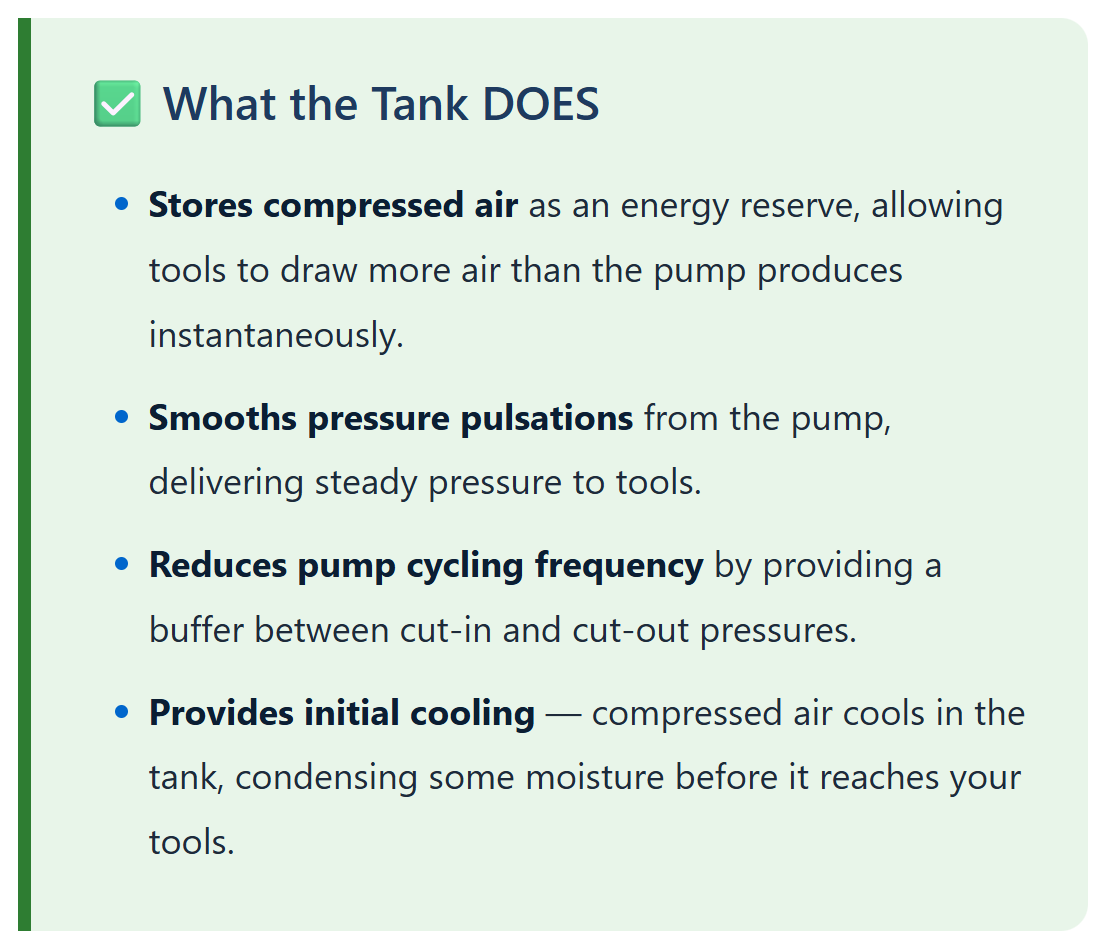
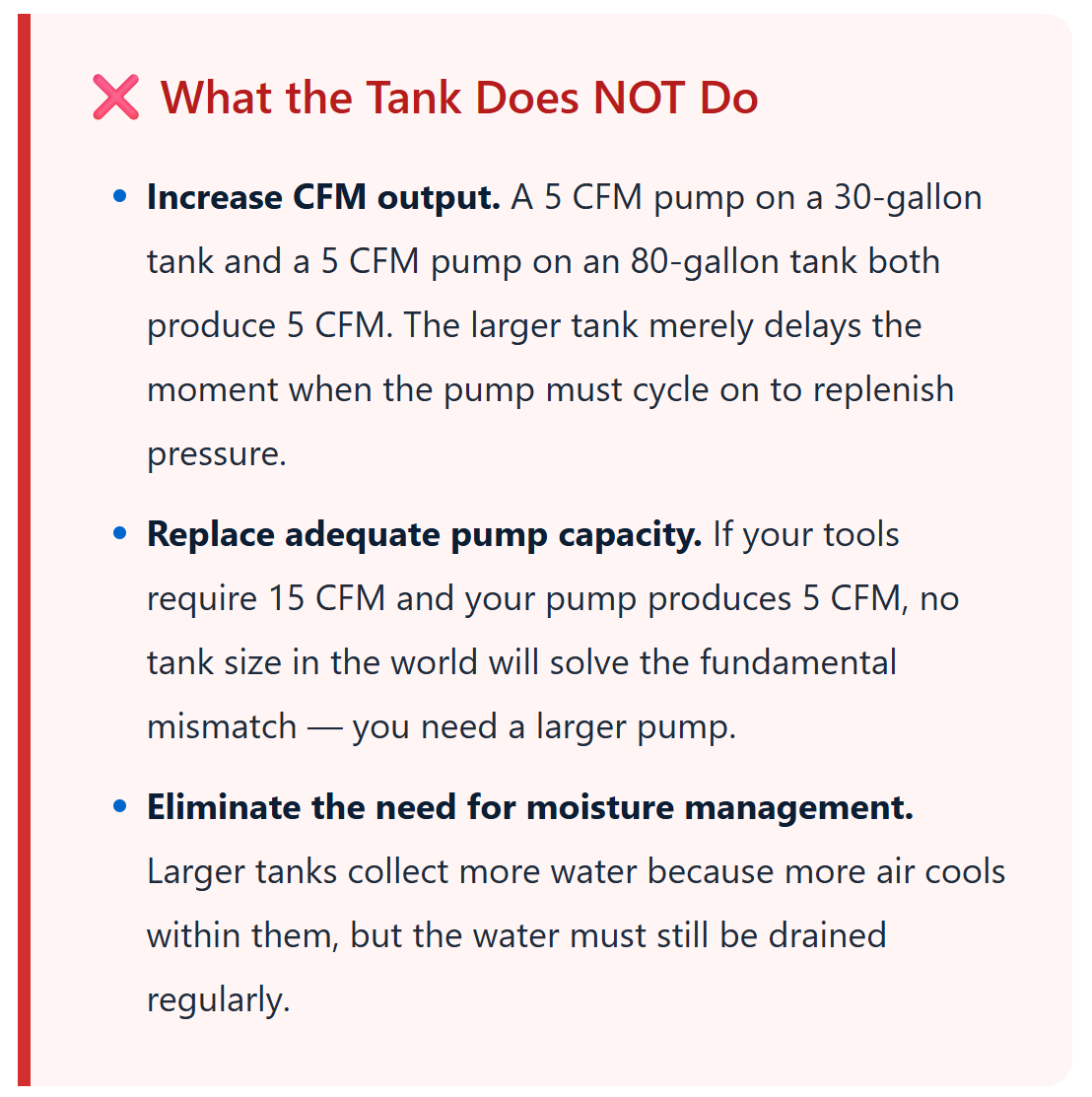
The practical implication: when choosing between a 30 gal air compressor, 60-gallon, or 80-gallon, you are primarily choosing how long your tools can run between pump cycles — not whether your compressor can run those tools at all. For CFM-to-tool matching, see HP, PSI, and CFM guide.
30-Gallon Compressors: The Practical Sweet Spot
Physical Characteristics
● Dimensions: Approximately 48"L × 22"W × 36"H (horizontal configuration)
● Weight: 180–250 lbs (electric), 200–280 lbs (gas)
● Footprint: Approximately 7–8 square feet
● Mobility: One person can move on level ground; two for loading/unloading
Electrical Requirements (Electric Models)
● 1.5–2 HP models: 120V, 15–20 amp dedicated circuit
● 2–3 HP models: 240V, 20–30 amp dedicated circuit
● Gas models: No electrical requirement
Ideal Applications
● Home workshops and hobbyist garages
● Small auto repair shops (1–2 bays)
● Portable job-site use (gas models)
● Woodworking shops running one tool at a time
● Light manufacturing with intermittent air demand
Runtime at 90 PSI with 5 CFM Pump
Approximately 30–60 seconds of continuous tool use at 10 CFM draw before pump cycles. Adequate for impact wrenches, air ratchets, and nailers used intermittently. Marginal for continuous painting or grinding.
HPDMC's 30 gallon compressor models feature ASME-certified tanks, cast-iron pumps, and factory-direct pricing. The air compressor 30 gal category is our best-selling format for good reason — it covers 80% of workshop applications while remaining physically and financially accessible. See our best 30-gallon picks.
60-Gallon Compressors: The Professional Upgrade
Physical Characteristics
● Dimensions: Approximately 60"L × 24"W × 48"H (vertical configuration common)
● Weight: 350–500 lbs
● Footprint: Approximately 10 square feet (vertical), 14 square feet (horizontal)
● Mobility: Requires two people or mechanical assistance (engine hoist, pallet jack) to move
Electrical Requirements
● Universally 240V, 30–40 amp dedicated circuit
● Hardwired or NEMA 6-50 plug
● Electrical installation cost: $300–$800 for new circuit (if not pre-existing)
Ideal Applications
● Professional auto repair shops (2–4 bays)
● Body shops with intermittent painting
● Light manufacturing with continuous air demand
● Woodworking shops running multiple tools
● Small fabrication shops
Runtime at 90 PSI with 10–12 CFM Pump
Approximately 1–2 minutes of continuous tool use at 15 CFM draw before pump cycles. Handles automotive air tools comfortably, supports intermittent painting, and allows two-person simultaneous tool use on most tools.
HPDMC offers 60-gallon compressors across both electric PM VSD rotary screw and belt-drive piston configurations. The larger tank pairs with correspondingly larger pumps (typically 3–5 HP electric), providing the CFM increase that actually matters for professional use — unlike simply putting a 5 CFM pump on a larger tank.
80-Gallon Compressors: Industrial Capacity
Physical Characteristics
● Dimensions: Approximately 30"W × 72"H (vertical configuration dominates)
● Weight: 500–800+ lbs
● Footprint: Approximately 8–10 square feet (vertical — surprisingly compact footprint for capacity)
● Mobility: Requires mechanical handling; essentially a permanent installation
Electrical Requirements
● 240V or 480V three-phase (check your facility — three-phase is common in industrial buildings but rare in residential and small commercial)
● 40–80 amp dedicated circuit
● Electrical installation cost: $500–$2,000+ (especially if three-phase service must be added)
Ideal Applications
● Production auto repair and body shops (5+ bays)
● Manufacturing plants with continuous compressed air demand
● Multi-user workshops with manifold distribution systems
● Sandblasting and industrial coating operations
● Any facility where air demand is continuous and multiple tools run simultaneously
Runtime at 90 PSI with 15–25 CFM Pump
Supports near-continuous multi-tool operation. An 80-gallon tank with a 20 CFM pump is the entry point for true industrial compressed air systems. HPDMC's PM VSD rotary screw compressors in 80-gallon configurations provide 7.5–100 HP with IE3 motors and up to 40% energy savings through variable-speed drive technology. Learn about VSD savings.
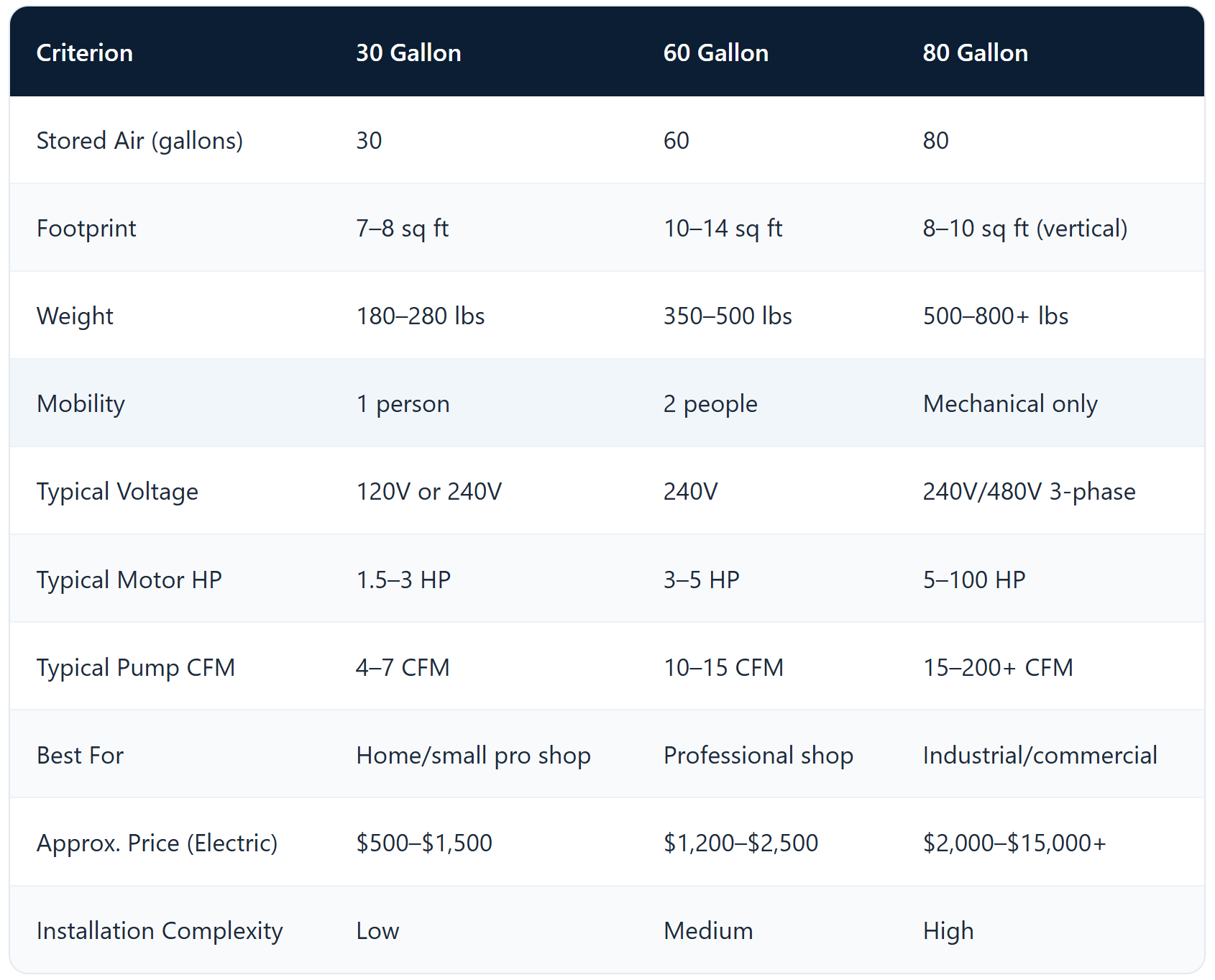
Head-to-Head Comparison Table
The Decision Framework: Which Tank Size Do You Actually Need?
Answer these five questions, and your tank size will become clear:
● How many people use air simultaneously? 1 person = 30-gallon adequate. 2 people = 60-gallon recommended. 3+ people = 80-gallon required.
● What is your highest-CFM tool? Under 10 CFM intermittent = 30-gallon. 10–20 CFM = 60-gallon. 20+ CFM or continuous use = 80-gallon.
● What power is available? 120V only = 30-gallon electric (1.5–2 HP) or gas 30-gallon. 240V single-phase = 30–80 gallon electric. 480V three-phase = 80-gallon industrial.
● Is the compressor stationary or mobile? Stationary = size up if budget and power allow. Mobile = 30-gallon gas model is the practical maximum for single-person portability.
● What is your budget including installation? Factor in electrical work — adding a 240V circuit costs $300–$800; adding three-phase can cost thousands.
💡 Pro Tip: Most home and small professional workshops are best served by a 30 gallon compressor. It provides enough air for automotive and woodworking tools, fits in a residential garage, and minimizes electrical installation requirements. The 60-gallon and 80-gallon formats are for users who have already identified that 30 gallons is insufficient — not for users upgrading preemptively "just in case."
For comprehensive sizing guidance, see our tank sizing guide and small business sizing guide.
Frequently Asked Questions About Compressor Tank Sizes
Will a bigger tank make my compressor more powerful?
No. Tank size does not increase CFM (airflow) or PSI (pressure). A 30 gallon compressor with a 5 CFM pump and an 80-gallon compressor with a 5 CFM pump both deliver 5 CFM to your tools — the larger tank simply provides a longer buffer before the pump must cycle on. The pump determines sustained tool capability; the tank determines runtime between cycles. If your tools demand more air than your pump produces, a larger tank only delays the inevitable pressure drop by a few minutes. To increase real capability, you need a larger pump (higher CFM), not a larger tank.
Can I run a 60 or 80 gallon compressor on 120V?
No. Motors above approximately 2 HP require 240V power — the amperage draw exceeds what a 120V circuit can safely provide. Since 60-gallon and 80-gallon compressors almost universally use 3 HP or larger motors, they require 240V (or 480V three-phase for large industrial units). The only large-tank exception is gas-powered compressors, which have no electrical requirements. If your workshop has only 120V power, your electric compressor options are limited to approximately 2 HP (30-gallon or smaller). For 120V-constrained workshops, consider a gas-powered HPDMC 30-gallon or 60-gallon portable compressor — these deliver 12–44 CFM without any electrical infrastructure.
Why would anyone buy a 30 gallon compressor if bigger tanks are available?
Four practical reasons: (1) Space — a 30 gallon compressor fits in a residential garage; an 80-gallon unit may not. (2) Power — many 30 gallon compressors run on 120V; 60+ gallon units require 240V (and electrician costs). (3) Portability — a 30 gallon compressor can be moved by one person; 60+ gallon units are stationary. (4) Cost — a quality 30 gallon compressor costs $500–$1,500; a quality 80-gallon unit with installation can exceed $4,000. For home workshops and small professional shops, the 30 gallon air compressor provides the best balance of capability, space efficiency, and cost. The "right" tank size is the one that matches your actual air demand — not the largest one that fits your budget.
How much does it cost to install a 240V circuit for a larger compressor?
Budget $300–$800 for a licensed electrician to install a 240V, 30–50 amp dedicated circuit, assuming your electrical panel has available capacity and is located in or near the garage. Costs increase if: the panel is on the opposite side of the house ($200–$400 additional for longer wire run), your panel is full and requires a sub-panel ($500–$1,200 additional), or your service entrance needs upgrading (100A to 200A service upgrade can cost $2,000–$4,000). Always get multiple quotes and ensure the electrician pulls a permit — unpermitted electrical work can void your homeowner's insurance. This installation cost should be factored into any 60+ gallon compressor purchase decision.
Can I connect two 30 gallon tanks together instead of buying one 60 gallon?
Yes — connecting two ASME-certified tanks in parallel effectively creates 60 gallons of storage. This can be a practical solution for users who already own a 30 gallon compressor and need more buffer capacity without replacing the entire unit. The auxiliary tank must have its own ASME certification, safety relief valve, pressure gauge, and drain. Connect them with a tee fitting and air hose rated for the system pressure. Important caveat: adding a second tank increases stored air volume but does NOT increase CFM output. If your issue is insufficient pump capacity (tools demanding more CFM than the pump produces), a second tank does not solve it — it only prolongs the inevitable pressure drop.
How do I move an 80 gallon compressor into my shop?
Plan ahead — an 80-gallon compressor weighs 500–800+ lbs and will not be moved by manpower alone. Delivery options: (1) liftgate truck service — the freight company lowers the crated compressor to ground level with a hydraulic liftgate (typically $75–$150 additional freight charge); (2) rent or borrow an engine hoist (cherry picker) to lift the compressor off the pallet and lower it into position; (3) a pallet jack can move a crated compressor on smooth concrete but cannot navigate steps or gravel; (4) consider professional rigging for difficult access (basement shops, tight doorways). Before ordering, measure all doorways, hallways, and corners the compressor must navigate — an 80-gallon vertical compressor is approximately 30" wide × 72" tall and must pass through every opening on its journey to its final location.
Is a vertical or horizontal tank better?
Neither is universally better — the choice depends on your space constraints. Vertical tanks (common in 60 and 80-gallon formats) occupy less floor space (approximately 8–10 sq ft) but require ceiling clearance (72"+ height). Horizontal tanks (common in 30-gallon formats) have a lower profile (approximately 36" height) but occupy more floor area (7–8 sq ft). For garages with standard 8-foot ceilings, either orientation works. For basements or spaces with low ceilings, horizontal is essential. For shops where floor space is at a premium, vertical is preferred. Functionally, tank orientation has no effect on performance — 30 gallons is 30 gallons regardless of which direction the cylinder points.
Find the Right Tank Size from HPDMC's Full Range
Whether a 30 gallon compressor, 60-gallon, or 80-gallon industrial unit is right for your application, HPDMC delivers factory-direct pricing with ASME-certified tanks, cast-iron pumps, and IE3 motors across all size categories. Fast shipping from Los Angeles and Chicago warehouses.
👉 Browse all tank sizes at the HPDMC product mall
contact our team for personalized tank-sizing guidance.



Find the Right Compressor for Your Needs
Find the Right Compressor for Your Needs