⚡Free Shipping: Ultra-Quiet Portable Oil-Free Air Compressor AWR800-18LM2
Need Help Choosing the Right Compressor?
Need Help Choosing the Right Compressor?
⚡Free Shipping: Ultra-Quiet Portable Oil-Free Air Compressor AWR800-18LM2
Need Help Choosing the Right Compressor?
⚡Free Shipping: Ultra-Quiet Portable Oil-Free Air Compressor AWR800-18LM2

The Cost of Choosing Wrong: Why Industrial Compressor Selection Matters
Summary
Selecting an industrial compressor is one of the most consequential equipment decisions a business makes — yet it is often approached with less rigor than choosing office furniture. The consequences of a poor selection cascade through the operation: an undersized compressor starves production tools of air, creating bottlenecks that idle expensive labor and machinery. An oversized compressor wastes energy continuously — every hour it runs, a portion of its output is literally blown off through a relief valve, converting expensive electricity into noise and heat. A compressor with the wrong air quality specification contaminates products, ruins finishes, or fails regulatory inspection.
The financial stakes are substantial. Compressed air is often called the "fourth utility" in manufacturing — alongside electricity, water, and natural gas — and for good reason. In a typical U.S. manufacturing facility, the compressed air system accounts for 10–30% of total electricity consumption. A 10% efficiency difference on a 50 HP compressor translates to approximately $3,000 per year in electricity costs at average U.S. industrial electricity rates. Over a 15-year equipment lifespan, that is $45,000 — often exceeding the purchase price of the compressor itself.
This guide provides a systematic framework for selecting the right industrial compressor for your U.S. business. It is the process that HPDMC's application engineers use when working with industrial customers, adapted for self-guided use. By following these steps, you will define your requirements in objective terms and identify the compressor configuration that matches them — without overspending on capacity you do not need or underspending on quality that will cost you later. For cost comparisons, see our industrial cost guide.
➡️Step 1: Calculate Your Total CFM Demand (Accurately)
CFM (Cubic Feet per Minute) at your operating pressure is the single most important specification. Everything else — horsepower, tank size, technology type — follows from this number. The calculation must be accurate, because the consequences of error are asymmetric: undersizing by 10% causes production problems; oversizing by 10% wastes energy for the life of the machine.
📌The Right Way to Calculate CFM Demand
1. List every compressed air consumer: Tools, machines, blow-off stations, air-operated valves, cylinder actuators, air curtains, everything. Do not guess — walk the facility and physically identify each consumer.
2. Determine CFM for each consumer: Use the manufacturer's published CFM specification at the operating pressure. If the specification is unavailable, use industry reference tables or measure with a flow meter. For pneumatic cylinders, calculate CFM from bore diameter, stroke length, and cycle rate.
3. Apply a diversity factor: Not all consumers operate simultaneously. For a CNC machine shop, the diversity factor might be 70–80% (not all machines are cutting at the same moment). For a continuous process line, it might be 95–100%. Be realistic — overestimating the diversity factor is a common cause of undersizing.
4. Calculate simultaneous demand: Sum the CFM of all consumers, multiplied by their individual utilization factors (percentage of time each consumer actually draws air). Add a 25–30% buffer for future growth, leaks, and unanticipated peak demands. This is your minimum required CFM.
📌CFM Reference: Common Industrial Tools
● 1/2" impact wrench: 4–6 CFM
● Die grinder: 6–8 CFM
● Random orbital sander: 8–12 CFM
● HVLP spray gun: 10–15 CFM
● CNC machine (per spindle): 3–8 CFM
● Pneumatic cylinder (4" bore, 12" stroke, 10 cycles/min): 2–4 CFM
● Blow-off nozzle: 3–10 CFM
● Sandblast cabinet (small): 15–25 CFM
● Sandblast cabinet (production): 50–100+ CFM
➡️Step 2: Define Your Duty Cycle
Duty cycle — the percentage of time the compressor actually runs versus rests — determines which compressor technology is appropriate. This is not the same as your facility's operating hours. A compressor rated for 100% duty cycle can run continuously. One rated for 60% duty cycle must rest 40% of the time to dissipate heat.
Define your duty cycle by answering: (1) How many hours per day does the compressor run? (2) During those hours, what percentage of the time is it actually compressing air (as opposed to idling or being off while the tank provides buffer)? (3) Is your demand pattern steady (continuous process) or variable (batch production, shift-based)?
A facility operating 8 hours per day with intermittent tool use (auto repair shop) may have a 30–50% effective duty cycle — a piston compressor is appropriate. A facility operating 24/7 with continuous pneumatic processes has a 90–100% duty cycle — a rotary screw compressor is required. Attempting to run a piston compressor at 100% duty cycle will destroy it within months. Running a rotary screw at 20% duty cycle will cause oil foaming and moisture accumulation. Match the technology to the duty cycle.
➡️Step 3: Determine Required Air Quality
Air quality is defined by ISO 8573-1, which classifies compressed air by particle content, water content, and oil content. Most general industrial applications require only basic filtration (remove bulk water and particles). Food, pharmaceutical, electronics, and medical applications require progressively higher purity — potentially up to Class 0 (zero oil).
The air quality requirement drives two decisions:
(1) Compressor type — oil-injected screw/piston (with downstream filtration) for general use; oil-free scroll or oil-free screw for critical applications.
(2) Air treatment equipment — dryer type (refrigerated, desiccant, or membrane), filter types (particulate, coalescing, activated carbon), and monitoring requirements.
Over-specifying air quality wastes capital and operating cost. Under-specifying risks product contamination and regulatory non-compliance. The correct approach: identify the highest air quality requirement among your consumers, and design the treatment system to meet that specification — treating all air to one standard is simpler and more reliable than point-of-use treatment for individual consumers.
➡️Step 4: Select Operating Pressure
Most industrial pneumatic equipment operates at 90–100 PSI. Compressing to higher pressure than necessary wastes energy — every 2 PSI increase in system pressure increases energy consumption by approximately 1%. However, pressure drop through piping, filters, dryers, and hoses must be accounted for. If your tools require 90 PSI at the point of use, and total system pressure drop is 15 PSI, your compressor must deliver 105 PSI minimum at the discharge.
Reduce pressure drop through: properly sized piping (oversized pipes pay for themselves in reduced energy costs), high-flow fittings and couplers, regularly changed filters, and locating the compressor as close as practical to the point of use. A 5 PSI reduction in system pressure drop is worth approximately 2.5% in energy savings — continuous savings that compound over the equipment's life.
➡️Step 5: Evaluate Total Cost of Ownership, Not Purchase Price
The purchase price of an industrial compressor represents only 10–20% of its total lifecycle cost. Energy consumption represents 70–80%. Maintenance represents 5–10%. Focusing on purchase price while ignoring energy efficiency is the single most expensive mistake in compressor selection.
For a 50 HP compressor operating 6,000 hours annually at $0.10/kWh: annual energy cost = approximately $22,000. Over 15 years, energy cost = $330,000 — while the compressor purchase price was $15,000–$25,000. A 10% efficiency difference amounts to $33,000 over the equipment's life — more than the purchase price. This is why technologies like HPDMC's PM VSD (up to 40% energy savings) and IE3 motors (2–4% more efficient than IE2) deliver value far exceeding their cost premium. See our energy efficiency guide.
📒Why HPDMC Industrial Compressors Deliver Better Value
When comparing HPDMC against Compressed Air Advisors, Compressor World, USAirCompressor, and other industrial suppliers, our factory-direct model creates structural advantages:
● 15–25% lower purchase price: No distributor or dealer markup in the supply chain.
● PM VSD technology standard: Up to 40% energy savings versus fixed-speed compressors — the single largest contributor to TCO reduction.
● IE3 motors standard: Higher efficiency, cooler running, longer motor life.
● Dual U.S. warehousing: Fast delivery and parts availability from Los Angeles and Chicago.
● Direct manufacturer support: Warranty claims, technical support, and parts go directly through Bravo Equipment Corporation — no dealer middleman.
Let HPDMC Help You Choose the Right Industrial Compressor
Selecting the right industrial compressor for your business is a decision with 15-year consequences. HPDMC's application engineers can analyze your specific requirements and recommend the optimal configuration — without technology bias, because we manufacture rotary screw, piston, and scroll compressors. Factory-direct pricing, U.S. warehouse support, and direct manufacturer warranty.
Explore HPDMC industrial compressors or contact our industrial team for a free application assessment and quotation.
Frequently Asked Questions
How do I calculate the CFM I need for my business?
Sum the CFM requirements of all tools that run simultaneously, apply a realistic diversity factor (percentage of tools actually running at the same time — typically 60–80% for job shops, 90–100% for continuous processes), then add 25–30% for future growth and system leaks. Example: 10 CNC machines at 4 CFM each (40 CFM total), 70% diversity = 28 CFM, plus 30% buffer = 36 CFM minimum required. Convert to approximate HP: divide CFM by 4 for rotary screw compressors (36/4 = 9 HP, round up to 10 HP). For precise sizing, HPDMC can perform an air audit using data-logging flow meters that capture actual demand patterns over a representative production period.
What's the difference between a 10 HP and 20 HP industrial compressor?
A 20 HP industrial compressor produces approximately twice the CFM of a 10 HP unit at the same pressure (roughly 40 CFM vs 80 CFM at 100 PSI for rotary screw). However, the 20 HP unit costs approximately 50–70% more to purchase (not 100% — there are economies of scale in larger airends, motors, and enclosures). The 20 HP consumes twice the electricity when running at full load. The correct size depends on your CFM requirement: if you need 35 CFM, a 10 HP unit is too small. If you need 70 CFM, a 10 HP unit is woefully undersized. But if you need 45 CFM and buy a 20 HP "just to be safe," you are paying for capacity you never use and wasting energy through blow-off and inefficiency at part-load operation. Size to actual demand plus buffer, not to "bigger is safer."
Do I need a dryer with my industrial compressor?
For most industrial applications — yes. Compressed air contains concentrated moisture from atmospheric humidity. Without drying, this moisture condenses in pipes, causing rust and scale that contaminate tools and processes. Minimum recommendation: a refrigerated air dryer for any industrial application. It provides a pressure dew point of 35–39°F — adequate for general manufacturing, machine tools, and pneumatic controls. For critical applications (painting, food contact, instrumentation, electronics), a desiccant dryer providing -40°F pressure dew point is required. HPDMC's SE Series refrigerated dryers are designed to pair with our compressor outputs. See our air dryer guide.
Should I buy multiple smaller compressors or one large one?
Multiple smaller compressors offer advantages for operations with variable demand: (1) Redundancy — if one compressor fails, the others maintain partial production (critical for operations where downtime costs exceed compressor cost). (2) Efficiency at part load — running one small compressor at full load is more efficient than running one large compressor at 30% load. (3) Maintenance flexibility — compressors can be serviced sequentially without shutting down production. The trade-off: multiple smaller units cost more to purchase and require more maintenance touch-points. Rule of thumb: if your demand is steady (continuous process), one properly-sized compressor with VSD is most efficient. If your demand is highly variable (batch production, shift-based), two or three smaller compressors with a sequencing control system often provide better overall efficiency and resilience. HPDMC can model both configurations for your specific demand profile.
How much can I save with a VSD industrial compressor?
Up to 40% energy savings compared to a fixed-speed compressor, with typical real-world savings of 25–35% for operations with variable demand patterns. A 30 HP compressor operating 6,000 hours annually at $0.10/kWh: annual energy cost at fixed speed = approximately $14,000. At 30% VSD savings = $4,200 saved annually. The VSD price premium (typically $2,000–$4,000 for a 30 HP unit) pays back in 6–12 months, then generates pure savings for the remaining 10–15 years of equipment life. For operations with steady demand (compressor running at near-full load continuously), VSD savings are lower (5–10%) because the compressor runs near its design speed most of the time. HPDMC's PM VSD technology combines variable speed with permanent magnet motor efficiency for maximum savings.
What electrical service does an industrial compressor require?
This varies by motor size: Under 5 HP: typically 208–240V single-phase, 20–40 amp circuit. 5–25 HP: 208–240V or 480V three-phase, 20–80 amp circuit. 30–100 HP: 480V three-phase, 60–200 amp circuit. 100+ HP: 480V or 4,160V three-phase. Verify your facility's available voltage and amperage before ordering. Three-phase power is standard in industrial buildings but rare in residential and small commercial — if your facility lacks three-phase, you may need a phase converter (adds $1,000–$5,000 and ongoing losses) or select a single-phase compressor (limited to approximately 10 HP). Always use a licensed industrial electrician for compressor electrical installation. HPDMC's technical team can provide electrical specifications for any model to support your planning.
How does HPDMC compare to Atlas Copco, Sullair, and Ingersoll Rand?
HPDMC occupies a different market position than the "Big Three" premium industrial compressor brands. Atlas Copco, Sullair, and Ingersoll Rand offer excellent products with global service networks — at premium prices reflecting their brand equity, extensive distribution networks, and comprehensive service infrastructure. HPDMC's value proposition: comparable core technology (PM VSD, IE3 motors, quality airends) at 30–50% lower purchase price through factory-direct sales without the distribution overhead. For Fortune 500 companies with global service agreements and unlimited capital budgets, the premium brands' comprehensive service networks justify their pricing. For small-to-medium U.S. manufacturers, job shops, and businesses where capital efficiency matters, HPDMC delivers equivalent compressed air capability at substantially lower total cost. Our dual U.S. warehouses, direct manufacturer support, and offline service centers provide the support infrastructure that smaller operations need.
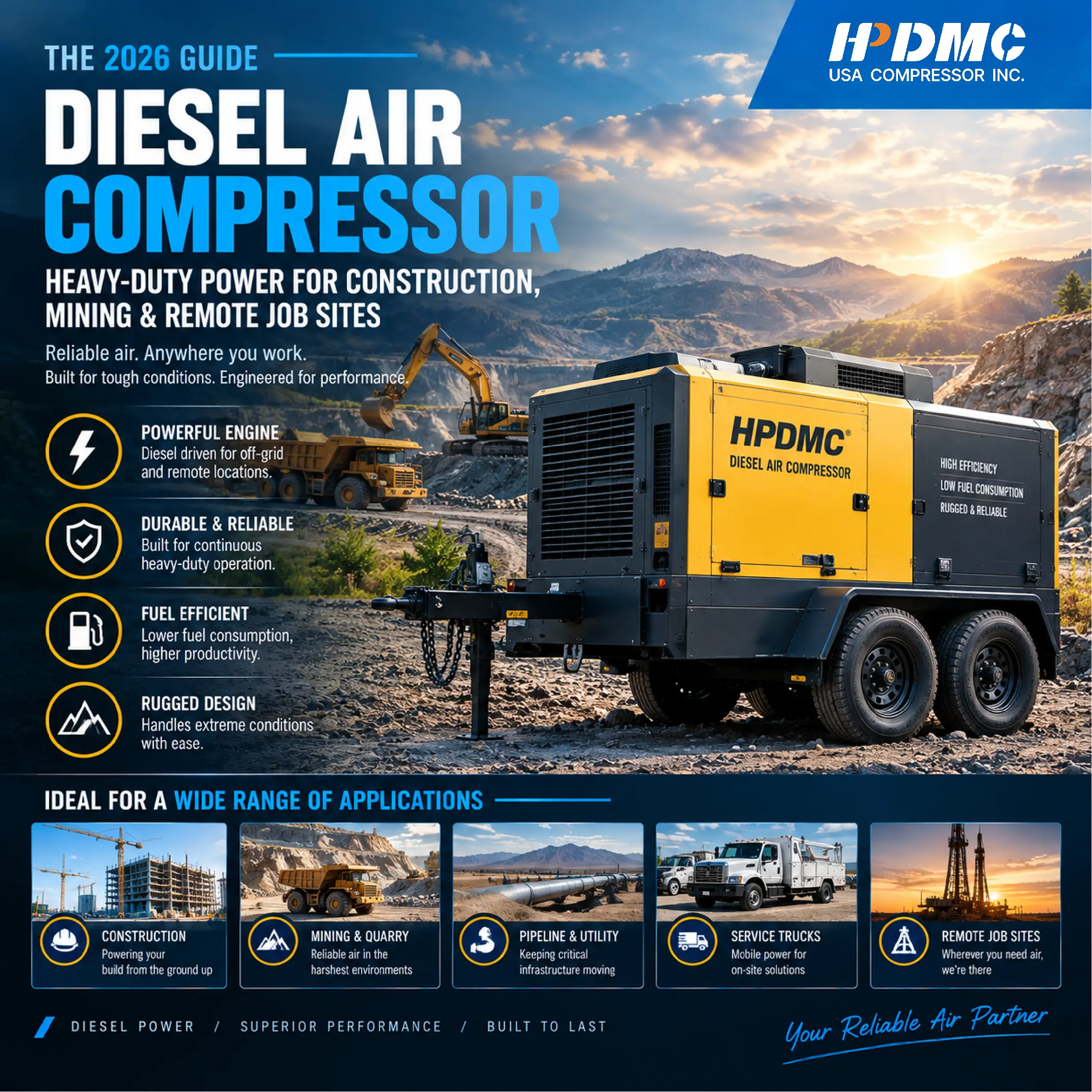



Find the Right Compressor for Your Needs
Find the Right Compressor for Your Needs