⚡Free Shipping: Ultra-Quiet Portable Oil-Free Air Compressor AWR800-18LM2
Need Help Choosing the Right Compressor?
Need Help Choosing the Right Compressor?
⚡Free Shipping: Ultra-Quiet Portable Oil-Free Air Compressor AWR800-18LM2
Need Help Choosing the Right Compressor?
⚡Free Shipping: Ultra-Quiet Portable Oil-Free Air Compressor AWR800-18LM2

CFM vs PSI in Air Compressors: What’s the Difference & Why It Matters
The key difference between CFM (cubic feet per minute, measuring airflow volume) and PSI (pounds per square inch, measuring pressure) in air compressors is that CFM determines how many tools you can run simultaneously, while PSI ensures tools operate at peak performance—HPDMC’s compressors balance both to fit U.S. industrial, workshop, and DIY needs.
Introduction: Why Understanding CFM vs PSI Air Compressor Matters
For U.S. business owners, mechanics, and DIY enthusiasts, choosing an air compressor often boils down to two confusing terms: CFM and PSI. Many buyers fixate on one metric (e.g., “higher PSI is better”) without realizing both work in tandem to power tools effectively. The result? Wasted money on a compressor that can’t run a spray gun, or a unit that struggles to inflate tires efficiently.
Understanding CFM vs PSI in air compressors isn’t just technical jargon—it’s the key to matching your tool’s requirements to the right machine. A small auto shop in Texas needs enough CFM to run a impact wrench and nail gun simultaneously, while a DIYer in California might prioritize PSI for inflating tires and powering a pressure washer. HPDMC’s U.S.-focused air compressors are engineered to balance CFM and PSI for every application, from portable piston models to industrial rotary screw units.
This guide breaks down the difference between CFM and PSI, how to calculate your needs, and which HPDMC compressors excel in U.S. use cases—so you never buy the wrong compressor again.
What Is CFM vs PSI in Air Compressors? (Clear Definitions)
To master the CFM vs PSI air compressor debate, start with the basics—both measure critical but distinct aspects of compressed air:
PSI: Pressure That Powers Tools
PSI (pounds per square inch) measures the pressure of compressed air—the force that pushes air through tools to make them work. Think of it as the “strength” of the air: higher PSI means more force to drive nails, inflate tires, or blast debris with a pressure washer.
● Typical PSI Ranges: Most HPDMC compressors range from 125–180 PSI.
○ 125 PSI: Ideal for U.S. DIYers, small shops, and tools like drills, nail guns, and tire inflators.
○ 150–180 PSI: Needed for heavy-duty tools (sandblasters, high-pressure spray guns) and industrial applications.
● Key Note: Tools have a “required PSI” (e.g., 90 PSI for a standard impact wrench). Your compressor’s PSI must meet or exceed this, but going too high (e.g., 180 PSI for a 90 PSI tool) wastes energy—use a regulator to adjust pressure.
CFM: Airflow That Sustains Tools
CFM (cubic feet per minute) measures the volume of air the compressor delivers at a specific PSI. It’s the “flow rate” that keeps tools running continuously. A compressor with high PSI but low CFM can power a tool for a few seconds but will stall as the tank depletes.
● Types of CFM:
○ Standard CFM: Airflow at 90 PSI (the most common tool requirement).
○ SCFM (Standard Cubic Feet per Minute): Airflow corrected to standard temperature/pressure (used for industrial compressors like HPDMC’s rotary screw models).
● U.S. Application Examples:A framing nail gun needs 2–4 CFM @ 90 PSI.
○ A paint sprayer requires 6–10 CFM @ 90 PSI.
○ A sandblaster demands 10+ CFM @ 100 PSI.
CFM vs PSI Air Compressor: Core Difference
| Metric | What It Measures | U.S. Use Case Impact | HPDMC Compressor Example |
| PSI | Pressure (force) | Powers tool operation; must meet tool’s minimum requirement | HPDMC 6.5HP Piston Compressor (125 PSI) – ideal for tire inflation, drills |
| CFM | Airflow (volume) | Sustains tool use; determines how many tools run at once | HPDMC 10HP Rotary Screw Compressor (18 CFM @ 125 PSI) – runs multiple shop tools |
How to Calculate Your CFM & PSI Needs (U.S. Tool Focus)
To choose the right compressor, match its CFM and PSI to your tools. Follow these steps for U.S. applications:
1. List Your Tools: Write down all tools you’ll use (e.g., impact wrench, paint sprayer, nail gun).
2. Find Tool Requirements: Check each tool’s manual for “required PSI” and “CFM @ PSI” (usually 90 PSI).
3. Calculate Total CFM: Add the CFM of all tools you’ll run simultaneously (e.g., impact wrench: 5 CFM + nail gun: 3 CFM = 8 CFM total).
4. Match Compressor Specs: Choose a compressor with PSI ≥ your tool’s max requirement and CFM ≥ your total calculated CFM.
Pro Tip for U.S. Shop Owners
Add 20% to your total CFM to account for air leaks (common in U.S. workshops with long hoses) and future tool additions. For example, if you need 8 CFM, choose a compressor with 9.6+ CFM (like HPDMC’s 10HP Rotary Screw model with 18 CFM).
CFM vs PSI Air Compressor: Which HPDMC Model Fits Your U.S. Needs?
HPDMC offers compressors tailored to U.S. use cases, balancing CFM and PSI for every application:
1. DIY & Small Workshops (Low CFM, Moderate PSI)
● Needs: 2–6 CFM @ 90–125 PSI (powers drills, nail guns, tire inflators).
● HPDMC Recommendation: 6.5HP Portable Gasoline Piston Compressor (HSJQY306508)
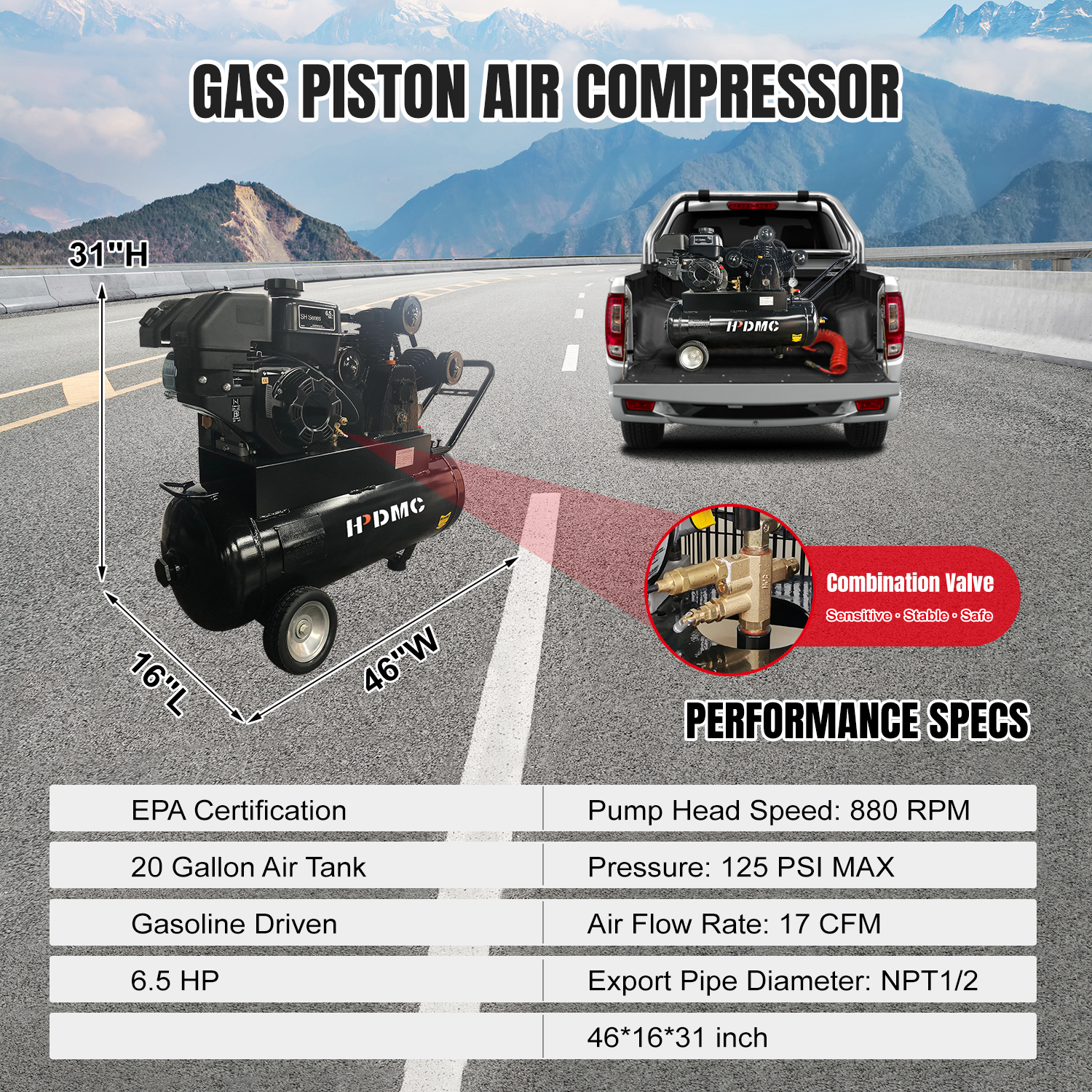
Specs: 125 PSI, 5.5 CFM @ 90 PSI, Kohler gas engine.
U.S. Fit: Portable design for home garages, mobile mechanics, and small auto shops in rural areas (no electricity needed).
● Why It Works: Balances enough CFM to run 1–2 small tools and 125 PSI for tire inflation—perfect for U.S. DIYers and hobbyists.
2. Professional Shops & Medium-Duty Use (Moderate CFM, High PSI)
● Needs: 6–12 CFM @ 125–150 PSI (runs spray guns, impact wrenches, and multiple tools).
● HPDMC Recommendation: 13HP Gasoline Piston Compressor (HSJQY309012)
Specs: 150 PSI, 9.8 CFM @ 90 PSI, Lonxin gas engine (electric/pull start).
U.S. Fit: Tire shops, body shops, and fleet maintenance teams in Texas, Florida, and California—handles spray painting, tire changing, and heavy-duty repairs.
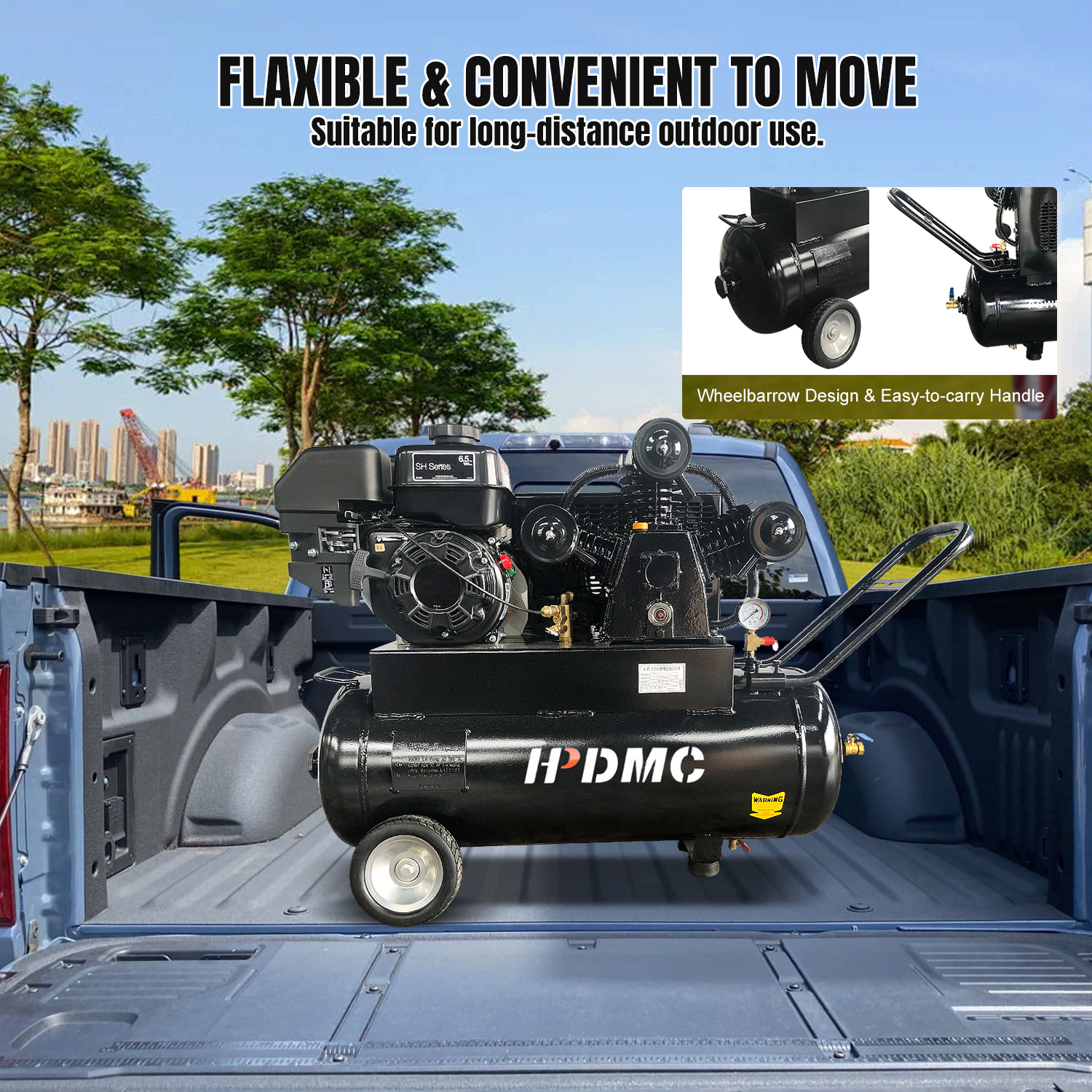
● Why It Works: High PSI for power tools and enough CFM to run 2–3 tools simultaneously, with a portable wheelbarrow design for jobsite mobility.
3. Industrial & High-Volume Operations (High CFM, Variable PSI)
● Needs: 12+ CFM @ 125–180 PSI (powers sandblasters, production lines, and multiple industrial tools).
● HPDMC Recommendation: 10HP Rotary Screw Compressor (LGJBP007004)
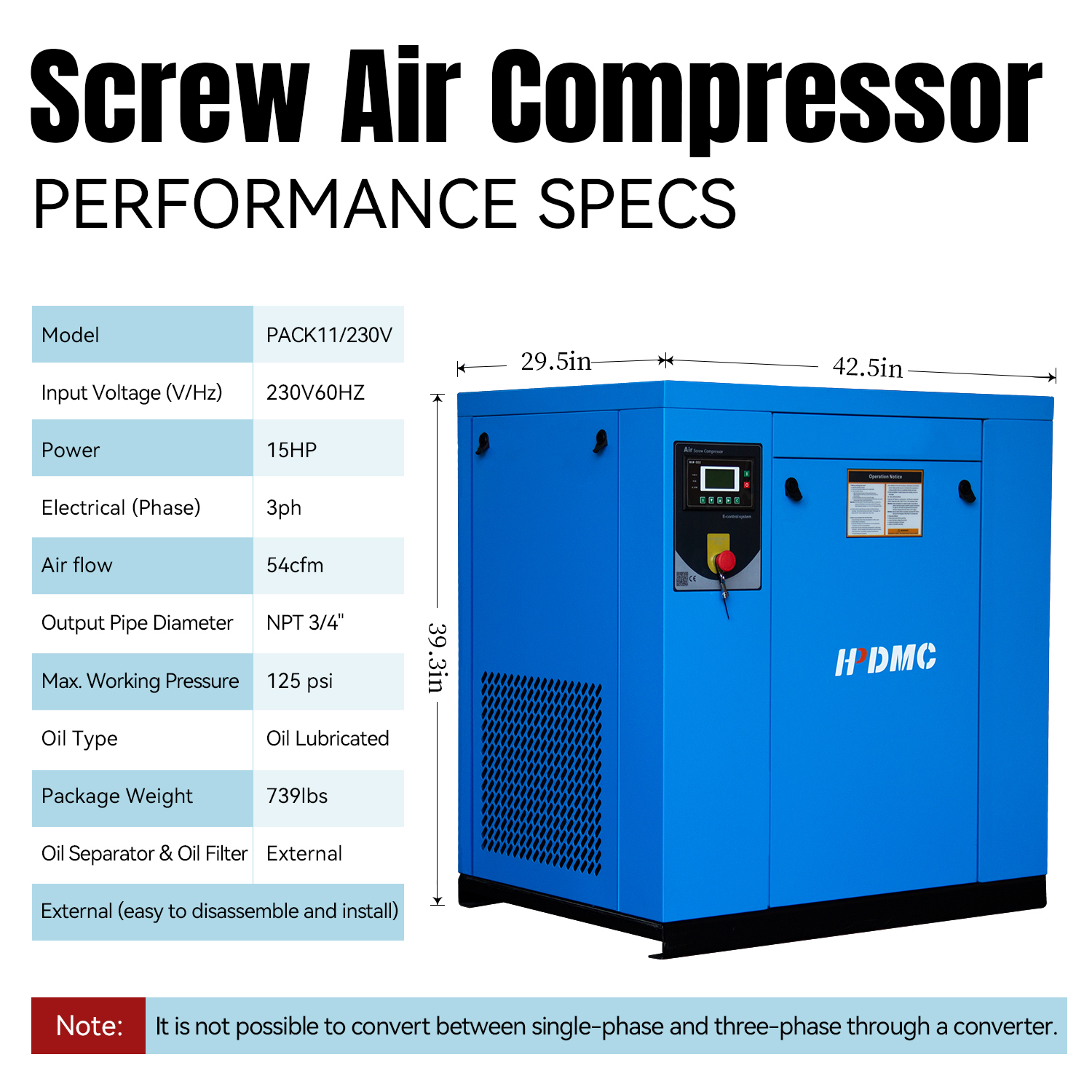
Specs: 125–150 PSI, 18 CFM @ 125 PSI, variable speed drive (VSD).
U.S. Fit: Manufacturing plants, large workshops, and industrial facilities in Ohio, Michigan, and Illinois—runs 4+ tools 24/7.
● Why It Works: VSD technology adjusts CFM to match demand, saving energy (per U.S. DOE guidelines) while delivering consistent high airflow for industrial tools.
4. Specialized Applications (High PSI, Low CFM)
● Needs: 1–5 CFM @ 3000+ PSI (diving, paintball, high-pressure testing).
● HPDMC Recommendation:4500 PSI PCP/Scuba Compressor
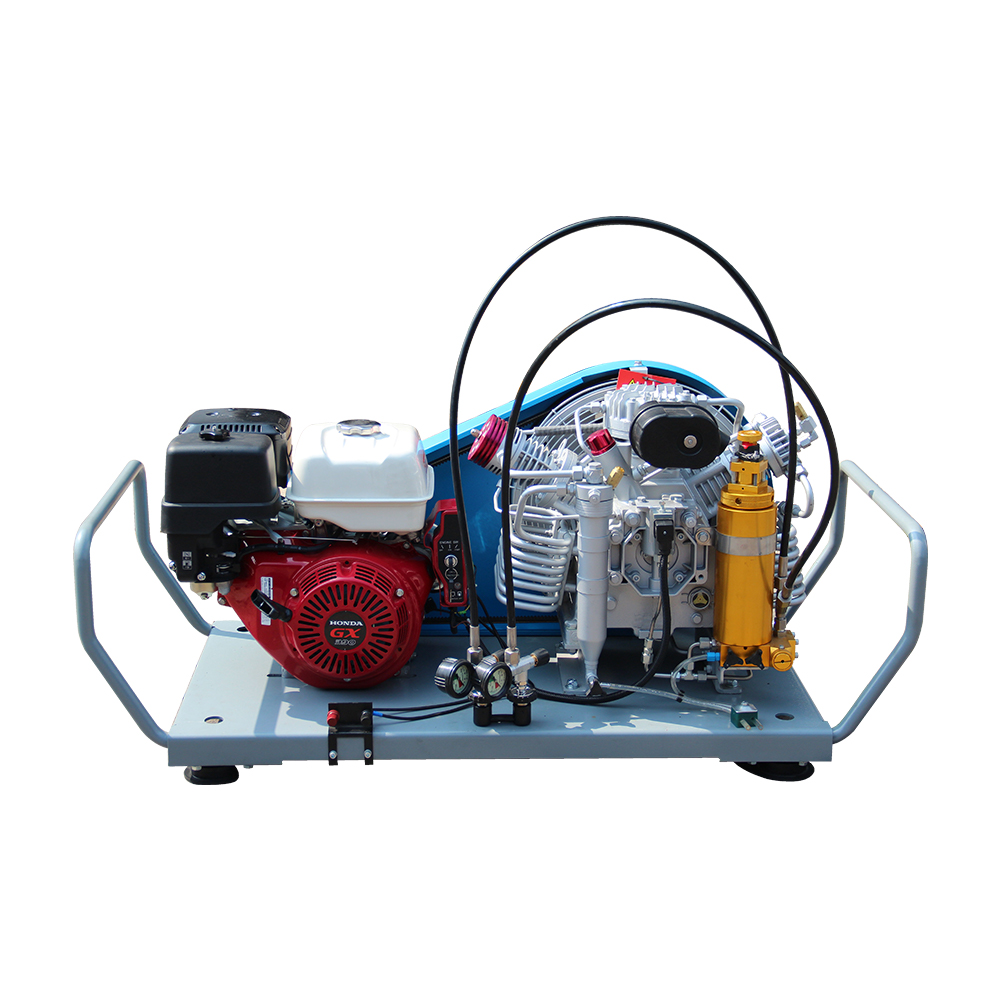
Specs: 4500 PSI, 1.8 CFM @ 4500 PSI, oil-lubricated pump.
U.S. Fit: Diving centers in Florida, paintball facilities, and industrial testing labs—delivers ultra-high pressure for specialized equipment.
Common CFM vs PSI Air Compressor Mistakes U.S. Buyers Make
Avoid these costly errors that plague U.S. compressor owners:
❌ Prioritizing PSI Over CFM: Buying a 180 PSI compressor with only 3 CFM won’t run a paint sprayer (needs 6+ CFM)—PSI provides the force, but CFM sustains the tool. For most U.S. shops, CFM is more critical for versatility.
❌ Underestimating Simultaneous Tool Use: A compressor that runs a single tool won’t cut it for a busy shop. Always calculate total CFM for tools used at the same time (e.g., impact wrench + nail gun + air ratchet).
❌ Ignoring Tank Size: A small tank (20 gallons) with high CFM will cycle frequently, reducing efficiency. For U.S. industrial use, pair high CFM with an ASME-certified tank (80+ gallons) like HPDMC’s 10HP Rotary Screw model.
❌ Forgetting Climate Adaptability: In cold U.S. states (Minnesota, Wisconsin), CFM can drop 5–10% in low temperatures. Choose a compressor with a cold-start feature (like HPDMC’s gas-powered models) to maintain airflow.
FAQs – CFM vs PSI Air Compressor (U.S. Buyers Ask)
Q1: Can I use a high-PSI compressor for low-PSI tools?
A: Yes, but use a pressure regulator to reduce PSI to your tool’s requirement. Running a 90 PSI nail gun at 180 PSI wastes energy and can damage the tool. HPDMC’s compressors include regulators for easy adjustment.
Q2: How much CFM do I need for a U.S. auto shop?
A: For a small auto shop running 2–3 tools (impact wrench, air ratchet, nail gun), aim for 8–12 CFM @ 90 PSI. HPDMC’s 13HP Piston Compressor (9.8 CFM) is perfect—see our small business compressor sizing guide for details.
Q3: Is higher CFM always better for air compressors?
A: No—higher CFM means a larger, more expensive compressor. If you only use a drill and tire inflator, a 5.5 CFM model (like HPDMC’s 6.5HP Portable Compressor) is more cost-effective.
Q4: What PSI do I need to inflate U.S. car tires?
A: Most car tires require 32–35 PSI, so a 125 PSI compressor is more than enough. HPDMC’s portable models have built-in pressure gauges for precise inflation.
Q5: How does VSD affect CFM vs PSI?
A: Variable Speed Drive (VSD) adjusts motor speed to match CFM demand, maintaining consistent PSI while saving energy. HPDMC’s VSD rotary screw compressors (10HP–20HP) are ideal for U.S. facilities with fluctuating tool use.
Q6: Where can I learn more about CFM/PSI for my specific tools?
A: HPDMC’s industrial air compressors guide includes tool CFM/PSI charts for U.S. common applications (auto repair, manufacturing, DIY). Contact our U.S.-based support team for personalized recommendations.
How HPDMC Ensures Optimal CFM & PSI for U.S. Users
HPDMC’s compressors are engineered with U.S. needs in mind, balancing CFM and PSI for every scenario:
● U.S. Compliance: All models meet OSHA safety standards and ASME tank certifications (for industrial use).
● Climate-Ready: Gas-powered piston models handle cold U.S. winters and hot summers, maintaining CFM/PSI consistency.
● Efficiency: VSD rotary screw models save 30–50% energy (per U.S. DOE data) by adjusting CFM to demand.
● Accessories: Compatible regulators, hoses, and filters help optimize CFM/PSI for your tools—shop HPDMC’s compressor accessories .
Ready to Choose the Right Compressor for Your CFM/PSI Needs?
Understanding CFM vs PSI in air compressors is the first step to powering your U.S. tools effectively. Whether you’re a DIYer, shop owner, or industrial operator, HPDMC has a compressor that balances airflow and pressure for your needs:
✅Shop HPDMC Portable Piston Compressors (DIY/Small Shops)
✅ Shop HPDMC Rotary Screw Compressors (Industrial/High-Volume Use)
✅ Shop HPDMC High-Pressure Compressors (Specialized Applications)
❓ Need Help Calculating CFM/PSI? Contact HPDMC’s U.S. sales team for a free custom recommendation.



Find the Right Compressor for Your Needs
Find the Right Compressor for Your Needs