⚡Free Shipping: Ultra-Quiet Portable Oil-Free Air Compressor AWR800-18LM2
Need Help Choosing the Right Compressor?
Need Help Choosing the Right Compressor?
⚡Free Shipping: Ultra-Quiet Portable Oil-Free Air Compressor AWR800-18LM2
Need Help Choosing the Right Compressor?
⚡Free Shipping: Ultra-Quiet Portable Oil-Free Air Compressor AWR800-18LM2

The Difference Between Piston and Screw Compressor: Which Is Right for Your U.S. Business?
The core difference between piston and screw compressor lies in design, performance, and use case—piston compressors excel for small U.S. shops/DIYers with intermittent demand, while screw compressors deliver continuous, efficient air for industrial facilities and high-volume operations.
Introduction: Why Understanding the Difference Between Piston and Screw Compressor Matters
For U.S. business owners, DIY enthusiasts, and industrial operators, choosing the right air compressor is a decision that impacts productivity, energy costs, and maintenance budgets. But with two dominant types—piston and rotary screw—many struggle to distinguish their strengths and limitations.
The difference between piston and screw compressor isn’t just about size or price—it’s about matching the machine to your specific U.S. application. A small auto shop in Texas might thrive with a piston compressor, while a manufacturing plant in Ohio needs the continuous output of a screw model. Choosing the wrong one leads to wasted energy, frequent downtime, and premature replacement.
HPDMC offers both piston and screw compressors engineered for U.S. conditions, from portable gas-powered piston units to industrial-grade screw models with variable speed drives. This guide breaks down the key differences, use cases, and U.S.-focused considerations to help you make the right choice.
Core Difference Between Piston and Screw Compressor: How They Work
To understand which compressor fits your needs, start with the fundamental difference in how they generate compressed air:
Piston Compressors (Reciprocating Compressors)
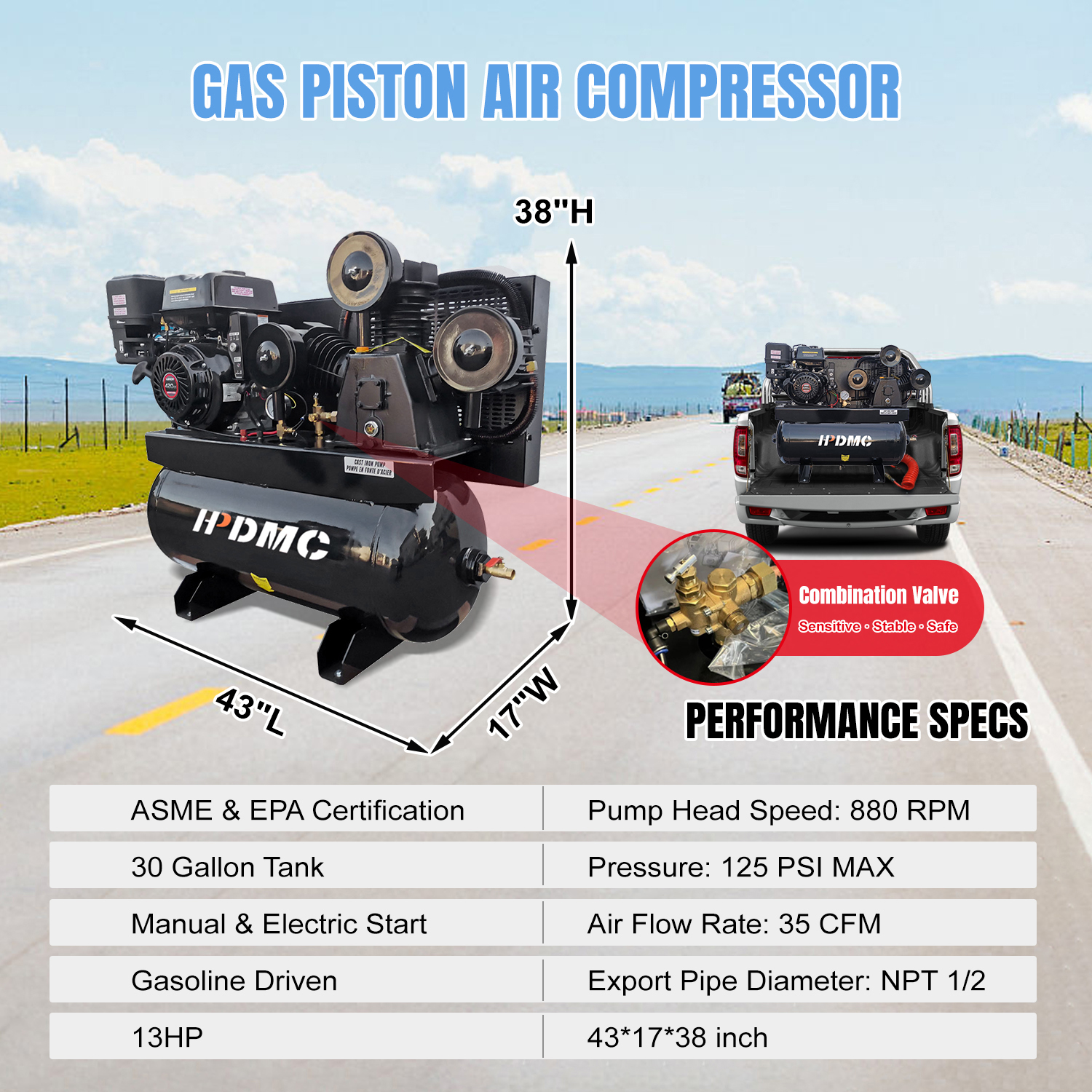
Piston compressors operate on a displacement principle, similar to a car engine. A piston moves up and down inside a cylinder, drawing in air on the downward stroke and compressing it on the upward stroke. They use a valve system with stainless steel discs to control airflow, forcing compressed air into a storage tank.
HPDMC’s piston models (e.g., 6.5HP Kohler-powered portable unit) are available in single-stage (for low-pressure needs) and two-stage (for higher pressure) designs, with gas or electric power options. They’re ideal for U.S. users who need air intermittently, as the tank stores compressed air for on-demand use.
Screw Compressors (Rotary Screw Compressors)
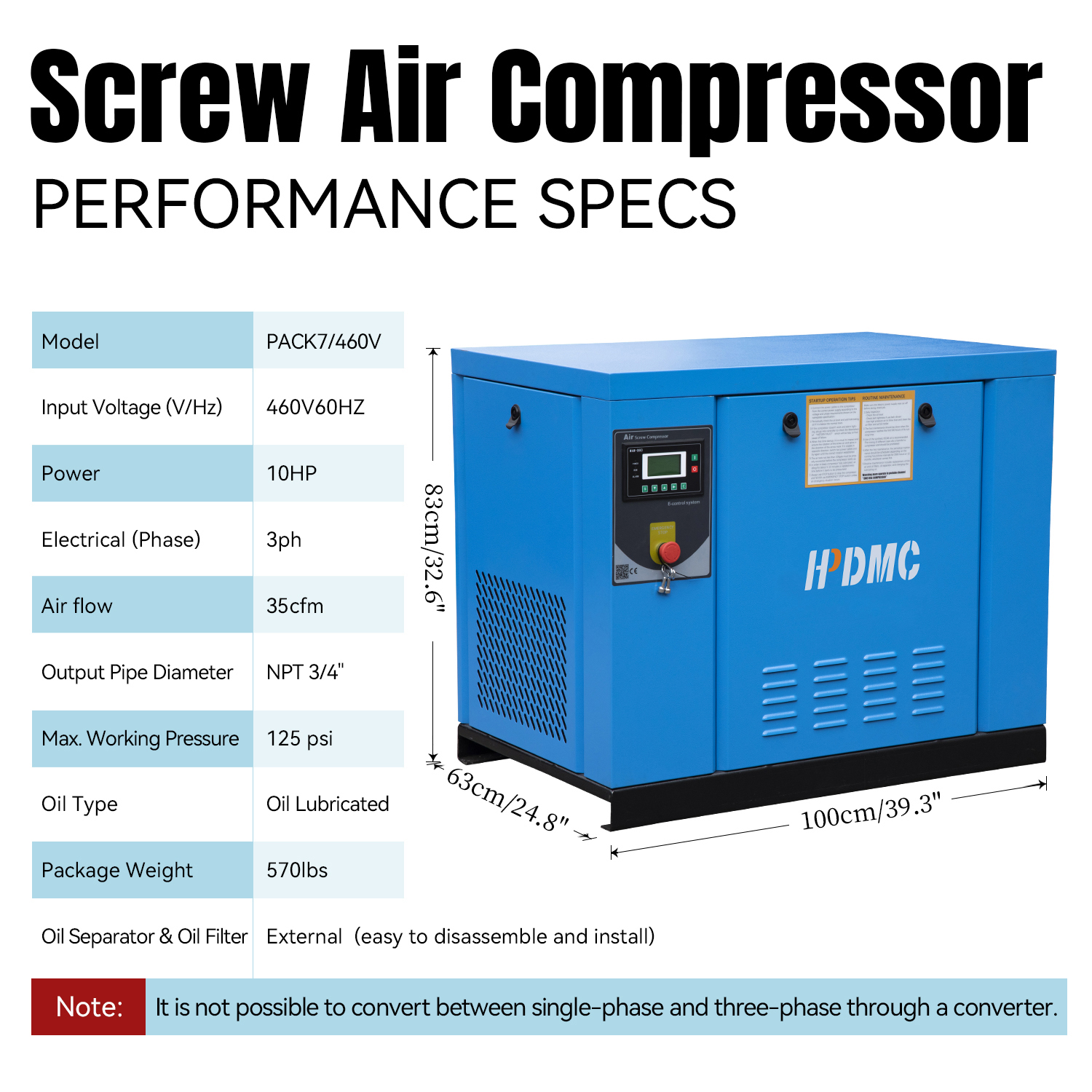
Screw compressors use two interlocking helical rotors to trap and compress air. As the rotors turn, air is drawn into the gap between them, squeezed as the rotors mesh, and pushed out at high pressure. Unlike piston models, screw compressors run continuously, delivering a steady stream of compressed air without the need for frequent cycling.
HPDMC’s screw compressors (10HP–20HP fixed/variable speed) feature air-cooled designs, auto start/stop functionality, and optional air dryers and ASME-certified tanks. They’re engineered for U.S. industrial facilities that require constant air flow for tools, machinery, and production processes.
Key Differences Between Piston and Screw Compressor (U.S. Focused)
Use this detailed comparison to see how the two types stack up for U.S. applications:
| Comparison Factor | Piston Compressor | Screw Compressor | U.S. Use Case Fit |
| Air Output | Intermittent (tank-dependent) | Continuous (steady flow) | Piston: DIY, small shops with on-and-off demand; Screw: Manufacturing, large workshops with 24/7 needs |
| Energy Efficiency | Less efficient at continuous use (cycles on/off) | Highly efficient for long runs (variable speed models save 30% energy) | Screw: Better for U.S. facilities with high air demand (reduces utility bills per DOE guidelines) |
| Noise Level | Louder (75–90 dB) – often requires sound dampening | Quieter (65–75 dB) – suitable for indoor use | Piston: Best for outdoor/garage use; Screw: Ideal for U.S. manufacturing plants or indoor workshops |
| Maintenance | Low maintenance (easy access to parts, affordable repairs) | Moderate maintenance (requires specialized service for rotors) | Piston: Great for rural U.S. areas with limited service access; Screw: Fits facilities with maintenance teams |
| Size & Portability | Compact, portable (gas-powered models for mobile use) | Large, stationary (industrial-sized units) | Piston: Mobile mechanics, construction sites; Screw: Fixed industrial locations |
| Pressure Capacity | 125–175 PSI (suitable for most tools) | 100–150 PSI (consistent pressure for industrial use) | Piston: Tire shops, DIY projects; Screw: Manufacturing, automation systems |
| Cost | Affordable upfront ($769–$1,679 for HPDMC models) | Higher upfront ($5,319–$7,469 for HPDMC models) | Piston: Budget-conscious U.S. small businesses; Screw: Long-term investment for high-volume operations |
| Oil Contamination Risk | Higher (oil-lubricated models may have carryover) | Lower (advanced oil separation systems) | Piston: Acceptable for general use; Screw: Better for ISO 8573-1 compliant U.S. industries (food, pharma) |
When to Choose a Piston Compressor (U.S. Scenarios)
The piston compressor is the right choice if your U.S. operation fits these profiles:
✅ Ideal U.S. Users
● DIY Enthusiasts & Home Garages: Need air for occasional projects (tire inflation, nail guns, small repairs) – HPDMC’s 6.5HP Kohler-powered model is compact and affordable.
● Small Auto Shops & Tire Centers: Intermittent air demand for tools like impact wrenches and tire changers – the tank stores air to avoid frequent cycling.
● Mobile Mechanics & Construction Teams: Require portability – gas-powered piston models (e.g., 13HP Lonxin-powered unit) work without electrical outlets.
● Rural U.S. Businesses: Limited access to maintenance services – piston compressors have simple designs with easy-to-find replacement parts.
👉 HPDMC Piston Compressor Picks for U.S. Users
● 6.5HP Portable Gasoline Piston Compressor– $679.99 (portable, ideal for mobile use)
● 13HP Gasoline Piston Compressor (Lonxin Engine)– $1,679.99 (heavy-duty, electric/pull start)
When to Choose a Screw Compressor (U.S. Scenarios)
The screw compressor is the better option for U.S. operations with these needs:
✅ Ideal U.S. Users
● Manufacturing Plants & Industrial Facilities: Continuous air demand for production lines, automation, and heavy machinery – HPDMC’s 10HP–20HP models deliver steady flow.
● Large Workshops & Fleet Maintenance: High-volume air use for multiple tools (sandblasters, paint sprayers) – variable speed models adjust to demand, saving energy.
● U.S. Facilities with Noise Restrictions: Indoor operations or urban locations – quieter operation avoids OSHA noise violations.
● Businesses Focused on Efficiency: Long run times (8+ hours/day) – screw compressors reduce energy costs by up to 30% compared to piston models (per U.S. DOE data).
👉 HPDMC Screw Compressor Picks for U.S. Users
● 10HP Rotary Screw Compressor – $3129.99 (fixed/variable speed, air dryer compatible)
● 20HP Rotary Screw Compressor – $4019.99 (industrial-grade, 24/7 operation)
● Open Box 10HP Rotary Screw Compressor– $2,799.00 (brand-new, discounted for outer box damage)
Critical U.S.-Specific Considerations (Beyond the Core Difference)
When choosing between piston and screw compressors, U.S. users must factor in regional and regulatory needs:
1. Energy Efficiency & Utility Costs
U.S. businesses face rising energy costs, so efficiency matters. The U.S. Department of Energy (DOE) notes that screw compressors with variable speed drives (VSD) use 25–35% less energy than fixed-speed piston models for continuous use. For U.S. facilities running compressors 8+ hours/day, this translates to thousands in annual savings.
2. Safety & Compliance
● ASME Certification: HPDMC’s screw compressors offer ASME-certified tanks, required for commercial use in most U.S. states.
● Noise Regulations: OSHA limits workplace noise to 90 dB over 8 hours – screw compressors’ quieter operation helps avoid fines.
● Emissions: Gas-powered piston models meet EPA standards, making them legal for U.S. outdoor use (critical for construction sites).
3. Climate Adaptability
● Piston Compressors: Gas-powered models work in remote U.S. locations (e.g., rural farms, construction sites) without electricity.
● Screw Compressors: Air-cooled designs handle U.S. temperature extremes, from Texas summers to Minnesota winters, without overheating.
4. Maintenance & Parts Access
HPDMC maintains U.S. warehouses for fast parts delivery. Piston compressors use common parts (filters, valves) available at U.S. auto parts stores, while screw compressor parts are shipped directly from HPDMC’s U.S. facilities.
FAQs – Difference Between Piston and Screw Compressor (U.S. Buyers Ask)
Q1: Which is more cost-effective for a small U.S. auto shop – piston or screw compressor?
A: For small shops with intermittent demand, a piston compressor (e.g., HPDMC’s 6.5HP model) is more cost-effective upfront ($769 vs. $5k+ for a screw model). It pays for itself in months, while a screw compressor would be overkill unless you’re running tools 8+ hours/day.
Q2: Can a piston compressor handle industrial use in the U.S.?
A: It’s not recommended. Piston compressors aren’t designed for continuous 24/7 operation – they overheat, use more energy, and require frequent maintenance. For industrial use, a screw compressor is built to handle the demand.
Q3: Do screw compressors require more maintenance than piston models in the U.S.?
A: Yes, but less frequent. Piston compressors need oil changes every 500 hours, while HPDMC’s screw compressors only require service every 2000 hours. Screw maintenance is more specialized, but U.S. users can access HPDMC’s U.S.-based support team for assistance.
Q4: Are gas-powered piston compressors legal for use in U.S. urban areas?
A: Yes, as long as they meet EPA emissions standards (which HPDMC’s models do). However, their noise level (75–90 dB) may require sound dampening for indoor use in dense urban areas.
Q5: Which compressor is better for U.S. cold climates – piston or screw?
A: Both work, but screw compressors have better cold-start features (auto start/stop, heated controls) for Minnesota, Michigan, or other cold U.S. states. Piston models may require block heaters for reliable winter operation.
Q6: Can I use a screw compressor for portable U.S. jobs (e.g., construction)?
A: HPDMC offers towable diesel-powered screw compressors for mobile industrial jobs, but they’re larger and more expensive than portable piston models. For most mobile U.S. applications (e.g., road repair, mobile mechanics), a piston compressor is more practical.
How HPDMC Supports U.S. Users Across Both Compressor Types
Whether you choose a piston or screw compressor, HPDMC’s U.S.-focused features ensure success:
✅ U.S. Warehousing: Fast shipping to all 50 states – most orders arrive in 3–7 business days.
✅ Compliance: All models meet U.S. safety (ASME) and emissions (EPA) standards.
✅ Support: U.S.-based technical team available via phone, email, and WhatsApp.
✅ Accessories: Compatible air filters, dryers, lubricants, and tanks to enhance performance – shop HPDMC’s compressor accessories.
Ready to Choose the Right Compressor for Your U.S. Business?
The difference between piston and screw compressor comes down to your U.S. operation’s demand, budget, and location. For small shops, DIYers, and mobile users, a piston compressor offers affordability and portability. For industrial facilities, large workshops, and continuous use, a screw compressor delivers efficiency and reliability.
✅ Shop HPDMC Piston Compressors
✅ Shop HPDMC Screw Compressors



Find the Right Compressor for Your Needs
Find the Right Compressor for Your Needs