
'%20fill='%23FFFFFF'%20fill-rule='nonzero'%3e%3cg%20id='编组-36'%20transform='translate(51.000000,%200.000000)'%3e%3cg%20id='形状结合'%20transform='translate(1659.000000,%2032.000000)'%3e%3cpath%20d='M16.2353972,0%20C20.4083149,0.00780207133%2023.7866269,3.38822739%2023.7853172,7.55464286%20L23.7853172,12.2689286%20C23.7899936,14.8455424%2022.4721654,17.2448923%2020.2936562,18.6261429%20L19.5216663,19.1211429%20L20.4164192,19.3073571%20C24.5336989,20.1724286%2028.240195,21.7234286%2028.943721,22.0275%20C30.107608,22.4918571%2031,23.8425%2031,25.1106429%20L31,31.0435714%20C30.5679689,32.2575%2029.5551748,33%2028.4219785,33%20L2.5803823,33%20C1.28681544,32.9969138%200.19505185,32.0388291%200.0259690808,30.7583571%20L0,30.6075%20L0,25.1177143%20C0,23.8401429%200.892392049,22.5130714%202.07280481,22.0275%20C2.5803823,21.8035714%207.05886833,19.8942857%2011.7144163,19.0952143%20L12.5997258,18.942%20L11.8678699,18.4187143%20C9.87415814,17.0023477%208.68806568,14.7119933%208.68311629,12.2689286%20L8.68311629,7.55464286%20C8.68440789,3.38838231%2012.0626372,0.00909643961%2016.2353972,0%20Z%20M15.5011804,20.8677857%20C10.3404158,20.8677857%203.67580535,23.6586429%202.93450613,23.9768571%20C2.50955754,24.1489286%202.13890793,24.6887143%202.13890793,25.1106429%20L2.13890793,30.8007857%20L28.5565456,30.8597143%20L28.7288858,30.7395%20L28.8634529,30.6287143%20L28.8634529,25.1106429%20C28.8634529,24.6910714%2028.5022466,24.1512857%2028.1245145,23.9980714%20C28.1179379,23.9957985%2028.0304368,23.9580782%2027.872723,23.8925325%20L27.6920016,23.817994%20C26.0653447,23.1520015%2020.1735914,20.8677857%2015.5011804,20.8677857%20Z%20M16,24%20C17.1045695,24%2018,24.8954305%2018,26%20C18,27.1045695%2017.1045695,28%2016,28%20C14.8954305,28%2014,27.1045695%2014,26%20C14,24.8954305%2014.8954305,24%2016,24%20Z%20M16.2353972,2.13321429%20C13.2442359,2.14617217%2010.8248283,4.56812387%2010.8196634,7.55464286%20L10.8196634,12.2689286%20C10.822245,15.2565159%2013.2431591,17.6799757%2016.2353972,17.6903571%20C19.2277917,17.681264%2021.6487701,15.2566691%2021.6487701,12.2689286%20L21.6487701,7.55464286%20C21.6474879,4.56743737%2019.2272519,2.14359978%2016.2353972,2.13321429%20Z'%3e%3c/path%3e%3c/g%3e%3c/g%3e%3c/g%3e%3c/g%3e%3c/svg%3e)
'%20fill='%23FFFFFF'%20fill-rule='nonzero'%3e%3cg%20id='编组-36'%20transform='translate(51.000000,%200.000000)'%3e%3cg%20id='编组-6'%20transform='translate(1753.000000,%2024.000000)'%3e%3cg%20id='Fill-2'%20transform='translate(0.000000,%2010.000000)'%3e%3cpath%20d='M14.1428571,24.7352941%20C15.3263245,24.7352941%2016.2857143,25.689981%2016.2857143,26.8676471%20C16.2857143,28.0453131%2015.3263245,29%2014.1428571,29%20C12.9593898,29%2012,28.0453131%2012,26.8676471%20C12,25.689981%2012.9593898,24.7352941%2014.1428571,24.7352941%20Z%20M30.4285714,24.7352941%20C31.6120387,24.7352941%2032.5714286,25.689981%2032.5714286,26.8676471%20C32.5714286,28.0453131%2031.6120387,29%2030.4285714,29%20C29.2451041,29%2028.2857143,28.0453131%2028.2857143,26.8676471%20C28.2857143,25.689981%2029.2451041,24.7352941%2030.4285714,24.7352941%20Z%20M7.07983129,0%20C7.64751536,0%208.14221146,0.383424121%208.26385804,0.934596295%20L9.029,4.264%20L34.7934994,4.26470588%20C35.1475316,4.26470588%2035.4774252,4.41549952%2035.7107646,4.67740427%20C35.9441039,4.93930903%2036.0406582,5.28851538%2035.9843349,5.63772174%20L34.0854351,17.7567694%20C33.996927,18.3361345%2033.4900174,18.7647059%2032.8945996,18.7647059%20L12.367,18.764%20L12.7972208,20.633011%20L32.2120159,20.633011%20C32.8851271,20.633011%2033.4285714,21.1682072%2033.4285714,21.8312114%20C33.4365916,22.4942156%2032.8932368,23.0294118%2032.2201257,23.0294118%20L11.8321579,23.0294118%20C11.2644738,23.0294118%2010.7697777,22.6459876%2010.6481311,22.0948155%20L6.11476838,2.39640079%20L1.21646583,2.39640079%20C0.543354726,2.39640079%200,1.8612046%200,1.19820038%20C0,0.535196157%200.543354762,0%201.21646583,0%20L7.07983129,0%20Z%20M33.3934631,6.64565825%20L9.577,6.645%20L11.819,16.383%20L31.8646878,16.3837535%20L33.3934631,6.64565825%20Z'%20id='形状结合'%3e%3c/path%3e%3c/g%3e%3c/g%3e%3c/g%3e%3c/g%3e%3c/g%3e%3c/svg%3e)
30 Gallon Air Compressor: The Complete Buying Guide
The Sweet Spot That Dominates American Garages
Walk through any serious home workshop, small auto repair shop, or light industrial facility in the United States, and the compressor you are most likely to see is a 30 gal air compressor. Not the tiny 6-gallon pancake that stalls halfway through an impact wrench job, and not the 80-gallon behemoth that requires 240V power, dedicated floor space, and a forklift to install. The 30-gallon compressor occupies the practical center of the market — enough stored air for real work, small enough to fit in a two-car garage, and priced sensibly for both serious DIYers and professional shops.
The 30 gallon compressor category is the most competitive segment in the U.S. compressor market, and for good reason. It represents the entry point to "real" compressed air capability — sufficient tank volume to run impact wrenches, paint sprayers, and air ratchets without the pump running continuously. Yet it remains accessible: most air compressors 30 gallon operate on standard 120V household current (though some larger-motor models require 240V), fit through a standard 36" doorway, and can be moved by one person on level ground.
At HPDMC, the 30-gallon format is our most popular tank size across both electric and gas-powered compressor lines. Our 30-gallon ASME-certified tanks are manufactured to the same rigorous standards as our 80-gallon and 270-gallon industrial tanks — there is no "consumer grade" compromise in our engineering. For existing HPDMC 30-gallon content, see our 30-gallon compressor overview.
30 Gallons of Air: What It Actually Means for Your Tools
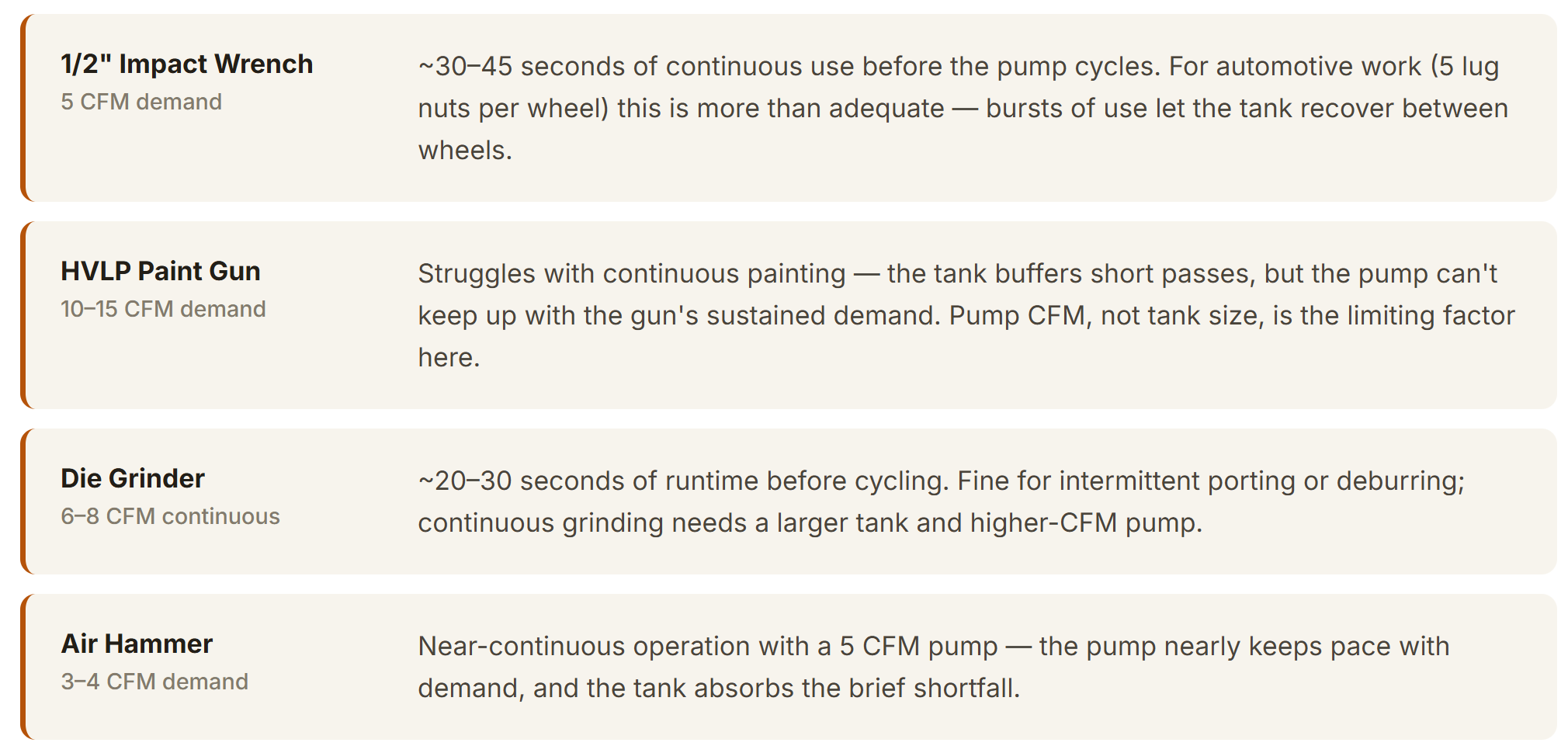
Tank size is the most visible specification on any compressor but the most commonly misunderstood. A larger tank does not increase CFM output — it increases stored air capacity, which translates to longer tool run time between pump cycles and smoother pressure delivery during intermittent use.
A 30-gallon tank at 125 PSI contains approximately 30 gallons of air compressed to roughly 8.5 times atmospheric density. As the air expands back to atmospheric pressure through your tool, it releases its stored energy. This buffer is what allows a 30 gallon compressor to run a high-demand tool intermittently without the pump running continuously.
Tool Runtime at 30 Gallons (5 CFM Pump)
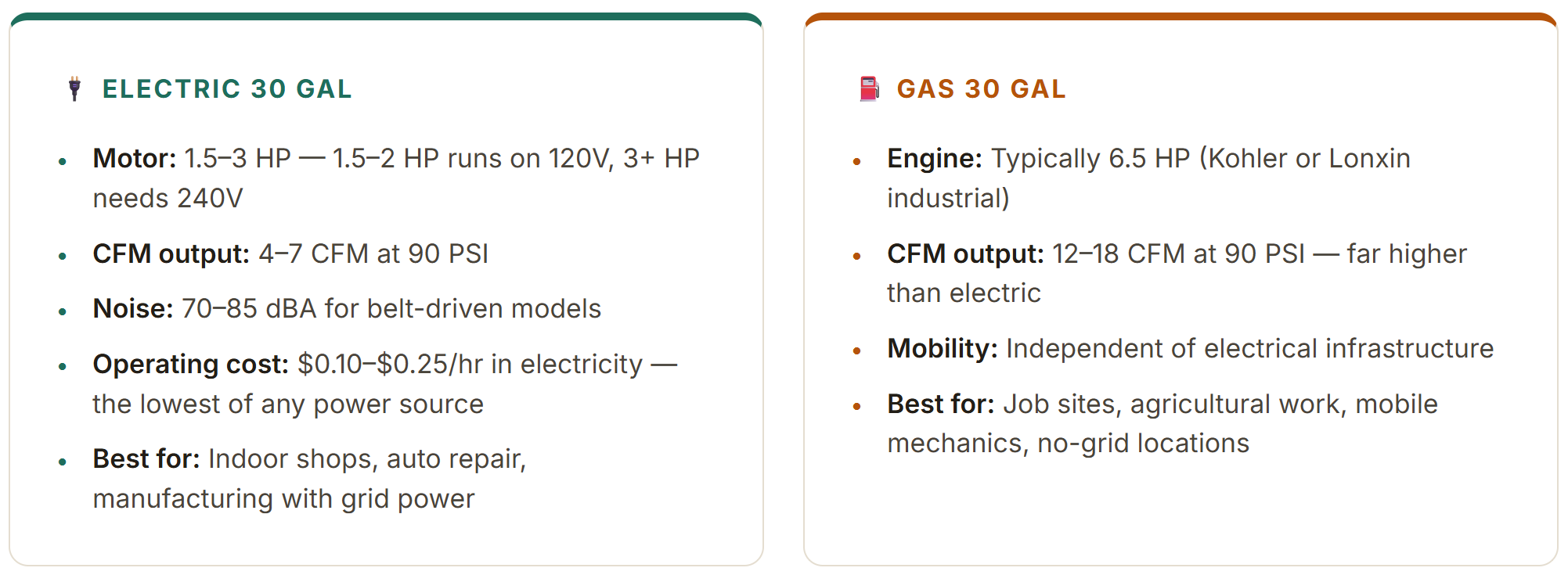
Electric vs Gas 30 Gallon Compressors
The 30-gallon format spans both electric and gas power, and the choice between them is one of the most important decisions in the buying process.
See our portable gas compressor guide for more on mobile applications.
ASME Certification: Why It Matters
One of the most important — and most overlooked — distinctions among air compressors 30 gallon is whether the tank carries ASME (American Society of Mechanical Engineers) certification. ASME-certified tanks are manufactured to the ASME Boiler and Pressure Vessel Code (BPVC) Section VIII, which governs the design, fabrication, testing, and inspection of pressure vessels. This is not a marketing label — it is a federal safety standard with legal implications for commercial use.
All HPDMC 30-gallon tanks are ASME-certified. Here's why that matters:
● Safety: ASME tanks undergo hydrostatic testing at 1.5× MAWP before leaving the factory. A tank rated for 125 PSI is tested to 187.5 PSI with water to verify weld integrity.
● Legal compliance: Many U.S. jurisdictions require ASME certification for commercial compressed air tanks. A non-certified tank can expose your business to OSHA citations and liability risk.
● Insurance: Commercial insurance policies may require ASME-certified pressure vessels. An uninsured failure may not be covered.
● Resale value: ASME-certified tanks hold value with a documented pedigree. Non-certified tanks are essentially scrap value at resale.
When comparing 30 gal air compressor models, ASME certification should be a non-negotiable requirement for any commercial application. HPDMC includes it as standard equipment; many budget competitors do not. See our complete tank guide for more on tank standards and safety.
HPDMC 30-Gallon Compressor Options
HPDMC offers 30-gallon compressors across multiple power sources and pump types to match diverse applications.
Electric Belt-Drive Compressor
Cast-iron, oil-lubricated, belt-driven pump powered by an IE3 efficiency motor. Belt-drive lets the pump run at lower RPM than direct-drive units, reducing noise, heat, and wear. Deep-fin cooling delivers consistent CFM with daily-shop-use durability. ASME-certified tank standard.
6.5HP Gas 30-Gallon Portable Compressor — Best Seller
Delivers 18 CFM at 115 PSI from a Kohler or Lonxin industrial engine. The 30-gallon ASME horizontal tank, pneumatic transport tires, and integrated handle make this a genuinely portable unit one person can roll onto a trailer. Ideal for framing crews, mobile mechanics, and farm use. Factory-direct pricing typically 20–30% below comparable dealer-brand units from EMAX and Eaton Compressor.
3-in-1 Welder-Generator-Compressor (30-Gallon Configuration)
For mobile operators who need welding, power generation, and compressed air in a single machine. The HPDMC 3-in-1 unit with 15HP Kohler engine eliminates the need for three separate machines on a service truck.
What Can You Actually Run?
The capabilities of a 30 gal air compressor depend primarily on pump CFM, not tank size. Here is a realistic application guide based on pump output.
With a 4–6 CFM Pump (Typical Electric 30-Gallon)
Excellent For: Impact wrenches (intermittent), air ratchets, tire inflation, brad/finish nailers, blow-off, air brushing, stapling, and inflation.
Marginal For: HVLP painting (pump can't sustain continuous spraying), sandblasting (insufficient CFM for even small nozzles), die grinders (short-duration use only).
Not Suitable For: Continuous sandblasting, production painting, running multiple high-CFM tools simultaneously.
With a 12–18 CFM Pump (Typical Gas 30-Gallon)
Excellent For: Framing nailers (2–3 simultaneous), roofing nailers, impact wrenches (near-continuous), air hammers, texture sprayers, and multi-tool manifold setups.
Marginal For: Light sandblasting (siphon-feed only), HVLP painting (adequate for small to medium projects).
Not Suitable For: Production sandblasting, continuous multi-tool industrial use, 3/4" or 1" drive impact wrenches (require 20+ CFM).
For application-specific guidance, see our small business sizing guide and individual application guides linked throughout this article.
Why HPDMC 30-Gallon Compressors Beat the Competition
When comparing HPDMC's air compressors 30 gallon against competitors like USAirCompressor, Eaton Compressor, EMAX Compressor, and Compressor World, several structural advantages emerge from our factory-direct business model:
● Factory-direct pricing: No distributor or dealer markup — you buy from Bravo Equipment Corporation, the manufacturer. A cast-iron pump, ASME tank, and industrial-grade motor/engine at a price competitive with aluminum-pump budget units from dealer-network brands.
● Dual-warehouse shipping: Los Angeles and Chicago warehouses provide fast delivery nationwide — typically 2–5 business days to most U.S. locations.
● ASME certification standard: Unlike competitors that offer ASME tanks as an optional upgrade, every HPDMC 30-gallon compressor includes one standard.
● Direct warranty support: Claims go directly to the manufacturer, not through a dealer who may or may not prioritize your claim.
● Local support: HPDMC maintains offline stores and service centers — a capability online-only competitors can't match.
Frequently Asked Questions
Q: Is a 30 gallon air compressor big enough for my workshop?
For 90% of home workshops and small professional shops — yes. A 30 gallon compressor with a 5+ CFM pump handles impact wrenches, air ratchets, nailers, inflation, and blow-off tasks without issue. It is marginal for continuous painting and insufficient for sandblasting. If your primary tools are automotive (impact wrench, air ratchet, tire inflation), a 30 gal air compressor is the ideal size. If you plan extensive painting or sandblasting, you need a higher-CFM pump rather than a larger tank — pump CFM, not tank gallons, determines continuous-tool capability.
Q: What's the difference between a 30 gallon and 60 gallon compressor?
The 60-gallon tank stores twice as much compressed air, providing longer tool run time between pump cycles. However, pump CFM (not tank size) determines sustained tool capability. A 30-gallon and a 60-gallon unit, each with a 5 CFM pump, will both struggle equally with a tool requiring 10 CFM continuously — the larger tank just delays the pressure drop by a few minutes. Practical differences: 60-gallon units are larger, heavier, more expensive, and typically require 240V power. For most home and light professional use, 30 gallons is sufficient. For production environments, upgrade both the tank AND the pump CFM.
Q: Can a 30 gallon air compressor run on 110V/120V?
Many 30 gallon compressors with motors up to approximately 2 HP can operate on a standard 120V, 15-amp household circuit. However, startup current draw can be 3–5× the running current, which may trip breakers on shared circuits. For reliable operation, dedicate a 20-amp circuit to the compressor. Larger 3+ HP electric models require 240V power. Gas-powered units have no electrical requirements and can operate anywhere outdoors. Always check the motor nameplate amperage and your circuit capacity before purchasing — a 15-amp circuit should not be loaded beyond 12 amps (80% rule per NEC) for continuous loads.
Q: How long will a 30 gallon air compressor last?
With proper maintenance, a quality 30 gallon compressor with a cast-iron, oil-lubricated pump and ASME-certified tank can deliver 15–20 years of reliable service or 5,000–8,000 pump hours before major overhaul. Budget units with aluminum pumps and non-certified tanks typically last 3–7 years under comparable use. Key longevity factors: regular oil changes (every 300 hours or annually), tank moisture draining (daily during active use), belt tension maintenance, and operating within the rated duty cycle. HPDMC's cast-iron pump design delivers approximately 30% longer equipment lifespan compared to aluminum-pump alternatives.
Q: Should I buy an oil-free or oil-lubricated 30 gallon compressor?
For a 30 gallon compressor that will see regular use, oil-lubricated (belt-drive) is the strongly recommended choice. Oil-lubricated pumps run cooler, last 3–5× longer, and are substantially quieter (70–80 dBA vs 85–95 dBA for oil-free). The downside — periodic oil changes — is minimal (5 minutes every 300 hours). Oil-free compressors make sense for very occasional use (a few times per year) where zero-maintenance convenience outweighs the shorter lifespan and higher noise. For any compressor used weekly or more, oil-lubricated is the economically and practically superior choice.
Q: What size air hose should I use with a 30 gallon compressor?
3/8" ID (inner diameter) hose is the minimum recommended size for any 30 gallon compressor application. 1/4" hose creates excessive pressure drop — a 50-foot 1/4" hose can drop 15–25 PSI at 5 CFM flow, robbing your tools of power. For runs over 50 feet, 1/2" ID hose is recommended to minimize pressure drop. Also critical: use high-flow quick-connect couplers (Type M industrial or universal), not the restrictive Type A automotive couplers sold at big-box stores. A single restrictive coupler can create more pressure drop than 50 feet of hose. HPDMC recommends V-style high-flow couplers for all 30 gallon compressor installations.
Q: Do I need an air dryer with a 30 gallon compressor?
It depends on your application. For general shop air (impact wrenches, nailers, inflation), daily tank draining is usually sufficient — no dryer needed. For painting, an air dryer (refrigerated or desiccant) is essential — moisture in compressed air causes fisheyes, orange peel, and other paint defects. For sandblasting, a dryer prevents media clumping and nozzle clogging. For any application where compressed air contacts sensitive surfaces (painting, plasma cutting, powder coating), invest in a dryer. HPDMC's SE Series refrigerated air dryers are purpose-matched to our 30-gallon compressor outputs.
Find Your Perfect 30 Gallon Air Compressor
The 30 gallon compressor is the most practical tank size for the majority of American workshops and job sites — and HPDMC's factory-direct pricing makes premium quality accessible without the dealer markup. ASME-certified tanks, cast-iron pumps, industrial engines and motors, and direct manufacturer support. Ships fast from our Los Angeles and Chicago warehouses.
Browse 30-Gallon Compressors →