⚡Free Shipping: Ultra-Quiet Portable Oil-Free Air Compressor AWR800-18LM2
Need Help Choosing the Right Compressor?
Need Help Choosing the Right Compressor?
⚡Free Shipping: Ultra-Quiet Portable Oil-Free Air Compressor AWR800-18LM2
Need Help Choosing the Right Compressor?
⚡Free Shipping: Ultra-Quiet Portable Oil-Free Air Compressor AWR800-18LM2

Diesel vs Gas Air Compressors: The Complete U.S. Buyer's Guide
One Decision That Shapes Everything: Diesel or Gas?
Of all the decisions involved in purchasing an air compressor — CFM rating, tank size, pump type, brand — the choice between diesel and gasoline power is perhaps the most consequential. It determines where you can operate, what you will spend on fuel, how much maintenance you will perform, how long the machine will last, and what it will be worth when you sell it. Yet many buyers treat this decision as an afterthought, defaulting to gasoline because it is familiar or diesel because "that's what the big machines use." Both assumptions can be expensive mistakes.
This guide provides a rigorous, data-driven comparison of diesel engine air compressor technology versus gas air compressor alternatives, drawing on HPDMC's experience equipping thousands of U.S. operators across construction, agriculture, mining, oil and gas, and mobile service industries. We will examine every dimension that matters: fuel efficiency, maintenance, longevity, safety, acquisition cost, and total cost of ownership.
The gasoline air compressor and the diesel compressor each have natural domains where they excel. The goal is not to declare a universal winner — there is none — but to identify which fuel type aligns with your hours of operation, fuel logistics, safety requirements, and budget. For detailed standalone guides, see our gas compressor guide and diesel compressor guide.
The Diesel Advantage in Hard Numbers
Fuel consumption is the largest single operating cost for any engine-driven compressor over its service life, exceeding even the purchase price for high-hour applications. Understanding the real-world fuel efficiency difference between diesel and gasoline is therefore essential to an accurate total-cost-of-ownership calculation.
Thermal Efficiency Fundamentals
Diesel engines achieve 35–45% thermal efficiency — meaning 35–45% of the fuel's energy content is converted to useful mechanical work. Gasoline engines achieve 25–30%.
This gap has two root causes:
(1) diesel's higher compression ratio (14:1–25:1 vs 8:1–12:1 for gasoline) extracts more work from each combustion event.
(2) diesel's lean-burn combustion reduces pumping losses across the throttle range. A diesel engine air compressor operating at partial load maintains efficiency far better than a gasoline engine, which suffers significant pumping losses as the throttle plate restricts intake air.
The Gasoline Advantage Upfront
There is no avoiding the reality: a gasoline air compressor costs significantly less to purchase than a diesel equivalent. The price premium for diesel power ranges from 30–50% for comparably sized units. The reasons are structural:
● Engine manufacturing cost: Diesel engines require stronger castings, forged crankshafts, precision fuel injection systems, and increasingly complex emission controls (DPF, SCR, EGR) to meet EPA Tier 4 standards — all adding genuine manufacturing cost.
● Production volume: The global market for small gasoline engines (under 25 HP) is tens of millions of units annually, spanning lawn equipment, generators, pressure washers, and more. The small diesel market is a fraction of this, limiting economies of scale.
● Starting system requirements: Diesel engines require larger batteries, heavier-gauge cables, and higher-torque starter motors to overcome compression ratios 2–3× higher than gasoline engines.
Different Demands, Different Costs
Diesel and gasoline compressors have fundamentally different maintenance profiles. Neither is universally "less maintenance" — they require different kinds of attention at different intervals.
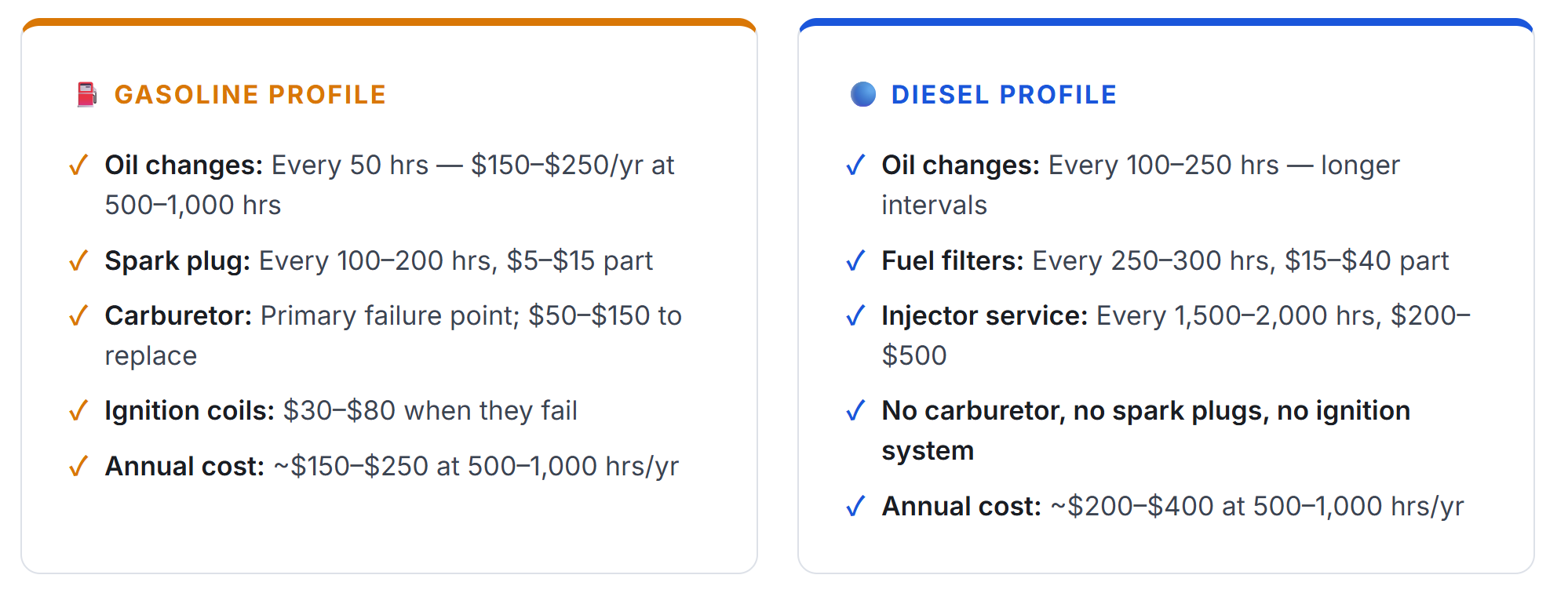
The maintenance cost crossover occurs at approximately 800–1,000 annual hours. Below that threshold, the gasoline gas air compressor costs less to maintain annually. Above it, the diesel's longer service intervals and elimination of carburetor/ignition problems create a maintenance cost advantage. See our complete maintenance guide for detailed procedures.
How Many Hours Will Each Engine Deliver?
Engine service life is where the diesel advantage becomes dramatic — and where the fuel-type decision has the largest financial impact: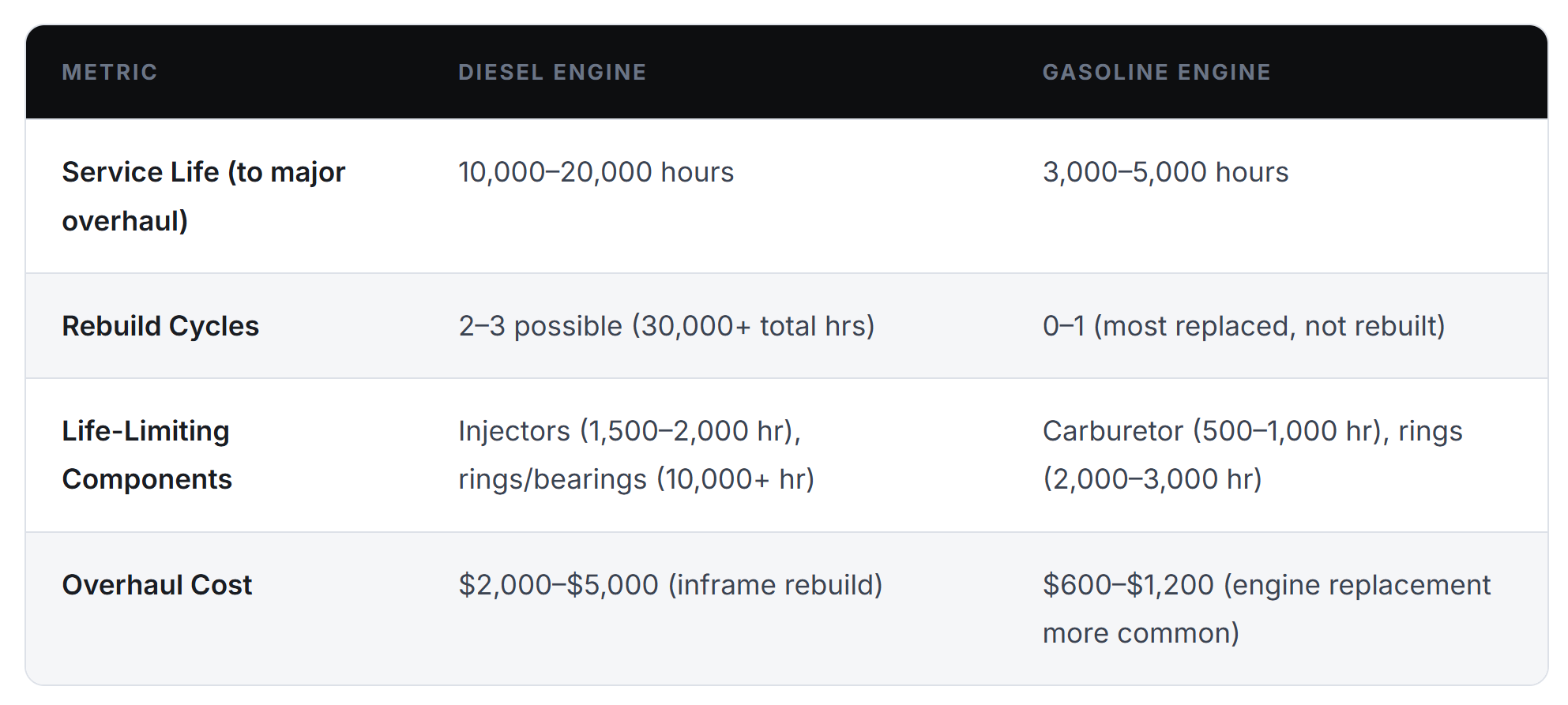
The diesel's 3–4× longer service life stems from lower operating RPM (1,800–2,400 vs 3,600 for gasoline), robust bottom-end construction, cleaner combustion, and the absence of a throttle plate. A gasoline air compressor that sees 1,500 hours annually may need engine replacement within 2–3 years; a diesel equivalent may run a decade before requiring major service. HPDMC's diesel compressors deliver approximately 30% longer equipment lifespan compared to gasoline alternatives in comparable service.
Diesel's Fire-Risk Advantage
Safety considerations often tip the decision toward diesel in specific industries, and for good reason:
● Flash point: Diesel fuel has a flash point of 125–200°F — it won't ignite from a spark at ambient temperature. Gasoline's flash point is -45°F, producing ignitable vapors virtually always. On sites with welding or grinding sparks, diesel's fire safety advantage is substantial and recognized by OSHA and MSHA regulations.
● Fuel storage: Diesel can be stored in simple, vented tanks without the elaborate vapor recovery and flame arrestor requirements applied to gasoline. Logistically simpler and safer for bulk fuel on job sites.
● Carbon monoxide: Both diesel and gasoline produce CO. Diesel produces lower CO concentrations per HP-hour due to lean-burn combustion, but neither is safe for indoor or confined-space operation.
● Refueling safety: Refueling a hot diesel engine carries lower fire risk than refueling a hot gasoline engine, though best practice is to let any engine cool first.
For operations where fire safety is paramount — oil and gas sites, mines, chemical plants, welding-intensive fabrication — diesel's safety profile often makes it the mandatory choice. See our OSHA safety guide for comprehensive requirements.
The Definitive 5-Year Analysis
The purchase price is the most visible cost but the least important over the machine's life. Here is a comprehensive five-year TCO analysis for a typical 25–30 CFM portable compressor at three annual usage levels:
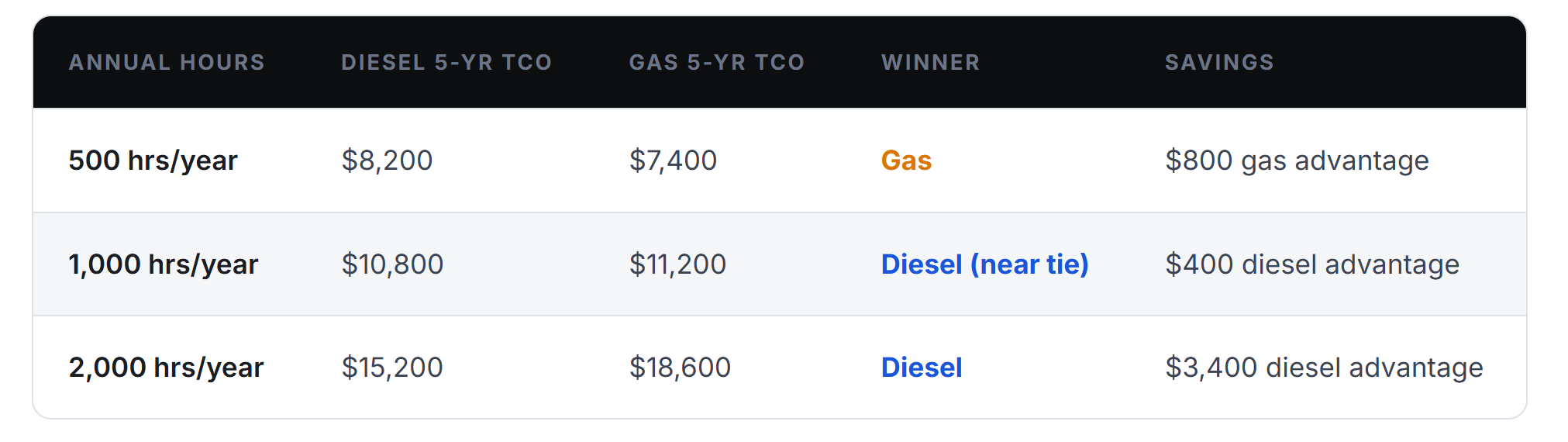
The crossover point: ~800–1,000 annual operating hours. Below this, gasoline wins on total cost. Above it, diesel's fuel efficiency and longevity advantages overcome its purchase price premium — saving thousands of dollars over the machine's life at high annual hours.
There is a corollary insight: if you are uncertain about your annual hours, err toward gasoline. A gasoline compressor can always be sold and replaced with diesel if your usage pattern proves to be high-hour. The reverse — buying diesel and discovering you only use it 400 hours per year — locks in the purchase premium without the high-hour benefits that justify it.
Decision Framework: Which Fuel Type Is Right for You?
After equipping thousands of U.S. operators with both diesel and gas air compressor models, here is HPDMC's decision framework:
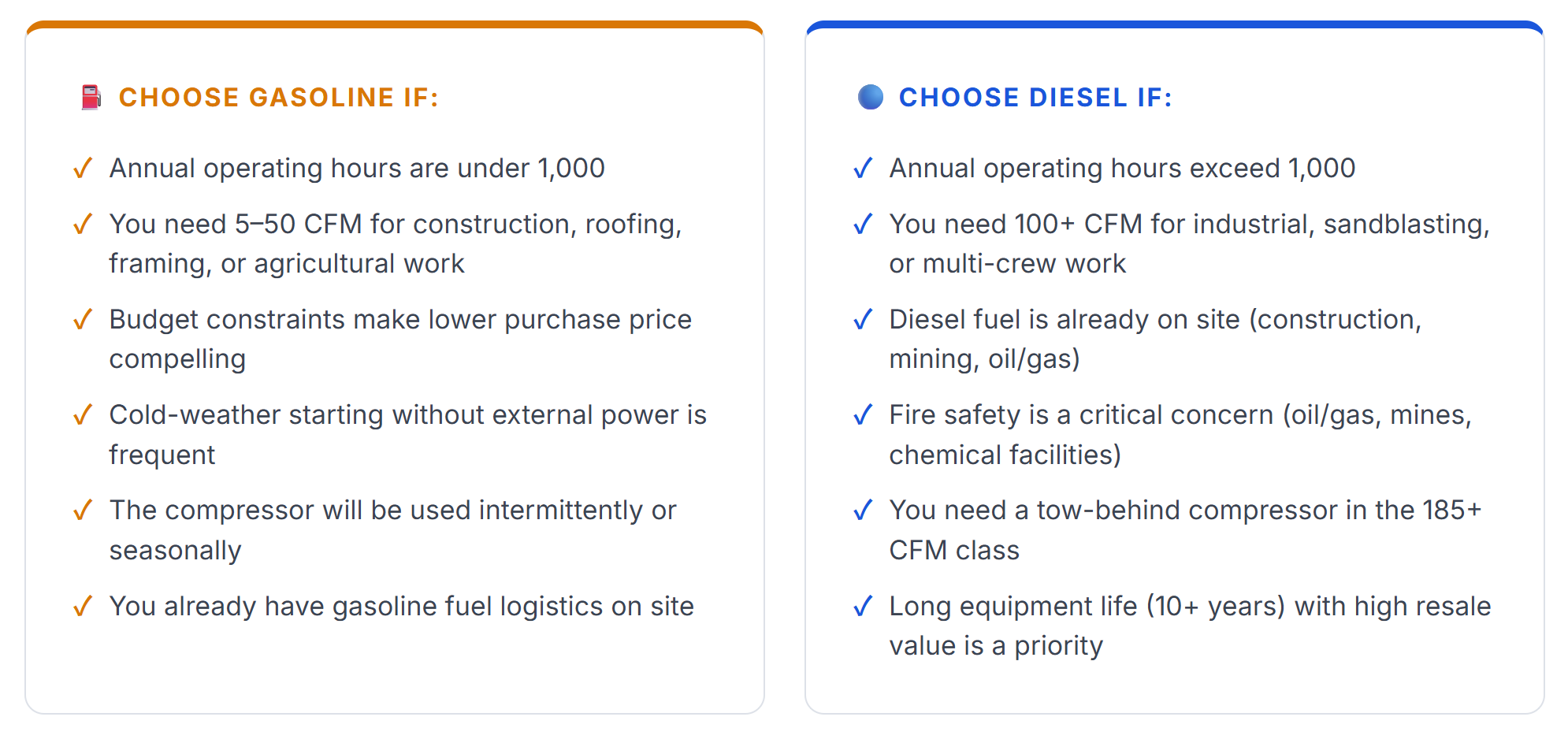
For both options, HPDMC's factory-direct pricing eliminates the distributor and dealer markups baked into competitor pricing. Fast shipping from our dual U.S. warehouses means your compressor arrives within days, not weeks. See our portable compressor guide for model-specific recommendations.
Frequently Asked Questions
Which is cheaper to operate: diesel or gas air compressor?
It depends on annual operating hours. Below approximately 800–1,000 hours per year, a gasoline air compressor is cheaper to operate overall because its lower purchase price outweighs its higher per-hour fuel and maintenance costs. Above 1,000 hours per year, a diesel engine air compressor becomes cheaper overall because its 20–30% better fuel efficiency and 3–4× longer engine life overcome the higher purchase price. Per-hour fuel cost alone, diesel is always cheaper (approximately 30–40% less per operating hour) due to higher thermal efficiency and the tax advantages of off-road diesel fuel.
Why don't more contractors use diesel air compressors?
Three primary reasons: (1) Higher purchase price — diesel compressors cost 30–50% more upfront, which is a meaningful barrier for small contractors and startups. (2) Familiarity — gasoline engines are what most people understand; diesel injectors, glow plugs, and fuel filters are unfamiliar territory. (3) Most construction compressor applications (framing, roofing, finish work) operate well under the 1,000-hour annual threshold where diesel's cost advantage begins. The contractors who do use diesel tend to be in high-hour applications: industrial sandblasting, mining support, oilfield service, and large-scale commercial construction where compressors run 2,000+ hours annually.
Can I run a diesel compressor on biodiesel?
Most modern diesel engines can run on biodiesel blends up to B5 (5% biodiesel, 95% petroleum diesel) without modification and without voiding the warranty. Blends up to B20 may be acceptable for some engines — consult the engine manufacturer's specification. Higher blends (B50–B100) can cause issues: biodiesel is a stronger solvent than petroleum diesel and can dissolve accumulated deposits in fuel tanks and lines, clogging filters; biodiesel has lower energy density (5–8% less power); and biodiesel is more prone to microbial growth and cold-weather gelling. For most compressor applications, standard petroleum diesel or B5 is the practical choice.
Do diesel compressors require DEF (Diesel Exhaust Fluid)?
Some do, depending on horsepower and emission certification. EPA Tier 4 Final diesel engines above 75 HP typically require Selective Catalytic Reduction (SCR) systems that use DEF to reduce NOx emissions. Smaller diesel engines (under 75 HP) may use alternative emission strategies (EGR + DPF) that do not require DEF. HPDMC can advise on specific model requirements. If your compressor requires DEF, plan for DEF consumption of approximately 2–3% of fuel consumption — a 100 HP diesel burning 3 gallons of fuel per hour will consume approximately 0.06–0.09 gallons of DEF per hour. DEF is widely available at truck stops, auto parts stores, and fuel distributors.
What's the resale value difference between diesel and gas compressors?
Diesel compressors retain value significantly better. After five years, a well-maintained diesel compressor typically holds 35–45% of its original purchase price; a gasoline equivalent holds 20–30%. After ten years, the difference widens: diesel at 20–30% residual versus gasoline at 5–15% (often sold for parts value). The diesel's longer service life means a used diesel with 5,000 hours still has 50–75% of its engine life remaining; a used gasoline unit with 2,000 hours is approaching major engine work. This residual value advantage offsets a portion of the diesel's higher purchase price.
Can HPDMC help me decide between diesel and gas?
Yes. HPDMC's U.S.-based technical sales team can analyze your specific operating profile — annual hours, application type, fuel logistics, budget, and operational environment — and provide a data-driven recommendation for diesel vs gasoline. We are uniquely positioned to provide objective guidance because we manufacture and sell both diesel engine air compressors and gas air compressors — we have no brand or fuel-type bias, only an interest in matching you with the right machine for your application. Contact us through our website for a free consultation.
Is diesel exhaust more hazardous than gasoline exhaust?
Both are hazardous and neither should be inhaled. Diesel exhaust contains higher concentrations of particulate matter (soot) and nitrogen oxides; gasoline exhaust contains higher concentrations of carbon monoxide. The International Agency for Research on Cancer (IARC) classifies diesel engine exhaust as Group 1 (carcinogenic to humans) based on lung cancer evidence in occupational settings. Gasoline exhaust is classified as Group 2B (possibly carcinogenic). In practice, both fuel types require the same safety protocol: never operate indoors or in confined spaces, position exhaust away from occupied areas, and comply with OSHA exposure limits for CO, NOx, and particulates.
Get the Right Compressor for Your Operation
Whether diesel or gasoline is the right choice for your application, HPDMC delivers factory-direct pricing, fast U.S. shipping, and direct manufacturer support. Our technical team can analyze your specific operating profile to determine which fuel type makes economic sense.
Browse Full Compressor Lineup →




Find the Right Compressor for Your Needs
Find the Right Compressor for Your Needs