⚡Free Shipping: Ultra-Quiet Portable Oil-Free Air Compressor AWR800-18LM2
Need Help Choosing the Right Compressor?
Need Help Choosing the Right Compressor?
⚡Free Shipping: Ultra-Quiet Portable Oil-Free Air Compressor AWR800-18LM2
Need Help Choosing the Right Compressor?
⚡Free Shipping: Ultra-Quiet Portable Oil-Free Air Compressor AWR800-18LM2

How to Choose the Right Rotary Screw Air Compressor
Choosing the wrong rotary screw air compressor can cost you thousands in wasted energy, downtime, or premature failure. For factory managers, equipment buyers, maintenance supervisors, and small business owners, this decision isn’t just about purchasing a machine—it’s about investing in your operation’s efficiency and profitability.
Here’s a critical stat from the U.S. Department of Energy (DOE): energy costs account for 70% or more of a rotary screw air compressor’s total lifecycle cost. A poorly selected model will drain your budget year after year, while the right one will boost productivity and cut unnecessary expenses.
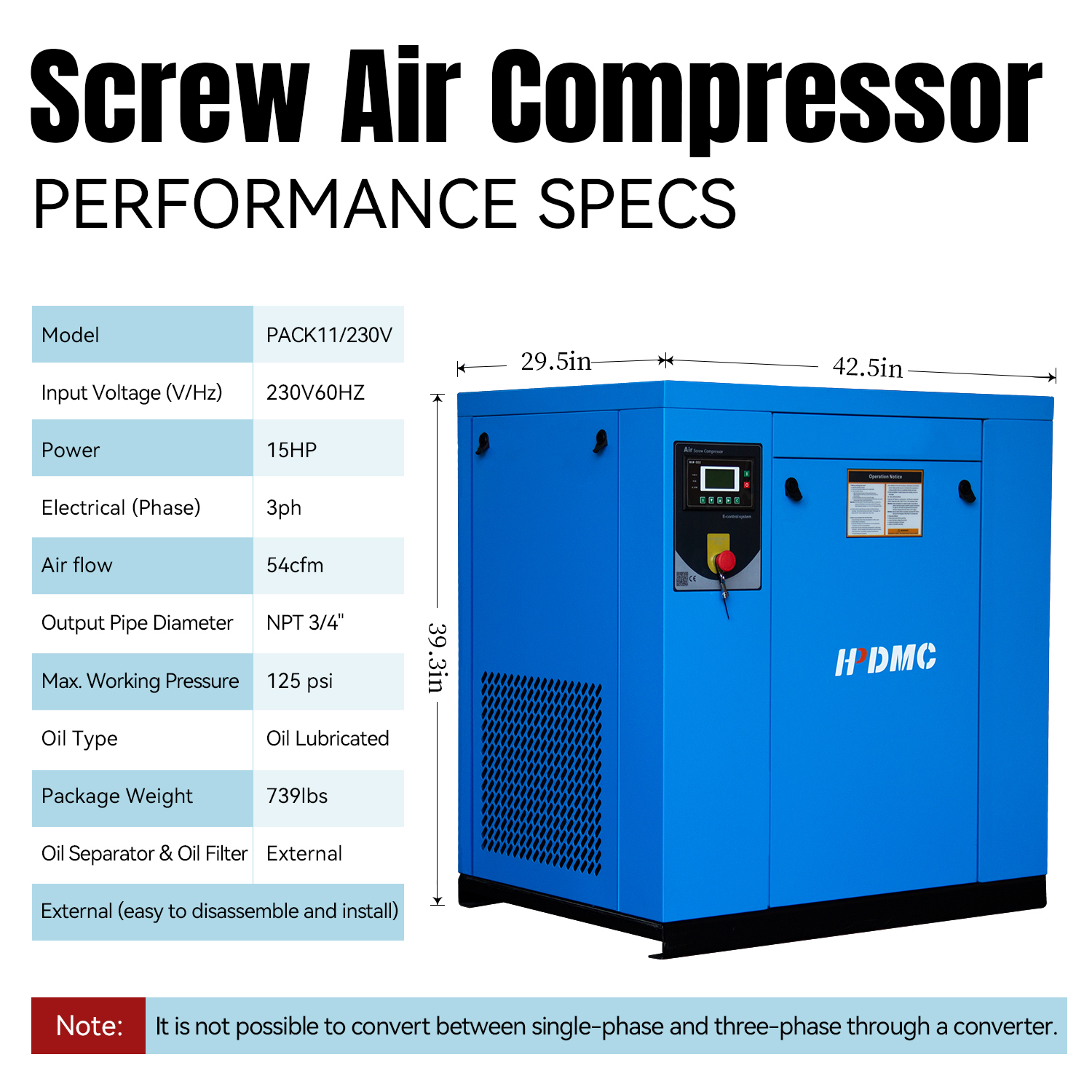
HPDMC Rotary Screw Air Compressor 🛒Buy Now
This guide delivers a practical, step-by-step framework to choose the perfect rotary screw air compressor for your needs—focused on real-world applications, clear comparisons, and actionable decisions, not abstract theory. By the end, you’ll know exactly whether to opt for fixed speed or variable speed, oil-flooded or oil-free, and how to build a complete system that works for your business.
Step 1: Determine Your Actual Air Demand (CFM @ PSI)
The foundation of rotary screw air compressor selection is understanding your air demand—measured in Cubic Feet per Minute (CFM) at a specific pressure (PSI). Ignore this step, and you’ll end up with a compressor that’s either too small (causing bottlenecks) or too large (wasting energy). HP (horsepower) is a secondary metric—never rely on it alone.
How to Calculate Your CFM & PSI Needs
📋 List all air-consuming equipment: Include tools, machinery, and processes (e.g., 5 air drills, 1 paint sprayer, 2 packaging machines).
🔍 Find CFM/PSI specs for each: Check the manufacturer’s manual (e.g., an air drill might require 5 CFM @ 90 PSI).
➕ Sum the CFM and add a safety margin: Total the CFM of all equipment, then multiply by 1.2 (a 20% buffer) for peak demand and future growth.
🎯 Confirm your target PSI: Most industrial applications use 90–125 PSI. High-pressure tools (e.g., sandblasters) may need 150 PSI.
⚠️ Common Mistake: Overlooking air demand fluctuations. A workshop with 10 tools that run intermittently has different needs than a production line with 24/7 equipment. 🛒Buy Now
Step 2: Fixed Speed vs. Variable Speed Drive (VSD) Rotary Screw Air Compressor
The biggest efficiency decision you’ll make is choosing between fixed speed and variable speed drive (VSD)—this directly impacts energy bills and machine lifespan.
| Comparison Dimension | Fixed Speed | Variable Speed (VSD) |
| Applicable Scenarios | Stable demand (80%+ load, e.g., continuous lines) | Fluctuating demand (e.g., auto repair, batch manufacturing) |
| Energy Efficiency | Efficient only when fully loaded; wastes energy during idle cycles | ✅ 35%+ energy savings—adjusts motor speed to match real-time demand |
| Upfront Cost | Lower (no VSD electronics) | 20–40% higher initial investment |
| ROI | Minimal | Typically 1–3 years via reduced electricity |
| Lifespan | Longer under constant load; wear from frequent starts/stops | Longer overall due to smoother operation |
✅ Expert Recommendation:
If your air demand fluctuates by more than 30% throughout the day, choose VSD. For steady, 24/7 operations (e.g., assembly lines), fixed speed offers reliable performance at lower upfront cost.
Step 3: Oil-Flooded vs. Oil-Free Rotary Screw Air Compressor
This choice hinges on air quality requirements and regulatory compliance, per ISO 8573-1 standards.
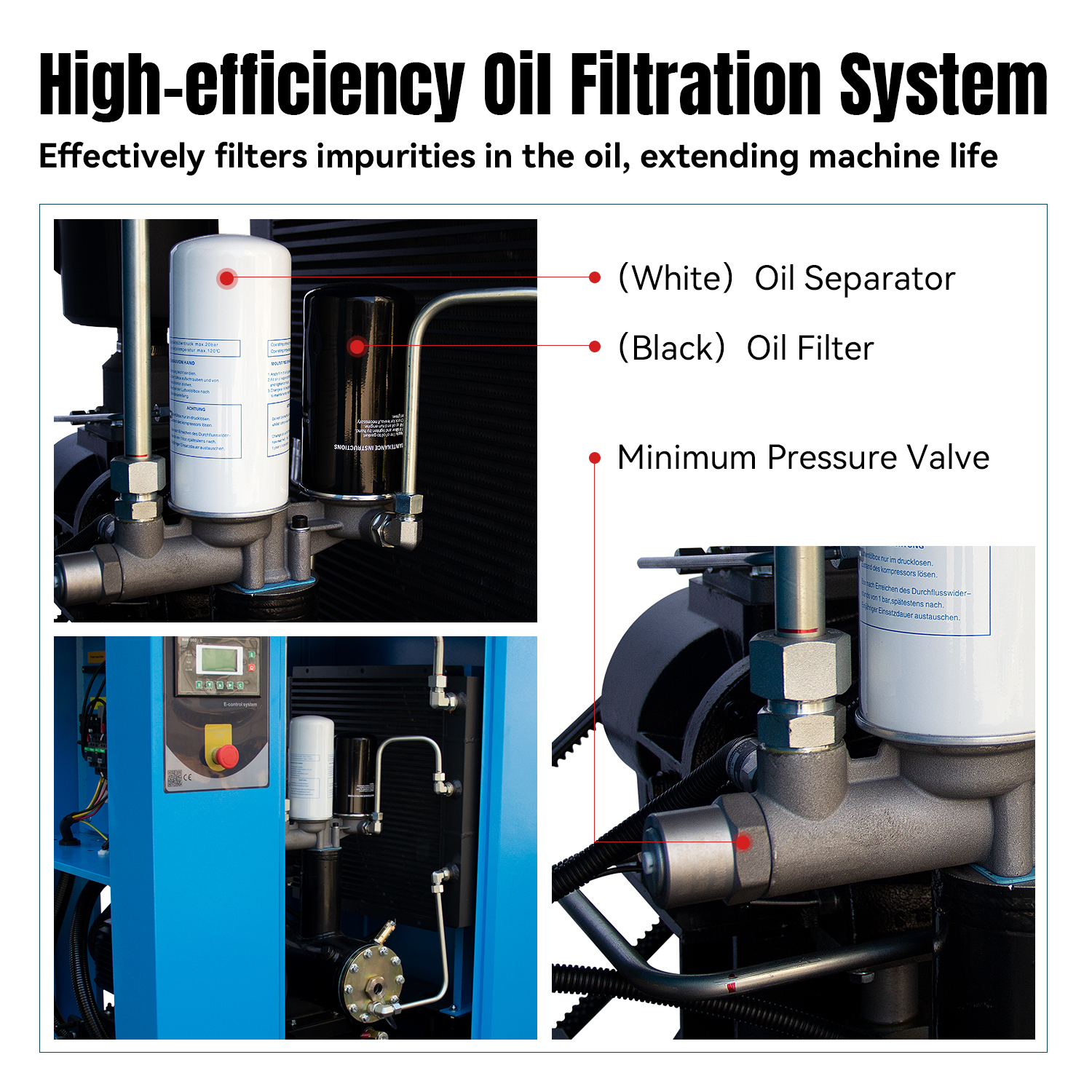
| Comparison Dimension | Oil-Flooded | Oil-Free |
| Air Quality | Trace oil mist (<5 ppm); requires filters/dryers | ✅ ISO 8573-1 Class 0—absolutely oil-free |
| Maintenance Cost | Low (oil changes, filter replacements) | High (precision rotors, specialized service) |
| Upfront Cost | Affordable (30–50% less than oil-free) | Premium pricing |
| Industries | Automotive, construction, woodworking, metal fab | 🏭 Food & beverage, pharma, medical, electronics, labs |
| Lifespan | Longer (oil reduces rotor wear) | Shorter if not meticulously maintained |
💡 Pro Tip: 90% of industrial users can meet air quality needs with an oil-flooded compressor + high-quality dryer/filter system. Reserve oil-free for applications where even trace oil would ruin products or violate regulations.
Step 4: Air-Cooled vs. Water-Cooled Rotary Screw Air Compressor
Your facility’s infrastructure often dictates this choice.
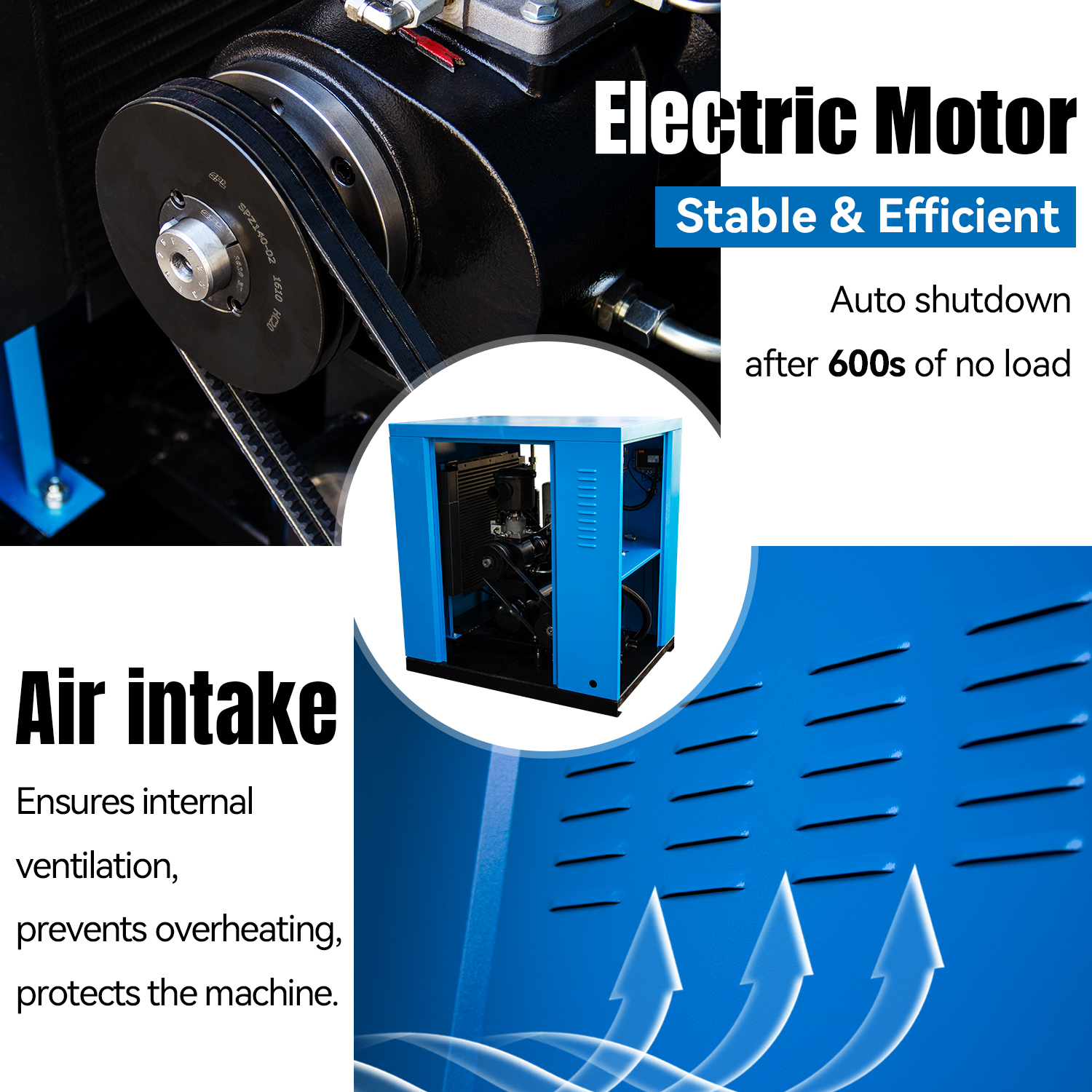
Air-Cooled
How it works: Built-in fan circulates ambient air.
Best for: Most workshops, factories, SMBs.
✅ Advantages: Easy install, low maintenance, cost-effective.
⚠️ Considerations: Needs good ventilation—avoid hot, dusty areas.
Water-Cooled
How it works: Uses facility water (e.g., cooling tower) to dissipate heat.
Best for: Environments >100°F (38°C) or large plants with existing water systems.
✅ Advantages: More efficient in extreme heat; quieter (no fan).
⚠️ Considerations: Higher install/operational costs (pipework, water treatment).
⚠️ Critical Reminder: For most small-to-mid businesses, water-cooled savings are offset by infrastructure costs. Stick with air-cooled unless your facility already supports water cooling.
Step 5: Don’t Forget the Supporting Compressed Air System
A compressor alone isn’t enough. Per ISO 11011, a complete system cuts energy use by up to 20% and reduces downtime.
Essential Components:
Air Receiver Tank 🛒Buy Now
Buffers demand spikes, reduces cycling, aids moisture removal.
Recommendation: 80–120 gal for 5–20 HP compressors.
Air Dryer: Prevents corrosion and tool damage. 🛒Buy Now
Options: Refrigerated (most apps) or adsorption (ultra-dry needs).
Air Filters 🛒Buy Now
Remove oil, dust, and contaminants—critical for compliance and equipment life.
✅ HPDMC Recommendation: Choose a TAS package (Tank + Air Dryer + Screw Compressor)—pre-engineered for compatibility, optimal performance, and faster setup.
Real-World Examples: Which Rotary Screw Air Compressor to Choose?
Based on hundreds of successful HPDMC installations:
Example 1: 🛠️ Automotive Repair Shop (10 Bays, Intermittent Use)
● Demand: 40 CFM @ 90 PSI (fluctuating)
● Solution: 7.5 HP VSD oil-flooded + 80-gal tank + refrigerated dryer
● Why: VSD saves energy during on/off cycles; oil-flooded = cost-effective; tank + dryer protect tools.
Example 2: 🥫 Food Packaging Line (24/7, Compliance Required)
● Demand: 100 CFM @ 100 PSI (stable, but oil-free mandatory)
● Solution: 20 HP oil-free + 120-gal tank + adsorption dryer
● Why: Meets FDA/USDA standards; fixed speed suits constant load; ultra-dry air prevents contamination.
Example 3: 🪵 Woodworking Shop (5 Machines, Steady Use)
● Demand: 30 CFM @ 90 PSI (consistent)
● Solution: 10 HP fixed speed oil-flooded air-cooled + 60-gal tank
● Why: Lower upfront cost; air-cooled fits shop layout; minimal maintenance for small teams.
❓ FAQ: Common Questions About Rotary Screw Air Compressor Selection
Q1: Is a rotary screw air compressor better than a reciprocating (piston) compressor?
For most commercial and industrial applications, yes. Rotary screw compressors are quieter, more efficient for continuous use, and have longer lifespans than piston compressors. Piston models are only recommended for low-demand, intermittent tasks (e.g., home garages).
Q2: How often does a rotary screw air compressor need maintenance?
● Oil-flooded models: Require oil changes every 2,000–4,000 operating hours, plus filter replacements every 6 months.
● VSD models: Need annual electronics checks.
● Oil-free models: Require more frequent inspections (every 1,000 hours) to maintain rotor precision.
Q3: What HP rotary screw air compressor do I need for my business?
HP correlates to CFM (e.g., 5.5 HP ≈ 15–20 CFM, 20 HP ≈ 70–80 CFM), but don’t rely on HP alone. Calculate your CFM demand first, then match it to the compressor’s CFM @ PSI rating—not HP. HPDMC’s product pages list CFM @ PSI for every model to simplify selection.
Q4: Can I upgrade my existing compressed air system with a new rotary screw compressor?
Yes. Most supporting components (tanks, dryers) are compatible with new compressors, as long as they match the CFM and PSI rating. Our engineers can assess your current setup to ensure a seamless upgrade.
Q5: How long does a rotary screw air compressor last?
● With proper maintenance, oil-flooded rotary screw compressors last 10–15 years.
● Oil-free models last 8–12 years.
● VSD models can reach 15+ years thanks to reduced mechanical stress from variable-speed operation.
Conclusion + Next Steps to Get Your Perfect Compressor
Choosing the right rotary screw air compressor follows a simple decision tree:
✅ Calculate CFM @ PSI (add 20% safety margin).
📊 Evaluate demand stability: >30% fluctuation → VSD; stable → Fixed Speed.
🧪 Check industry rules: Need Class 0? → Oil-Free; else → Oil-Flooded.
🏢 Assess infrastructure: Has cooling water? → Water-Cooled; else → Air-Cooled.
🔧 Add tank, dryer, filters for a complete, efficient system.
Now that you have your roadmap—it’s time to act.
HPDMC offers a full range of rotary screw air compressors (5.5 HP to 100 HP) tailored for every scale—from neighborhood workshops to industrial plants.
✅ Your Next Steps: 👉 Browse HPDMC Rotary Screw Air Compressors
Don’t let guesswork inflate your energy bills.
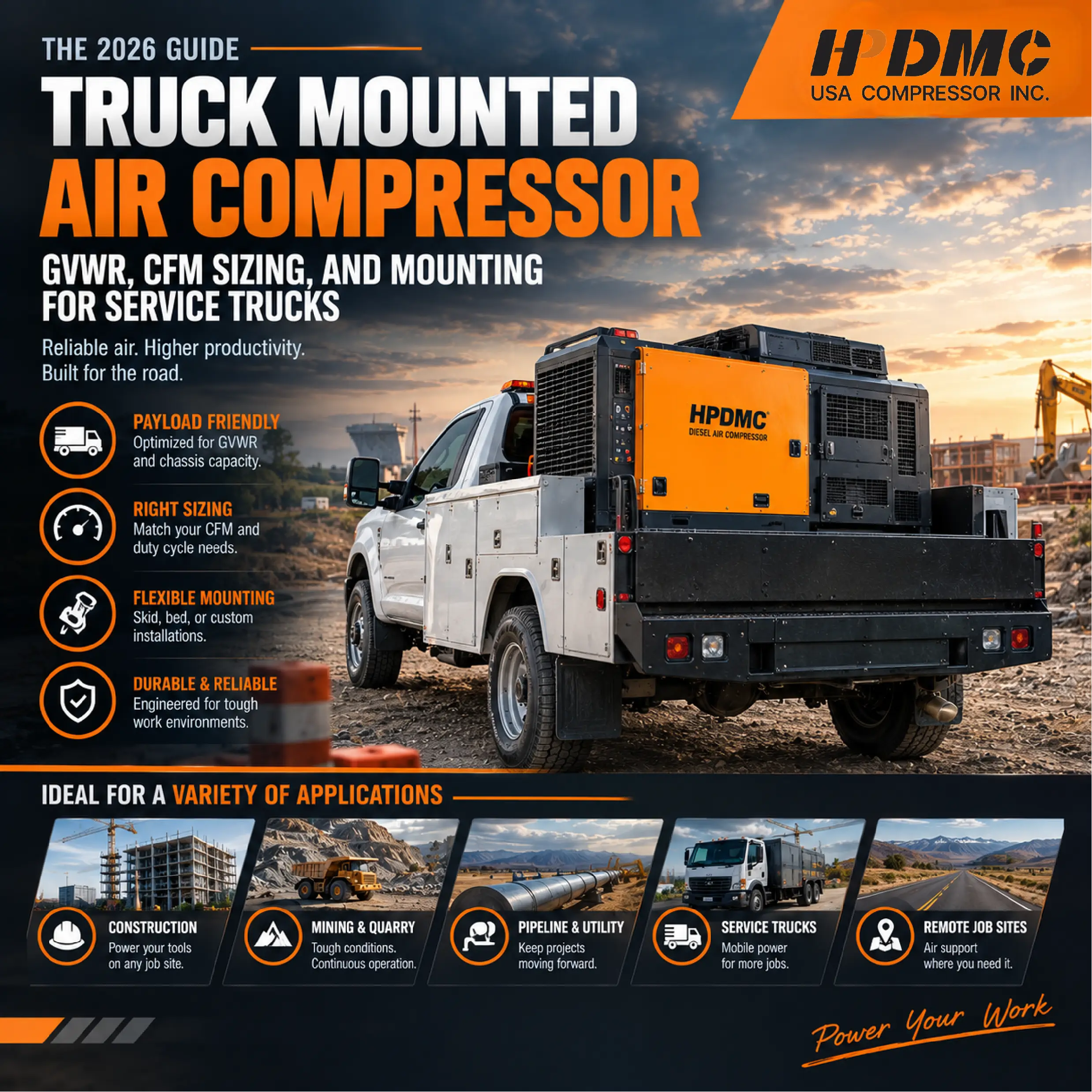



Find the Right Compressor for Your Needs
Find the Right Compressor for Your Needs