⚡Free Shipping: Ultra-Quiet Portable Oil-Free Air Compressor AWR800-18LM2
Need Help Choosing the Right Compressor?
Need Help Choosing the Right Compressor?
⚡Free Shipping: Ultra-Quiet Portable Oil-Free Air Compressor AWR800-18LM2
Need Help Choosing the Right Compressor?
⚡Free Shipping: Ultra-Quiet Portable Oil-Free Air Compressor AWR800-18LM2

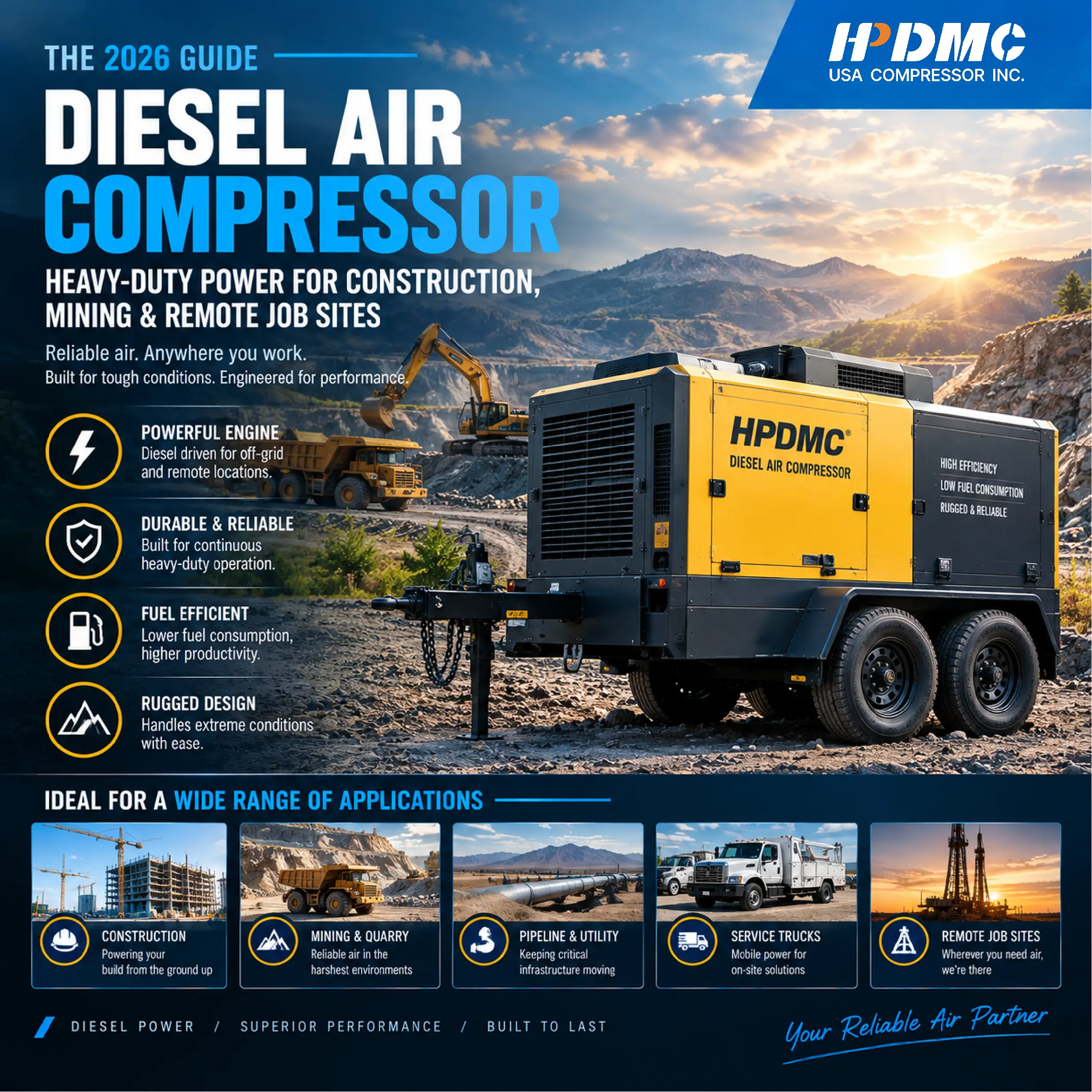
Diesel Engine Air Compressors: Heavy-Duty Power for Remote & Off-Grid Job Sites
The Diesel Difference: Why Diesel-Powered Compressors Excel in Heavy Industry
When the job site is miles from the nearest power line, when the ambient temperature exceeds 100°F day after day, and when the compressor must run for 10–12 hours continuously without complaint — that is when a diesel engine air compressor demonstrates why it remains the power source of choice for the world's most demanding industrial applications. From oil and gas fields in West Texas to mining operations in Nevada, from remote pipeline construction to disaster response staging areas, diesel-powered compressors deliver a combination of fuel efficiency, durability, and operational autonomy that gasoline and electric alternatives cannot match.
The U.S. market for industrial compressors continues to grow, driven by infrastructure investment, energy sector expansion, and the increasing demands of remote operations. Within this market, the diesel engine air compressor occupies a specific and vital niche: applications requiring sustained high CFM output where grid power is unavailable and where the operational characteristics of diesel — fuel economy, fuel safety, engine longevity — provide decisive advantages over gasoline alternatives.
HPDMC, as the flagship brand of Bravo Equipment Corporation, offers diesel-powered compressor solutions engineered for American industrial conditions. Unlike competitors such as Compressed Air Advisors and Compressor World that may source diesel units from various overseas manufacturers with limited U.S. support infrastructure, HPDMC's diesel compressor line is backed by factory-direct warranty support, dual-warehouse parts availability from Los Angeles and Chicago, and U.S.-based technical service. For background on fuel-type comparisons, see our gas compressor guide.
How a Diesel Engine Air Compressor Works: Engineering Deep Dive
While the fundamental air compression mechanism is identical across fuel types — a pump (piston, rotary screw, or scroll) compresses ambient air into a receiver tank — the diesel power plant brings unique engineering characteristics that shape the entire compressor's design and operational profile:
Compression Ignition: No Spark Plugs, No Ignition System
Unlike a gasoline engine that relies on a spark plug to ignite the air-fuel mixture, a diesel engine compresses air alone to a ratio of 14:1 to 25:1, heating it to approximately 1,000°F (538°C). Diesel fuel injected into this superheated air ignites spontaneously. This compression-ignition principle eliminates the entire spark ignition system — spark plugs, ignition coils, magnetos, and high-tension leads — removing these failure-prone components from the equation entirely. For a compressor operating in remote locations where maintenance access is limited, this inherent simplicity translates directly to reliability.
Thermal Efficiency: More Work Per Gallon
Diesel engines achieve thermal efficiencies of 35–45%, compared to 25–30% for gasoline engines. This means a diesel engine air compressor extracts significantly more mechanical work from each gallon of fuel. In practical terms: a diesel compressor may consume 0.4–0.6 gallons per hour to produce a given CFM, while a gasoline equivalent consumes 0.6–0.9 gallons per hour. Over a 2,000-hour operating year, this difference can represent $500–$1,500 in fuel savings — and more importantly, fewer refueling interruptions in remote operations where fuel logistics are challenging.
Low-End Torque: The Compressor's Best Friend
Diesel engines produce peak torque at low RPM (typically 1,400–2,000 RPM), exactly where compressor pumps operate most efficiently. This torque characteristic means a diesel can drive a pump through resistance spikes (tank pressure buildup, cold startup with thick oil) without bogging down — a common frustration with gasoline compressors that lose RPM and CFM output when the pump encounters resistance.
When a Diesel Engine Air Compressor Is the Right Choice
Not every application benefits from diesel power. The decision tree for choosing diesel over gasoline or electric should be driven by operational requirements, not brand preference or fuel availability:
Diesel Is the Correct Choice When:
✔ Fuel is already on site as diesel. Construction sites, mines, and oil/gas operations typically have diesel fuel infrastructure (bulk tanks, fuel trucks) already in place for heavy equipment. Adding a diesel engine air compressor means fueling from the same supply chain, simplifying logistics and often securing bulk pricing.
✔ Fire safety is a critical concern. Diesel fuel has a flash point of 125–200°F, compared to gasoline's -45°F. In environments with welding, cutting torches, or other ignition sources, diesel's dramatically lower fire risk is a genuine safety advantage recognized by OSHA and MSHA regulations.
✔ Continuous operation exceeds 8 hours daily. Diesel engines are engineered for continuous-duty cycles that would destroy consumer-grade gasoline engines. For applications where the compressor runs 10–16 hours per day, the diesel's durability and fuel efficiency create a compelling total-cost-of-ownership advantage.
✔ High CFM requirements (100+ CFM). Large rotary screw compressors requiring 50–200 HP are almost exclusively diesel-powered in mobile/portable configurations. The torque characteristics and fuel efficiency of diesel scale more favorably than gasoline at these power levels.
✔ The compressor is a tow-behind unit. Towable compressors (185 CFM, 375 CFM, and larger) are virtually always diesel-powered for the combination of fuel efficiency, safety, and compatibility with existing job-site diesel infrastructure.
Diesel Is Probably NOT the Right Choice When:
❌ CFM requirements are modest (under 50 CFM). Below this threshold, the diesel engine cost premium is difficult to justify against gasoline alternatives that perform the same work at lower capital cost.
❌ The compressor is used intermittently or seasonally. Diesel engines do not tolerate long periods of inactivity well. Fuel degrades, injectors can gum up, and batteries discharge. A gasoline engine with a fuel stabilizer is more forgiving of infrequent use.
❌ Cold-weather starting is a frequent requirement. While modern diesel engines with glow plugs and block heaters start reliably in cold weather, gasoline engines start more easily in sub-freezing temperatures — a practical consideration for winter construction in northern states.
❌ Noise restrictions apply. Diesel engines are inherently louder than gasoline engines of equivalent power — a function of compression-ignition combustion dynamics. In noise-sensitive environments (residential construction, urban sites), gasoline or electric may be preferable.
Diesel Fuel Management for Compressor Applications
Proper diesel fuel management is critical for compressor reliability, particularly in remote operations where fuel quality may be uncertain:
Fuel Quality: The #1 Diesel Engine Killer
Contaminated diesel fuel — by water, sediment, or microbial growth — is the leading cause of diesel engine problems in compressor applications. Diesel fuel tanks on job sites often sit for extended periods, accumulating condensation (water) and providing an environment for diesel bug (microbial growth at the fuel-water interface). Key practices:
● Filter fuel during transfer. Use a fuel filter funnel or water-separating filter when filling the compressor tank from bulk storage.
● Keep tanks full during storage. Minimizing air space in the fuel tank reduces condensation. Fill to 95% capacity before extended shutdown.
● Use fuel biocide if storing for 3+ months. Microbial growth in diesel fuel produces acidic byproducts that corrode injectors and fuel system components. A biocide treatment before storage prevents this.
● Drain water from fuel filters regularly. Most diesel fuel filters include a water separator with a drain valve. Drain accumulated water weekly during active use.
Winter Diesel: #1 vs #2 and Anti-Gel Additives
In cold weather, paraffin wax crystals in #2 diesel fuel can gel, clogging fuel filters and preventing engine operation. Solutions: use winter-blend #1 diesel (lower gel point but reduced energy density), add anti-gel additives before cold weather arrives (treating fuel already in the tank is easier than trying to un-gel a frozen system), or install a fuel filter heater if operating in sustained sub-zero conditions.
Diesel Compressor Maintenance: What's Different from Gas
Diesel engine maintenance shares some fundamentals with gasoline but introduces critical differences that operators must understand:
Fuel System Maintenance
● Fuel filter replacement: Diesel fuel filters should be replaced every 250–300 hours — more critical than on gasoline engines because diesel injectors operate at extremely tight tolerances (2–5 microns) and any contamination causes immediate injector damage.
● Water separator draining: Daily during active operation. Water in diesel fuel causes catastrophic injector damage through cavitation erosion and corrosion.
● Injector service: Diesel injectors typically require professional servicing (cleaning, pop-testing, and calibration) every 1,500–2,000 hours. This is not a field-maintenance task — it requires specialized equipment.
Air System Maintenance
● Turbocharger (if equipped): Allow a 30-second idle cool-down before shutdown to prevent oil coking in the turbocharger bearings. Check turbo oil feed and drain lines for carbon buildup annually.
● Air filtration: Even more critical than on gasoline engines. Diesel engines ingest far more air per horsepower-hour, and turbocharged engines multiply this volume. A single dust ingestion event can destroy a turbocharger in seconds.
Cold-Weather Considerations
● Glow plugs: Test glow plug operation before cold weather arrives. A single failed glow plug can make starting impossible in sub-freezing temperatures.
● Block heater: If operating in sustained sub-freezing conditions, a block heater (either coolant or oil pan type) is not a luxury — it is essential for reliable starting and reduced engine wear during cold starts.
● Battery condition: Diesel engines require substantially more cranking power than gasoline engines. A marginal battery that starts a gasoline engine may fail to start a diesel, particularly in cold weather. Load-test batteries before winter.
For comprehensive maintenance guidance applicable to all compressor types, see our maintenance guide and rotary screw maintenance guide.
HPDMC Diesel Compressor Solutions
HPDMC offers diesel-powered compressor solutions engineered for the specific demands of U.S. industrial applications. Our diesel lineup includes:
Portable Diesel Piston Compressors
For contractors and operators who need the reliability and fuel efficiency of diesel in a portable package, HPDMC offers diesel-powered piston compressors ranging from 10–20 HP with CFM ratings appropriate for construction, agricultural, and field service applications. These units feature industrial diesel engines from established manufacturers, cast-iron compressor pumps with deep-fin cooling, and ASME-certified receiver tanks.
Diesel Rotary Screw Compressors
For applications requiring 100+ CFM continuously, HPDMC's diesel rotary screw compressors deliver the efficiency of screw compression with the autonomy of diesel power. These are the units that power sandblasting operations, pipeline testing, and large-scale construction sites where multiple pneumatic tools run simultaneously. PM VSD technology on our premium diesel screw models provides up to 40% energy savings compared to fixed-speed diesel compressors. Learn about VSD energy savings.
Tow-Behind Diesel Compressors
For maximum mobility and capacity, HPDMC's towable diesel compressors provide 185–375+ CFM in a DOT-compliant trailer package. These are the industry-standard format for construction, sandblasting, and industrial rental applications. Highway-rated running gear, integrated fuel tanks for full-shift operation, and weather-protected enclosures make these units ready for immediate deployment. See our mobile compressor guide for form-factor comparisons.
Diesel vs Gas Compressor: Total Cost of Ownership Analysis
The purchase price of a diesel engine air compressor is typically 30–50% higher than a gasoline equivalent of comparable CFM output. However, purchase price is only one component of total cost of ownership (TCO). Here is a five-year TCO comparison for a hypothetical 30 CFM compressor operating 1,500 hours per year:
| Cost Category | Diesel Compressor | Gas Compressor | Difference (5-Year) |
|---|---|---|---|
| Purchase Price | $6,000 | $4,000 | +$2,000 diesel premium |
| Fuel Cost (5 years) | $4,500 (0.5 GPH) | $6,750 (0.75 GPH) | -$2,250 diesel savings |
| Routine Maintenance | $1,875 | $1,500 | +$375 diesel premium |
| Major Service (3,000 hr) | $500 | $800 (engine replacement) | -$300 diesel savings |
| Residual Value (Year 5) | $2,400 (40%) | $1,200 (30%) | +$1,200 diesel advantage |
| Net 5-Year TCO | $10,475 | $11,850 | -$1,375 diesel advantage |
Despite a $2,000 higher purchase price, the diesel compressor shows a $1,375 net advantage over five years. This advantage grows with higher annual operating hours — at 2,500+ hours per year, the diesel's fuel efficiency advantage becomes dominant. At under 800 hours per year, the gasoline unit's lower purchase price wins. The crossover point, based on HPDMC's analysis of customer operating data, is approximately 1,000–1,200 annual operating hours — below that, buy gasoline; above that, diesel becomes the economically rational choice.
Regulatory Considerations: EPA Tier Standards and CARB Compliance
Diesel engines in compressor applications are subject to EPA emissions regulations that have become increasingly stringent. As of 2026, new diesel engines sold in the United States must meet EPA Tier 4 Final standards, which require advanced emission control technologies including diesel particulate filters (DPF), selective catalytic reduction (SCR), and exhaust gas recirculation (EGR) on engines above 25 HP.
For compressor buyers, this means:
● Higher engine cost: Tier 4 compliance adds $2,000–$5,000 to the cost of a diesel engine compared to a Tier 3 equivalent, depending on horsepower.
● Additional maintenance: DPF systems require periodic regeneration (either passive during operation or active through a service procedure) and eventual ash cleaning at 3,000–5,000 hours.
● Fuel sensitivity: Tier 4 engines are more sensitive to fuel quality — ultra-low sulfur diesel (ULSD, 15 PPM sulfur maximum) is mandatory. Using higher-sulfur fuel (off-road diesel in some regions) can permanently damage emission control systems.
● California CARB requirements: California Air Resources Board (CARB) regulations are more stringent than federal EPA standards. Compressors operated in California may require additional certification and may be subject to in-use compliance testing. HPDMC can advise on CARB-compliant configurations.
All HPDMC diesel compressors sold for U.S. use meet or exceed applicable EPA and CARB emissions standards at the time of manufacture. See our California-specific compressor guide for state-specific regulatory information.
Power Your Remote Operations with HPDMC Diesel Compressors
When the job demands continuous, reliable compressed air far from the grid, a diesel engine air compressor from HPDMC delivers the fuel efficiency, durability, and autonomy your operation requires. Factory-direct pricing, fast shipping from our U.S. warehouses, and direct manufacturer warranty support — without the dealer markup that inflates competitor pricing.
Browse HPDMC's diesel compressor lineup at our product mall or contact our technical team for a custom specification and quote tailored to your application.
Frequently Asked Questions About Diesel Engine Air Compressors
How long does a diesel engine air compressor last compared to gasoline?
A properly maintained diesel engine in compressor service typically lasts 10,000–20,000 hours before major overhaul — 2–3 times longer than a gasoline equivalent (3,000–5,000 hours). This longevity stems from diesel's lower-RPM operation, robust bottom-end construction (forged steel crankshafts, heavier bearings), cleaner combustion (no spark plug deposits), and the lubricity of diesel fuel itself, which provides some upper-cylinder lubrication absent in gasoline engines. HPDMC's diesel compressors are engineered for approximately 30% longer equipment lifespan compared to gasoline alternatives in comparable duty cycles.
Why are diesel compressors so much more expensive than gas?
Diesel engine cost is 2–3× that of a comparable gasoline engine due to: (1) robust construction required for 14:1–25:1 compression ratios (forged steel crankshafts, heavier blocks, reinforced cylinder heads); (2) precision fuel injection systems (high-pressure common rail or mechanical injection pumps vs simple carburetors); (3) emission control systems required by EPA Tier 4 regulations (DPF, SCR, EGR); and (4) lower production volumes creating less manufacturing economy of scale. The cost premium is offset by 2–3× longer service life and 20–30% better fuel efficiency — making diesel the lower total-cost-of-ownership choice for high-hour applications.
Can I use off-road diesel (red dye) in my compressor?
Yes — off-road diesel (dyed red for tax identification) is chemically identical to on-road diesel (clear) and is the appropriate fuel for stationary and off-road diesel engines including compressors. Off-road diesel is exempt from federal and state highway fuel taxes, making it significantly less expensive per gallon. IMPORTANT: using red-dyed diesel in an on-road vehicle is illegal and carries substantial fines. For compressor applications, ensure you are purchasing from a supplier who will deliver off-road diesel to your location. Also ensure the fuel is ultra-low sulfur (15 PPM maximum) — some off-road diesel supplies in remote areas may still be higher-sulfur fuel that damages Tier 4 emission systems.
Do diesel compressors require special permits or certifications?
Stationary diesel compressors may require air quality permits depending on engine horsepower and location. EPA and state-level regulations typically exempt small diesel engines (under 50 HP) from permitting requirements. Engines above 50 HP may require a minor source permit. California CARB regulations are stricter — consult with HPDMC for CARB compliance guidance if operating in California. Tow-behind diesel compressors require DOT-compliant trailer lighting, braking, and registration. ASME tank certification (standard on all HPDMC diesel compressors) is required for commercial use in most U.S. jurisdictions.
What causes black smoke from a diesel compressor?
Black smoke indicates incomplete combustion — unburned fuel particles in the exhaust. Common causes in compressor applications: (1) restricted air filter (check and clean/replace immediately — a single dust-clogged filter on a diesel can cause smoking and power loss); (2) overloading — the compressor pump demanding more power than the engine can deliver at the governed RPM (check for pump mechanical issues); (3) injector problems (worn, dirty, or sticking injectors causing poor fuel atomization); (4) turbocharger failure (if equipped) causing insufficient combustion air. Black smoke is not normal and should be diagnosed immediately — continued operation can cause carbon buildup, oil contamination, and accelerated engine wear.
How is diesel exhaust managed for indoor or confined-space use?
Diesel exhaust contains carbon monoxide, nitrogen oxides, particulate matter, and other hazardous compounds. Diesel compressors should NEVER be operated indoors or in confined spaces without engineered exhaust ventilation. For applications requiring indoor compressor operation, use an electric compressor. For applications where the compressor must be near a building or occupied area, position the unit at least 25 feet from air intakes, doors, and windows; direct exhaust away from occupied areas; and consider diesel particulate filter (DPF) equipped units that significantly reduce visible smoke and particulate emissions. OSHA and MSHA have specific exposure limits for diesel exhaust components — consult the relevant standard for your industry.
What size diesel compressor do I need for sandblasting?
Sandblasting is one of the most air-intensive industrial applications. Minimum requirements: light-duty siphon-feed blasting requires 50–80 CFM; pressure-feed blasting requires 90–125 CFM; production blasting with large nozzles requires 185–375+ CFM. HPDMC's diesel rotary screw compressors in the 185 CFM class are the industry standard for professional sandblasting — sufficient for a 3/8" nozzle on a pressure-feed system. Always match the compressor CFM rating at 90–100 PSI (typical blasting pressure) to the nozzle CFM requirements published by the nozzle manufacturer, then add a 15–20% buffer for hose losses and compressor wear. Undersizing is the most common sandblasting mistake — it leads to inadequate blasting velocity and dramatically increased job time.




Find the Right Compressor for Your Needs
Find the Right Compressor for Your Needs